


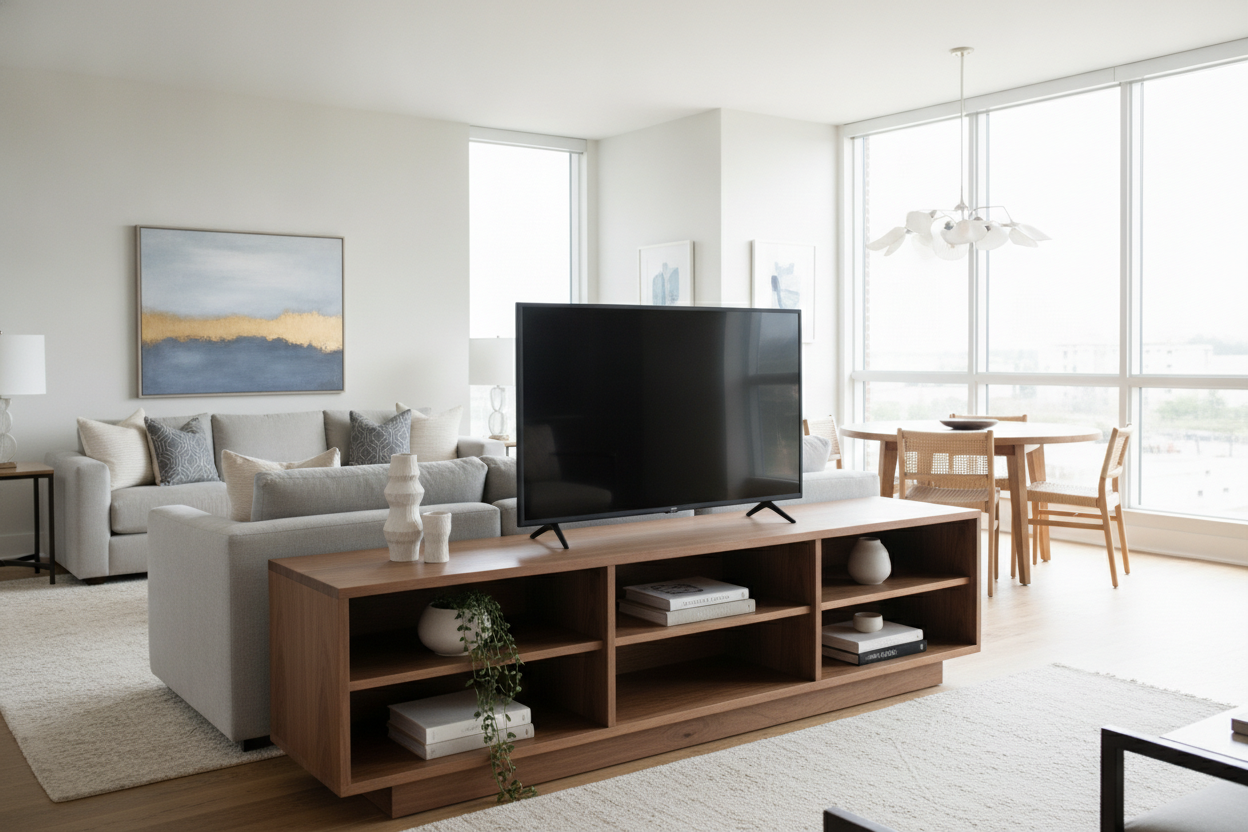
I remember standing in the middle of my new living room, clutching a tape measure and staring at a wall that felt approximately three miles long. My old 50-inch stand, which looked perfectly fine in my last apartment, now looked like a postage stamp lost on a billboard. That is the moment I realized a 70 in tv console isn't just a place to park your tech; it is a structural necessity for your sanity.
- Anchors massive walls that otherwise feel empty and echoing.
- Provides enough surface area to balance out today's 65 and 75-inch screens.
- Offers significantly more storage for gaming rigs, soundbars, and messy cables.
- Costs thousands less than custom built-in cabinetry while providing a similar look.
The Open Concept Dilemma (Why Your Living Room Feels Like a Lobby)
Open floor plans are a double-edged sword. You get all that glorious light and 'flow,' but your furniture often ends up floating around like it is lost at sea. Most people make the mistake of buying pieces that are too small for the scale of the room. I have seen 20-foot walls ruined by a tiny media stand that looks like it belongs in a dorm room.
Context is everything. If you are furnishing a narrow entryway or a tiny hallway nook, you should absolutely grab a 22 inch wide accent cabinet to save space. But in a cavernous living area? That small-scale thinking will make your room feel like a hotel lobby rather than a home. You need furniture with enough horizontal presence to actually 'stop' the eye.
Enter the 70 Inch Console Cabinet: The Goldilocks Solution
Finding the right 70 inch console cabinet is about hitting that sweet spot of scale. At nearly six feet wide, it has enough visual gravity to ground a massive sectional sofa. It tells the room, 'This is the living area,' without you having to build a literal wall.
What I love about this size is that it creates a focal point that does not require a contractor. I once quoted a custom built-in for my living room and the carpenter wanted $4,200. I bought a high-quality 70-inch unit for a fraction of that, and honestly, the ability to move it if I decide to rearrange the room is a huge plus. It is the 'built-in look' for people who like to change their minds.
Visual Weight vs. Actual Weight (Getting the Proportions Right)
Not all large consoles are created equal. In an open-concept space, you want a 70 inch media cabinet with real visual weight. Avoid those spindly, open-shelved metal units that you can see right through. They disappear against the wall and do nothing to anchor the space.
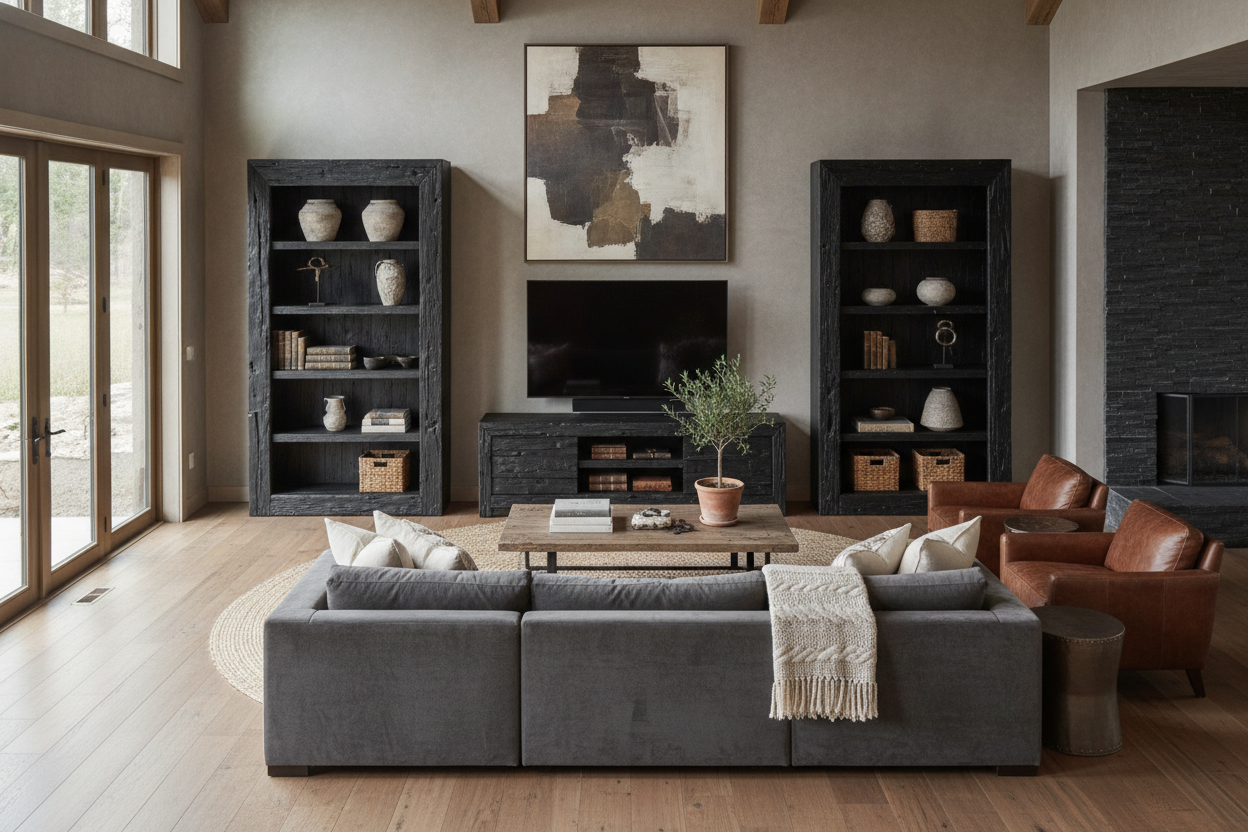
Go for something solid. Think thick wood grains, heavy doors, or even a dark matte finish. You want a piece that looks like it is holding down the floor. I personally prefer units with a mix of closed cabinetry and maybe one open slot for a soundbar. It hides the plastic clutter of a PS5 or a cable box while still looking like a deliberate piece of architecture.
The Unexpected Cleaning Perk of Upgrading Your Setup
Let's talk about the dust bunnies that live under your furniture. When you commit to a 70 console cabinet, you are covering a lot of floor real estate. If that cabinet sits flat on the floor, you are creating a permanent tomb for cat hair and lost Cheerios.
This is why I always advocate for specific base styles. Choosing a TV cabinet on legs is a total life-saver. If those legs give you at least 4 inches of clearance, a robot vacuum can glide right under there. You get the massive storage and the visual anchor without the 'science experiment' growing underneath your furniture.
How to Style Six Feet of Surface Area Without Making a Mess
Once you have six feet of surface area, the temptation is to fill it with every framed photo and candle you own. Don't do it. Tiny knick-knacks on a large console just look like clutter. Because the piece is so big, your decor needs to be big, too.
I usually go with the 'Rule of Three.' On one end, a stack of oversized coffee table books. In the middle, the TV (obviously). On the other end, one massive structural vase or a sculptural lamp. Keep the lines clean. When the furniture is this substantial, the styling should feel effortless, not crowded.
My Personal Take: The Mistake I Made
I once bought a 70-inch console made of cheap, thin MDF because I liked the color. Within three months, the weight of my 75-inch TV caused the top to bow in the middle. It looked terrible and the doors stopped closing right. If you are going this big, check the specs. Look for a center support leg and kiln-dried wood or high-grade plywood. Cheap materials can't handle this much span.
70 Inch Console FAQ
Will a 70-inch console fit in my SUV?
Probably not. Most 70-inch units come in a box that is at least 75 inches long and quite heavy. Unless you have a massive suburban or a van, just pay for the delivery. Your lower back will thank you.
Is a 70-inch console too big for a 55-inch TV?
Actually, it looks great. Having a bit of 'overhang' on either side of the TV makes the setup look more high-end and intentional. It prevents that 'top-heavy' look where the TV is wider than the stand.
How high should the console be?
For a 70-inch unit, look for a height between 24 and 30 inches. You want the center of your TV to be at eye level when you are sitting on your sofa. If it's too tall, you'll end up with 'bedroom dresser' vibes, which is a total design fail for a living room.

Laisser un commentaire
Ce site est protégé par hCaptcha, et la Politique de confidentialité et les Conditions de service de hCaptcha s’appliquent.