


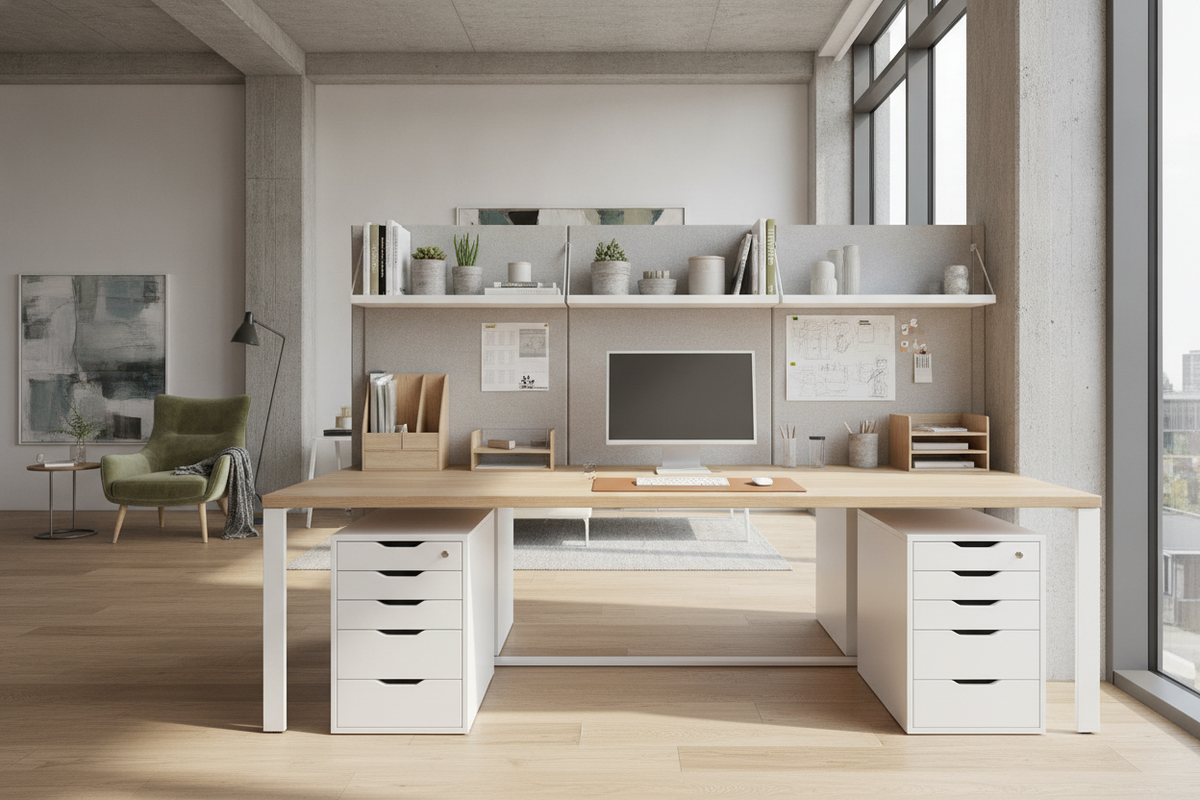
Creating a personalized workspace often starts with the concept of modular assembly. Combining an ikea desk top with drawers gives you the freedom to customize work surface dimensions, storage volume, and layout orientation without locking into a rigid, fixed-frame design. Whether you are assembling a dedicated home office, a quiet study nook, or a creative crafting station, understanding how modular components interact ensures a stable, functional, and visually appealing setup.
The classic modular pairing—such as an ikea linnmon alex desk configuration or similar combinations using modular tabletops and drawer units—relies on separate structural elements working in harmony. By understanding structural balance, legroom requirements, and storage accessibility, you can curate a workstation tailored precisely to your daily routine. For additional workspace styling inspiration, exploring an ikea desk guide can provide useful ideas for vertical organization and refined aesthetics.
The Modular Formula: Why Pair a Tabletop with Drawer Pedestals?
The primary benefit of pairing a standalone tabletop with separate drawer pedestals is flexibility. Unlike integrated desks with fixed dimensions, modular systems allow you to choose your desired tabletop length, depth, and finish independently from the storage components below. An ikea table top with drawers setup provides several distinct advantages for modern living spaces:
- Adaptable Spatial Footprints: You can select narrow or wide boards to match the exact dimensions of your room, swapping surfaces as your spatial needs change over time.
- Customized Storage Distribution: Drawer pedestals can be placed on the left, right, or both sides depending on whether you are right- or left-handed and how much stationery, paperwork, or equipment you store.
- Ease of Transport and Reconfiguration: Because the components detach easily, moving the desk between rooms or reconfiguring the layout is straightforward compared to moving a heavy, one-piece executive desk.
- Long-Term Upgradability: If a tabletop incurs surface wear over years of daily use, replacing the board is simple while retaining your existing drawer units, making it a cost-effective furniture strategy.
- Aesthetic Versatility: Mixing contrasting colors—such as a wood-effect tabletop over neutral white or dark grey pedestals—allows you to create custom design aesthetics that complement diverse interior decors.
When planning an alex and linnmon desk arrangement or a similar modular build, the foundational decision is choosing between an asymmetrical single-pedestal base and a symmetrical dual-pedestal setup.
Core Configuration Archetypes: Single Base vs. Dual Drawer Units
How you distribute storage beneath the surface influences both storage capacity and daily physical comfort. While some users prioritize maximum filing capacity, others require wide side-to-side legroom for mobility. If you are comparing classic and modern workstation profiles, reviewing another ikea desk guide can help clarify traditional versus contemporary utility.
Single Drawer Unit with Support Legs
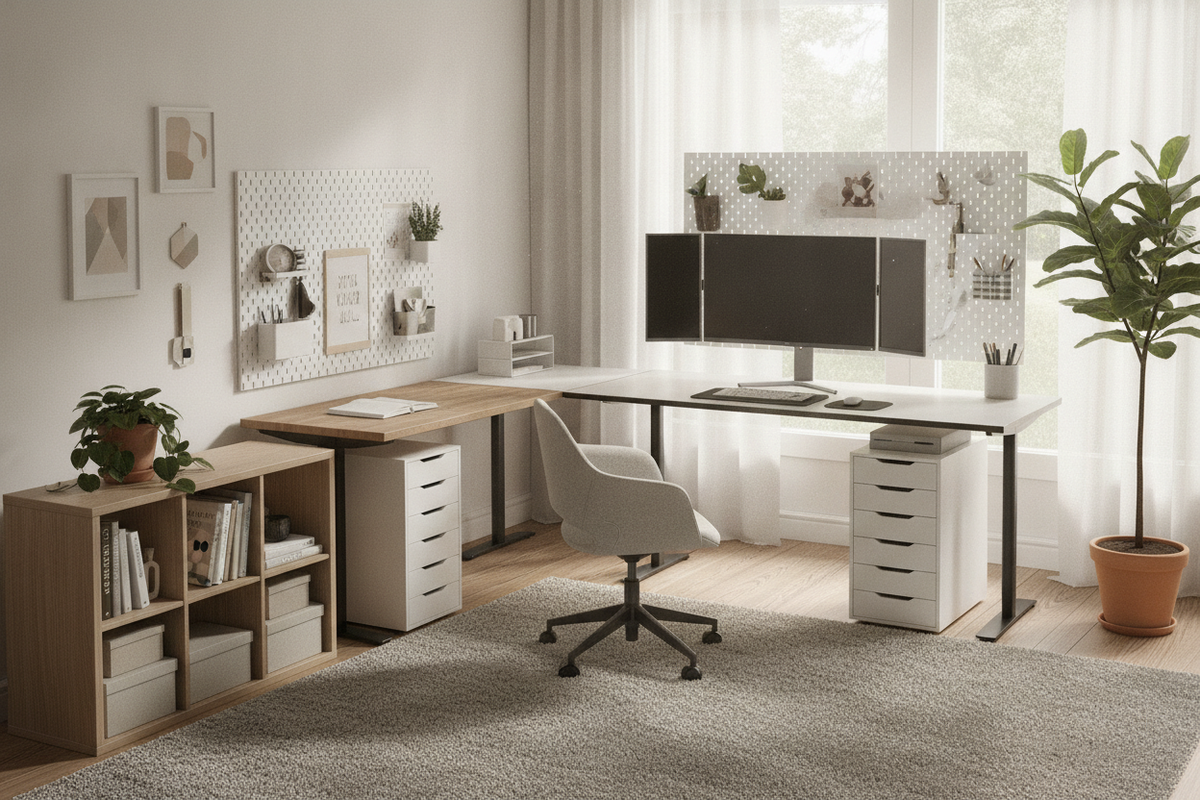
The single-pedestal configuration pairs one drawer unit on one side with two standalone support legs on the opposite side. An ikea linnmon desk with drawers arranged this way is widely popular for smaller footprints and multifunctional rooms.
This arrangement leaves a wide, open expanse for your chair, allowing comfortable sideways movement, footrest positioning, or under-desk computer tower placement. Placing the linnmon table top with alex drawers foundation on your dominant hand side ensures easy access to frequently used notebooks, pens, and accessories while preserving an airy, uncluttered visual aesthetic that makes smaller rooms feel more spacious.
Dual Drawer Pedestals for Maximum Storage
For individuals managing substantial office supplies, crafting materials, or technical peripherals, using two drawer units—one supporting each end of the tabletop—creates a balanced, high-capacity workstation. An alex drawers and linnmon table top pairing with dual pedestals delivers substantial under-desk organization and gives the desk a grounded, architectural presence.
However, dual drawer pedestals require careful width planning. If the tabletop span is too short, placing two drawer units underneath can compress the central seating cavity, restricting legroom and preventing wider office chairs with armrests from tucking in neatly. Measuring your seating width before finalizing a dual-pedestal layout is essential for everyday comfort.
Tabletop Materials, Span Lengths, and Structural Balance
Structural stability is essential when designing a modular desk. The length of the surface and its internal construction determine how the desk handles equipment weight and daily pressure across its span.
- Hollow-Core vs. Solid Composite Surfaces: Lightweight tabletops often utilize an engineered paper honeycomb core framed by fiberboard. While easy to move and handle, these tops require mindful weight distribution. Heavier solid composite or solid wood surfaces offer increased rigidity but add downward mass onto the drawer units.
- Span Length Considerations: Shorter tabletops rest securely across a single drawer unit and two legs or two drawer pedestals without noticeable center deflection. However, when spanning extended widths, the center of the board can experience gravitational sagging over time, especially if supporting heavy monitors or display stands.
- Central Support Reinforcement: For long spans, installing an adjustable central leg positioned near the back edge provides crucial reinforcement. This additional support point absorbs central downward force without intruding on knee clearance.
- Secure Surface Gripping: Most modular setups use non-skid rubber pads or mechanical fasteners between the top of the drawer units and the underside of the table. Ensuring these contact points remain clean and firmly seated prevents the tabletop from shifting during active use.
- Weight Distribution Tactics: Placing heavy items, such as multi-drawer organizers, large books, or printer units, directly above the solid pedestals helps keep downward stress off the open span.
Proper planning of your linnmon table top alex drawers combination prevents structural sag and keeps the work surface level for typing, writing, and peripheral placement.
Ergonomics, Seating Clearances, and Drawer Accessibility
Ergonomics extends beyond chair height; it encompasses the full spatial relationship between the tabletop, your seating posture, and storage access. When designing an ikea desk top with drawers, keep these clearance considerations in mind:
- Seating Clearance Width: Ensure the open span between drawer pedestals or between a pedestal and side legs accommodates your chair width, including armrests, with generous buffer space for natural posture shifts.
- Under-Desk Depth: Verify that your knees and feet have sufficient depth clearance so you can sit upright without contacting the rear wall or under-mounted cable management trays.
- Drawer Extension Radius: Leave ample floor clearance in front of the drawer pedestals so you can pull drawers fully open without striking chair casters, surrounding furniture, or adjacent doors.
- Desktop Layout Balance: Placing frequently accessed everyday essentials near the center while arranging heavier items or organizational accessories directly above the drawer pedestals helps keep the main work surface tidy and stable.
- Cable Pathway Routing: Planning paths for power strips and computer cables along the rear edge or down the interior side of a drawer unit prevents clutter from interfering with leg movement.
Room Placement and Integrated Multi-Functional Alternatives
Where you place your modular desk defines the room's flow and daily productivity. Aligning your desk along a primary wall offers stable anchoring and easy cable management along baseboards. In larger rooms, positioning the desk perpendicular to a wall can act as a natural room divider between work and relaxation zones.
In compact rooms or multipurpose bedrooms, a standard modular office desk may feel too deep or purely utilitarian. In these cases, multifunctional furniture that incorporates concealed storage, flip-top surfaces, or dedicated vanity functions can offer a compact alternative. Choosing an integrated drawers product provides dedicated organization for smaller items while keeping floor footprints efficient. Similarly, a dedicated desk product with built-in hidden compartments can seamlessly transition between a morning preparation area and an afternoon laptop workspace.
By thoughtfully assessing your room dimensions, storage volume requirements, and structural support needs, you can configure an ikea desk top with drawers that delivers long-term comfort, practical utility, and clean design to your home.

Laisser un commentaire
Ce site est protégé par hCaptcha, et la Politique de confidentialité et les Conditions de service de hCaptcha s’appliquent.