


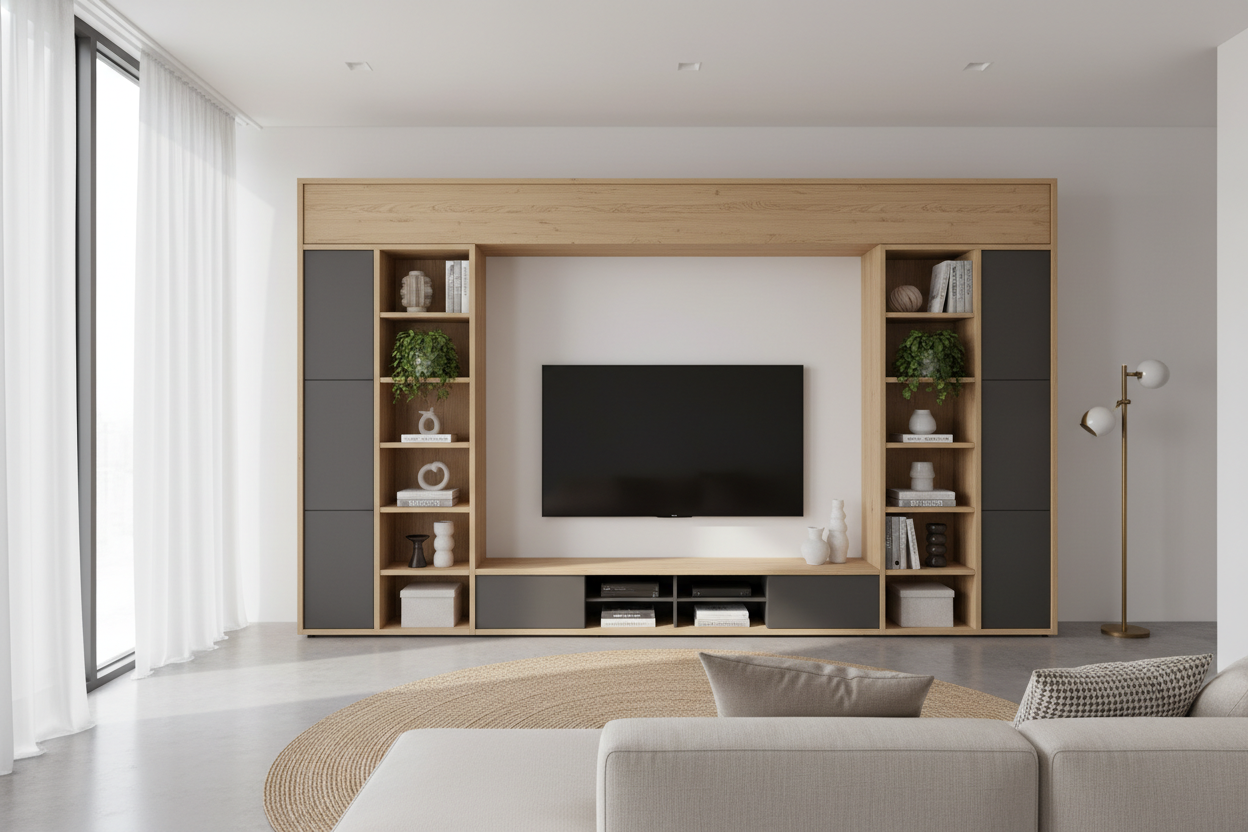
I spent three months staring at a 14-foot living room wall that looked like a wasteland. I had a decent 65-inch TV on a mid-century console, but it felt like a postage stamp on a billboard. Every time I sat on the sofa, all I could see was the vast, empty drywall closing in on my electronics. I realized that unless I wanted to spend five figures on a contractor, I needed a bridge for entertainment center setup to actually fill the void.
Quick Takeaways
- Scale is everything: A lone console on a big wall always looks like an afterthought.
- The bridge is the secret sauce that turns separate towers into a single architectural unit.
- Buying a cohesive set is safer than trying to DIY a bridge between random bookshelves.
- Negative space on the shelves prevents the unit from looking like a 1994 Blockbuster aisle.
The Giant Blank Wall Problem (And Why a Console Isn't Enough)
We’ve all been there. You buy a beautiful, solid wood TV stand, center it on your main wall, and realize it looks pathetic. The proportions are just wrong. In my case, the ceiling height made the TV look like it was floating in a vacuum. I tried the 'gallery wall' approach with a dozen mismatched frames, but it just looked cluttered and messy. It didn't provide the visual weight the room demanded.
I started shopping for a full entertainment center because I needed height. A standard console is usually 24 to 30 inches tall. If your wall is 9 feet high, you have 7 feet of nothingness above your TV. By adding vertical towers, you start to reclaim that space, but even then, two towers standing like sentinels next to a TV can feel disconnected. You need something to tie the 'U' shape together at the top.
Why an Entertainment Center With Bridge is the Ultimate 'Fake It' Hack
The bridge is that long, horizontal shelf or cabinet that connects the tops of your left and right towers. It’s the finishing touch that creates a 'frame' around your television. When you use an entertainment center with bridge, you aren't just buying furniture; you’re creating an alcove. This mimics the look of high-end custom cabinetry that usually requires a carpenter and a massive mess of sawdust.
I went with a modern 3 piece entertainment center setup because the bridge piece actually featured integrated lighting. Suddenly, the wall felt intentional. The horizontal line of the bridge draws the eye across the entire width of the unit, making the whole room feel wider and more expensive. It’s a trick of the eye—instead of seeing three separate boxes, your brain registers one massive, built-in feature.
Can You Buy an Entertainment Center Bridge Only?
I get asked this a lot by people who already have two Billy bookcases and a TV stand. Technically, you can find an entertainment center bridge only, but it is a massive headache. First, the finish almost never matches. Wood grains are finicky, and 'espresso' from one brand is 'dark walnut' from another. More importantly, there’s the safety issue. These bridges aren't usually designed to be tension-mounted; they need specific hardware to lock into the towers.
If you try to retrofit a random shelf as an entertainment center bridge, you’re asking for a structural failure. I once tried to 'hack' a bridge using a heavy-duty floating shelf. It looked okay for a week until the weight of a few books caused the tower on the left to lean inward. If you want the look, buy the set. It’s engineered to distribute the weight and stay level, which is a lot better than having 40 pounds of particle board collapse onto your OLED.
How to Style an Entertainment Center Towers and Bridge Layout
The biggest mistake people make with an entertainment center towers and bridge layout is overstuffing it. If you fill every single square inch with DVDs and Funko Pops, it looks like a dorm room. You need to treat these shelves like a curated gallery. I follow the 60-40 rule: 60% of the shelf is for objects, 40% is empty 'breathing' space.
For the bridge itself, I love trailing plants like Pothos or Philodendron. Let the vines hang down slightly over the edge of the bridge—it softens the hard lines of the wood. When styling a bookcase and entertainment center, I also suggest grouping items by texture rather than color. Mix matte ceramics with glass vases. And for the love of all things holy, hide your cables. I used adhesive cord channels painted the same color as my wall to run the power up to the bridge lighting. If you see a 'spaghetti mess' of wires behind your $2,000 unit, the illusion of a custom built-in is immediately ruined.
FAQ
Is an entertainment center bridge hard to assemble?
It’s usually a two-person job. While the towers are easy enough to build solo, you need someone to hold the bridge in place while you bolt it in from the sides. Don't try to balance it on your head while using a drill—I tried, and I still have the dent in my drywall to prove why that's a bad idea.
How wide should the bridge be?
The bridge needs to be slightly wider than your TV, obviously, but pay attention to the 'overhang.' Most bridges are designed for specific TV sizes (like 65 or 75 inches). If the bridge is too long for the console below it, the whole unit will look top-heavy and awkward.
Does a bridge make the room feel smaller?
Actually, it’s the opposite. Because it draws the eye upward and fills the vertical space, it makes the ceilings feel higher. It’s a lot like hanging curtains high and wide; it defines the boundaries of the room more clearly.

Laisser un commentaire
Ce site est protégé par hCaptcha, et la Politique de confidentialité et les Conditions de service de hCaptcha s’appliquent.