


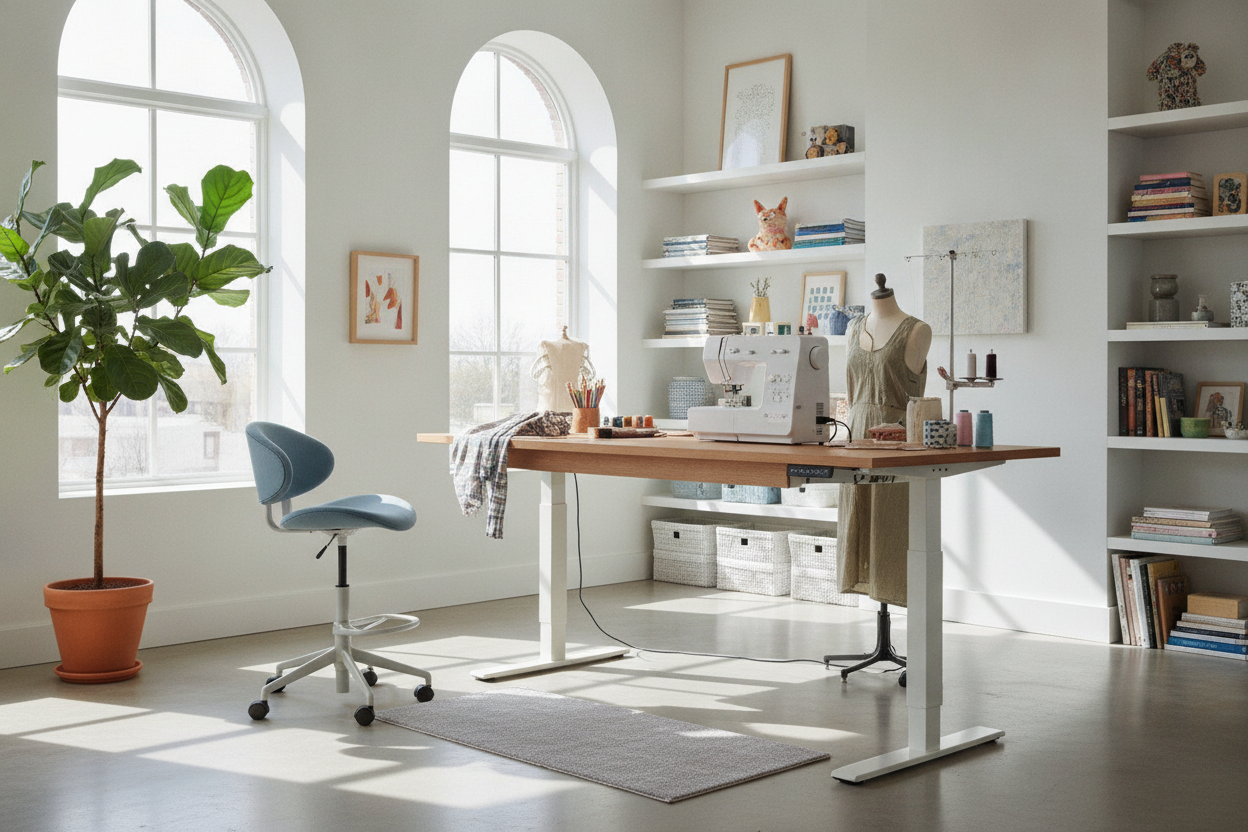
I spent last Saturday hunched over a 30-inch dining table, pinning a quilt pattern until my lower back felt like it was being squeezed by a rusty vice. It is the same old story for anyone with a hobby: we repurpose furniture that was never meant for the job. We bend, we lean, and we wake up on Sunday morning wondering why we feel like we just ran a marathon when we actually just spent four hours with a rotary cutter.
I finally snapped and dragged my desk for standing from my home office into the spare room. I thought it was just for spreadsheets and Zoom calls, but it turns out I have been doing my hobbies wrong for a decade. Transitioning to a desk standup setup for my sewing and painting has been the single biggest improvement to my creative life.
- Dining tables are 29-30 inches high, which is a recipe for chronic back pain during long projects.
- Electric sit and stand up desk models can handle the vibration of a high-speed sewing machine motor without wobbling.
- Memory presets allow you to switch between 'cutting height' and 'sewing height' in seconds.
- Laminate surfaces are far superior to wood or glass for resisting glue, pins, and stray paint.
The 'Hunch' Phase: Why traditional craft tables are back-breakers
Most dedicated craft tables are just glorified folding banquet tables. They are static, they are usually too low, and they look like they belong in a church basement. It is incredibly frustrating when you want a workspace that actually blends with your home decor instead of sticking out like a sore thumb. I spent years trying to make a standard desk office work, but my neck always paid the price.
When you are cutting fabric or painting a canvas, you need to be over the work, not reaching across it. A standard table forces you into a permanent C-shape. I realized I did not need a 'craft table'—I needed a standing working table that could meet me where I was, rather than forcing me to bow down to it.
Enter the desk for standing: My accidental studio upgrade
The first time I used my desk stand and sit setup for a sewing project, I felt like an idiot for waiting so long. I raised the surface to 42 inches—right about elbow height—and suddenly, I could see every thread without squinting. It turned my desk for standing or sitting into a professional-grade cutting station.
The relief was immediate. No more stretching my hamstrings just to reach the back of a pattern. Being able to toggle between a sit and stand home desk setup means I can stand while I do the physical work and sit down when it is time to do the tedious hand-finishing. It is about having a desk with standing option that adapts to the task, not the other other way around.
3 reasons an adjustable workspace beats a fixed-height table
If you are on the fence about moving your adjustable standing office desk into your hobby room, here is the breakdown of why it works for more than just typing.
You can finally cut large patterns without bending over
Rotary cutting is a contact sport. You need leverage to get through multiple layers of denim or wool. On a basic standing desk, you can set the height so you are pushing down from your core rather than your wrists. Most adjustable height standing desks allow you to find that sweet spot where you aren't straining your shoulders just to keep the ruler straight.
It handles heavy sewing machines without shaking
I was worried my heavy-duty Juki would make the whole thing rattle like a tin can. Cheap, thin-legged desks that raise will definitely vibrate, but a solid adjustable desk stand up frame is built for weight. During my hunt for an industrial adjustable standing desk, I learned that dual-motor systems are non-negotiable if you are using heavy tools. A high-quality stand office desk stays planted even when I am flooring the foot pedal at 1,500 stitches per minute.
The magic of micro-adjustments for tiny details
Sometimes you need the work six inches from your face; sometimes you need it at waist height. A standing working table gives you that granularity. When I’m painting miniatures, I drop the desk standing workstation low so I can rest my elbows. When I move to a large standing desks layout for a quilt, I bring it back up. You can't do that with a wooden table from a big-box store.
What to look for if you want a hobby desk (Hint: Skip the glass)
Not all adjustable standing tables are created equal for makers. First, skip the glass tops. They look sleek, but they show every fingerprint, they are cold to the touch, and you can't use magnetic accessories on them. Go for a high-pressure laminate or a solid wood top that can take a beating.
Second, look for a desk with a high weight capacity. Between a sewing machine, a serger, and a heavy cutting mat, you are looking at 50-70 pounds before you even lean on it. I highly recommend the Ergonomic Home Office Sit Stand Up Desk With Memory Preset Controller. The presets are a lifesaver—I have Button 1 set for my sitting height and Button 2 set for my 'standing and cutting' height. It saves me from fiddling with the buttons every twenty minutes.
FAQ
Can I use a desk standing workstation for heavy equipment?
Yes, as long as you choose a dual-motor frame. These are designed to lift over 200 pounds, which is more than enough for a sewing machine, a 3D printer, or even a small tabletop loom.
Is a work table standing better than a drafting stool?
A drafting stool is a band-aid. It solves the height issue but doesn't give you the freedom to move your body. An adjustable desk office setup lets you actually walk around your project, which is better for your circulation and your creativity.
Will my pins scratch the surface?
If you get a cheap veneer, yes. If you opt for a high-quality laminate or a solid butcher block top, it is incredibly resilient. I always use a self-healing cutting mat anyway, which protects the surface from blades and pins.

Laisser un commentaire
Ce site est protégé par hCaptcha, et la Politique de confidentialité et les Conditions de service de hCaptcha s’appliquent.