


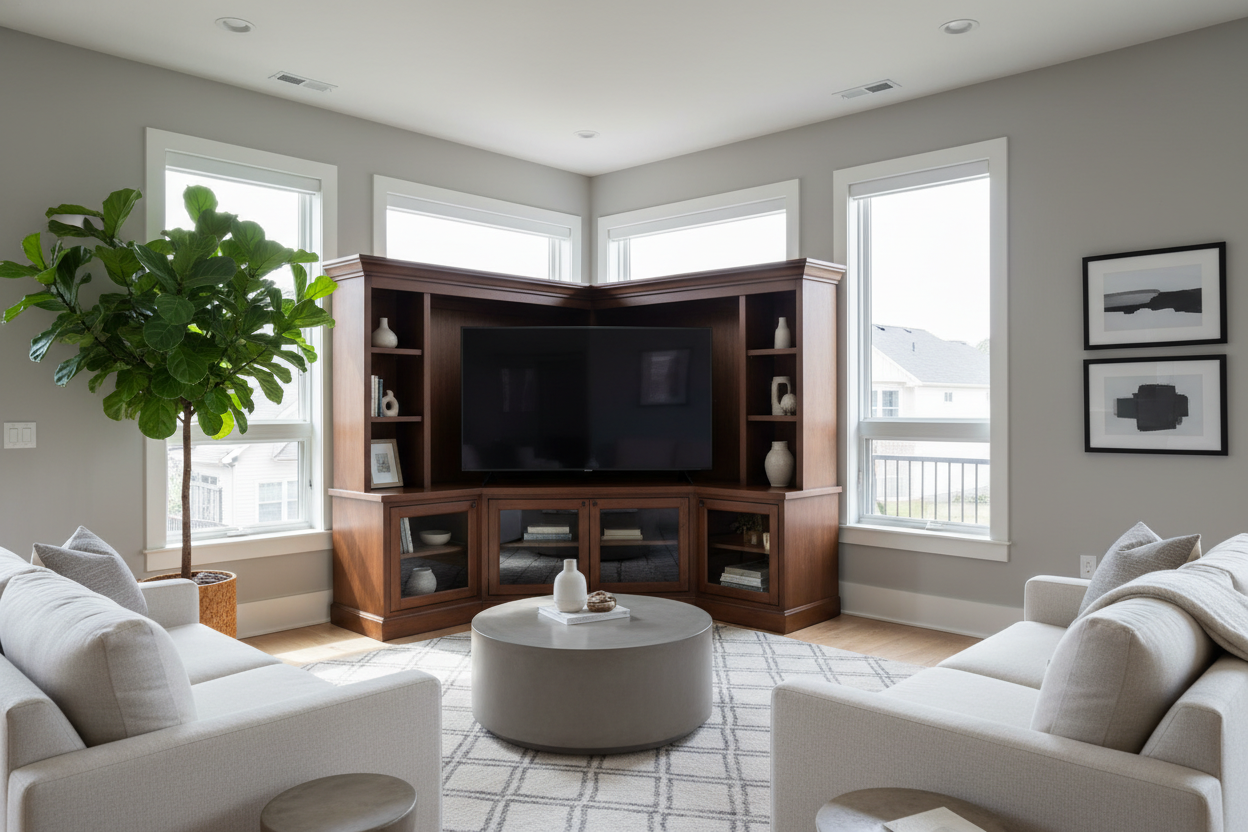
I once bought a "compact" velvet armchair that arrived looking like a throne for a giant. It blocked the radiator, tripped my dog, and eventually became a very expensive laundry basket. It was a classic case of "eyeballing it" gone wrong. But that mistake was nothing compared to the time I decided to upgrade my media setup with a 58 inch corner tv stand.
I figured a corner unit was the ultimate space-saving hack. It’s a corner, right? It’s dead space. By tucking the TV back there, I thought I’d open up the rest of my 12x14 living room for a bigger rug or maybe a floor plant that didn't die in two weeks. I was wrong. A console that wide doesn't just sit in the corner; it colonizes it.
Quick Takeaways
- A 58-inch front face requires significantly more wall space than you think—usually over 40 inches on each side.
- The "depth" of a corner unit pushes your screen further into the room than a flat stand would.
- Baseboards and window trim are the natural enemies of a flush corner fit.
- Always use painter's tape to map the footprint before hitting 'buy.'
I Thought 'Corner' Meant 'Space-Saving' (The Big Mistake)
The logic seemed sound at 1 AM while I was scrolling through furniture listings. My old setup was cramped. I previously gave up my main wall for a smaller unit, but upgrading to a 58-inch changed everything. I assumed that by choosing a corner-specific design, the sheer mass of a five-foot-wide piece of furniture would somehow be neutralized by the geometry of the room. It’s the furniture equivalent of thinking black clothing makes you invisible.
When the boxes arrived—two of them, weighing about 90 pounds each—the reality started to sink in. This wasn't a dainty little shelf. This was a massive hunk of MDF and laminate (or if you’re lucky, kiln-dried oak) that was designed to support a 65-inch screen. As I started assembling the base, I realized that the "corner" part of the stand was actually quite deep. To get that wide 58-inch front face, the unit has to extend quite far back into the corner, but it also has to spread its wings wide along the adjacent walls.
By the time I slid it into place, it didn't look like it was saving space. It looked like it was eating the room. My walking path between the coffee table and the TV was suddenly cut in half. The "dead space" I thought I was reclaiming was actually serving a purpose: it was giving the room air to breathe. Now, that air was replaced by a dark wood monolith.
The Brutal Math of Wide Corner Furniture
Let's talk about the geometry they don't teach you in school—or at least the geometry I ignored. When you buy a standard 58-inch flat TV stand, it takes up 58 inches of linear wall space. Simple. But when you buy a 58 inch corner tv stand, that 58 inches is the hypotenuse of a triangle. To support a front face that wide, the sides of the unit have to be deep enough to keep it stable.
Most people forget that for a corner unit to have a 58-inch front, the "wings" (the parts that touch the walls) aren't just 10 or 12 inches long. They are often 40 inches or more. If you have a window within four feet of your corner, or a doorway, or even a radiator, this stand is going to overlap it. I found out the hard way that my window casing was exactly 38 inches from the corner. The stand I bought? It needed 41 inches of clear wall space. I ended up with a stand that partially blocked my curtains, which looked cluttered and cheap.
Then there is the internal volume. Because it's a triangle, you lose a lot of usable storage space in the very back point of the unit. Sure, it looks deep, but unless you're storing a collection of traffic cones, that narrow back corner is basically a graveyard for lost charging cables and dust bunnies. You’re trading a huge amount of floor real estate for a relatively small amount of actual shelf utility.
The 'Wall Return' You're Probably Forgetting
The "wall return" is the distance the furniture travels along your wall from the point of the corner. This is the measurement that actually determines if the piece fits in your room. If you’re looking at a corner tv stand 58 inches wide, you need to check the manufacturer's diagram for the "side depth." If that number is 42 inches, and you only have 40 inches of wall before a door frame starts, you are in trouble.
Don't forget the baseboards either. Most high-end furniture assumes you have perfectly square 90-degree corners with no obstructions. If you have thick, decorative baseboards, the stand won't sit flush against the wall. It will lean forward or leave a weird two-inch gap at the back. That gap doesn't just look bad; it makes the whole unit feel less stable. I had to actually notch out a bit of my baseboard to get my stand to sit right, which is a level of commitment I wasn't prepared for on a Tuesday night.
How to Tell if Your Room Can Actually Handle the Depth
Before you commit, you need to do more than just measure the width. You need to map the footprint. Grab a roll of blue painter's tape—the kind that won't peel the finish off your floors—and actually tape out the triangle on your carpet or hardwood. When you're browsing TV stands, look for the depth measurement from the front edge to the back corner. Usually, for a 58-inch unit, this is around 20 to 25 inches.
Tape that out. Now, stand back. Does the front edge of that tape line feel like it’s in the middle of the room? It probably does. Because corner stands sit at a 45-degree angle, they project much further into your living space than a flat console. If your sofa is directly opposite the corner, you might find that your 58-inch screen is now two feet closer to your face than it used to be. For some, that’s a cinematic win. For those of us in small apartments, it feels like sitting in the front row of a movie theater.
Check your viewing angles, too. A corner stand dictates exactly where your furniture has to go. You can't just shimmy it six inches to the left to accommodate a new armchair. Once it’s in that corner, your entire room layout is locked in. If your room is narrow, a 58-inch corner unit can create a bottleneck that makes the whole space feel claustrophobic.
Styling Tricks to Make It Look Less Like a Barricade
If you’ve already bought the stand and realized it’s a beast, don't panic. There are ways to soften the blow. The goal is to make the stand feel like a part of the architecture rather than a wooden fence you’ve erected in the corner. I started by adding some height. A tall, thin floor lamp tucked just behind the side of the stand can help bridge the gap between the furniture and the wall, making the transition feel less abrupt.
Visual weight is your biggest enemy here. If you have a dark, heavy wood finish, it’s going to feel twice as big. I’ve found that a rustic corner tv stand for 65 inch tv setups requires even more styling care because the chunky textures and dark stains draw the eye straight to the floor. To counter this, keep the top of the stand relatively clear. Don't clutter it with small knick-knacks. One or two large, intentional pieces—like a substantial ceramic vase or a stack of coffee table books—will make the scale feel intentional rather than accidental.
Also, consider the "float." If your stand has legs rather than a solid base that goes all the way to the floor, it will feel much lighter. Seeing the floor continue underneath the furniture tricks the brain into thinking the room is larger. If yours is a solid block, try placing a light-colored rug partially under the front edge to break up the mass of the wood.
My Final Verdict on the Corner TV Stand 58 Inch Setup
The corner tv stand 58 inch size is a specialized tool. It’s brilliant if you have a massive, open-concept living area where you need to anchor a floating seating arrangement. It’s also great if you’re trying to fit a huge 65-inch TV into a room where the only long wall is taken up by a fireplace or a floor-to-ceiling window.
However, if you're in a standard apartment or a small suburban living room, I’d think twice. The "space-saving" promise is often a myth. You’re usually better off with a slim, flat 50-inch console on a side wall than a massive 58-inch triangle that dictates every movement in the room. Measure twice, tape it out, and be honest about whether you want a TV stand or a new roommate made of wood.
FAQ
Will a 65-inch TV actually fit on a 58-inch stand?
Usually, yes. TV sizes are measured diagonally, while stands are measured by width. A 65-inch TV is roughly 57 inches wide. It will be a tight fit with almost no overhang, which actually looks quite sleek and custom if you center it perfectly.
Can I put a corner TV stand against a flat wall?
You can, but it looks weird. You’ll have two massive triangular gaps behind the unit that will become magnets for dust and cat toys. If you don't have a corner, stick to a rectangular stand.
Are corner TV stands harder to assemble?
In my experience, yes. Because of the 45-degree angles, the cam-locks and dowels can be a bit more finicky to align than a standard boxy unit. Budget an extra 30 minutes and have a second person nearby to help hold the side panels while you tighten the base.


Laisser un commentaire
Ce site est protégé par hCaptcha, et la Politique de confidentialité et les Conditions de service de hCaptcha s’appliquent.