


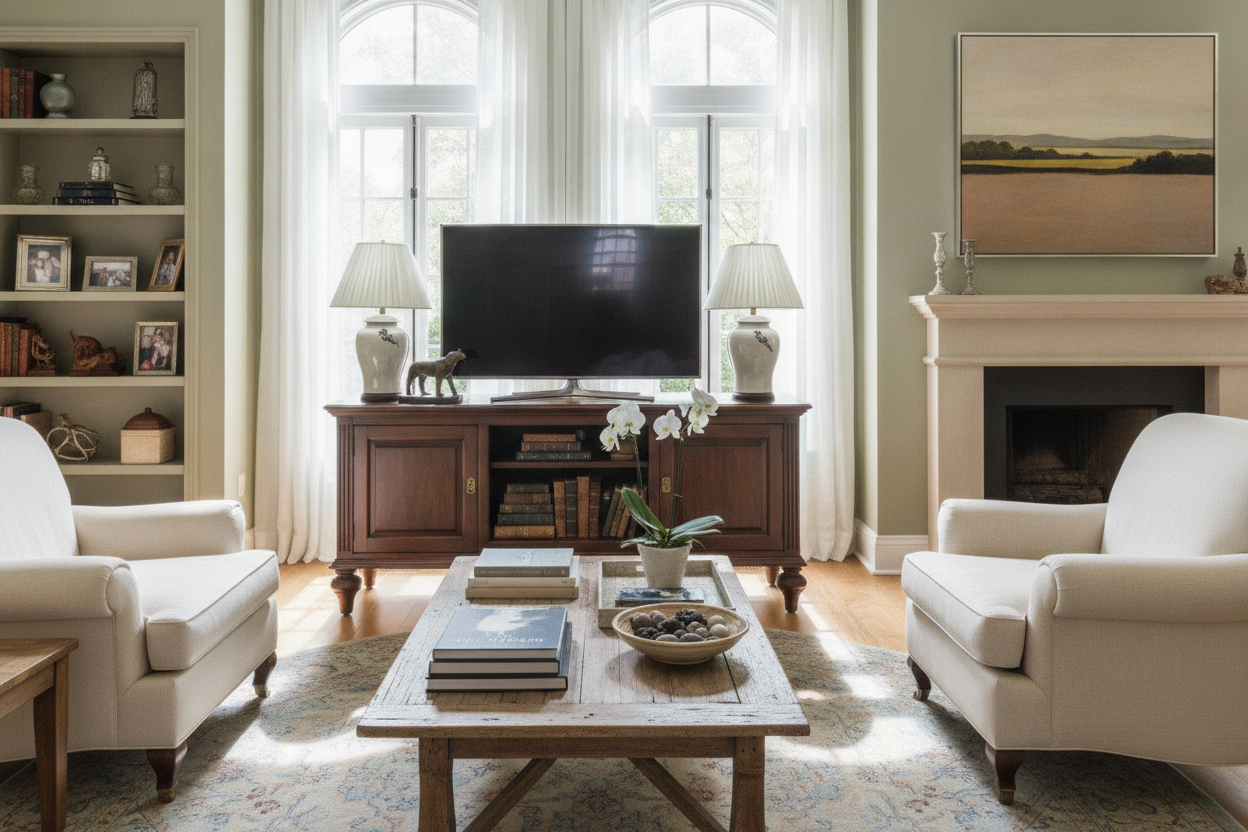
I spent three years pretending a $200 particle-board credenza with spindly metal legs was 'minimalist chic.' In reality, it wobbled every time the cat jumped on it, and the wire management was a nightmare of tangled black snakes. I finally hit a breaking point when I realized my living room felt like a temporary staging area rather than a home. I needed a traditional tv stand—something with actual gravity.
- Traditional pieces offer superior weight distribution for heavy 65-inch+ screens.
- Enclosed cabinetry hides the clutter that open shelving highlights.
- Solid wood construction (look for kiln-dried hardwoods) outlasts MDF by decades.
- A 'modern traditional' aesthetic prevents the room from feeling dated.
The Minimalist Fatigue (Why I Needed a Change)
My living room had become a sea of thin legs and floating shelves. It looked great in a filtered Instagram photo, but in person, it felt cold and unanchored. The 'less is more' approach failed me the moment I tried to store more than two remote controls and a PlayStation. I realized I was tired of seeing my router and power strips through the gaps of a 'sleek' frame.
I started craving furniture that felt permanent. There is a psychological comfort in a piece that doesn't move when you bump it. Moving toward a trading a minimalist console for a display cabinet style taught me that visual weight isn't the enemy—it is the anchor. I wanted a traditional media console that could hold a stack of heavy coffee table books without the middle shelf bowing two inches.
Finding the Perfect Modern Traditional TV Stand
The trick is finding a piece that feels classic without looking like it was pulled from a 1998 Sears catalog. A modern traditional tv stand keeps the soul of the old world—think crown molding and recessed panel doors—but updates the scale. We are talking about traditional style tv stand options that are wider and lower than the boxy units of the CRT era.
I looked for a traditional tv console that featured updated finishes like weathered charcoal or a deep, matte navy. These colors pull the classic silhouette into the present. You want the craftsmanship of traditional media cabinets—dovetail joinery and soft-close hinges—but with the clean lines that play nice with a 4K OLED screen. It’s about the presence of the piece, not just the ornament.
Avoiding the 'Grandma's House' Vibe
To keep a tv cabinet traditional but fresh, stay away from high-gloss cherry finishes or overly ornate brass 'batwing' pulls. Those are the hallmarks of the 90s. Instead, look for traditional media cabinets with simplified molding and hardware in matte black or antique bronze. If the wood grain looks like a sticker, walk away. Real oak or maple has a depth that cheap veneers can't replicate, and it ages into a beautiful patina rather than just peeling at the corners.
Do Traditional Entertainment Centers Still Work Today?
People get scared of traditional entertainment centers because they remember the massive wall units that housed 300-pound tube TVs. But today’s traditional entertainment centers are built for the flat-screen era. They provide a massive visual base that actually makes a 75-inch TV look proportional. When you put a huge screen on a tiny, thin stand, the TV looks like it’s about to tip the whole thing over.
If you are worried about the commitment of a heavy piece, you might look into an adjustable length media console, but for me, the solid footprint was the whole point. A heavy unit hides the ugly wall outlets and the mountain of cables that modern streaming setups require. It turns a tech-heavy corner into a finished piece of architecture.
How I Styled My Traditional TV Console to Look Fresh
Once the unit arrived, I had to make sure it didn't look like a museum piece. I balanced the heavy wood of my traditional style tv stand with contemporary elements. I placed a sleek, linear table lamp on one end and a stack of modern art books on the other. This contrast is what makes the room feel curated and 'grown-up' rather than just old-fashioned.
I also used the enclosed storage to hide every bit of plastic. My consoles, controllers, and extra cables are all tucked behind solid doors. Now, when I walk into the room, I see a beautiful piece of furniture, not a tech graveyard. If you are ready to stop living in a showroom and start living in a home, I highly recommend you browse modern and traditional TV stands to find something that actually has some soul.
Traditional TV Stand FAQ
Are traditional TV stands too heavy to move?
Yes, they are heavy. That is the point. Use felt furniture sliders during the initial setup so you can tweak the positioning without ruining your floors or your back.
Will a traditional style look okay with a modern TV?
Actually, it looks better. The organic texture of wood provides a necessary contrast to the cold, black glass of a large television.
What should I look for in terms of quality?
Check the back panel. If it is flimsy cardboard, keep looking. A quality unit will have a finished or at least a sturdy plywood back with pre-drilled, reinforced cord management holes.


Laisser un commentaire
Ce site est protégé par hCaptcha, et la Politique de confidentialité et les Conditions de service de hCaptcha s’appliquent.