


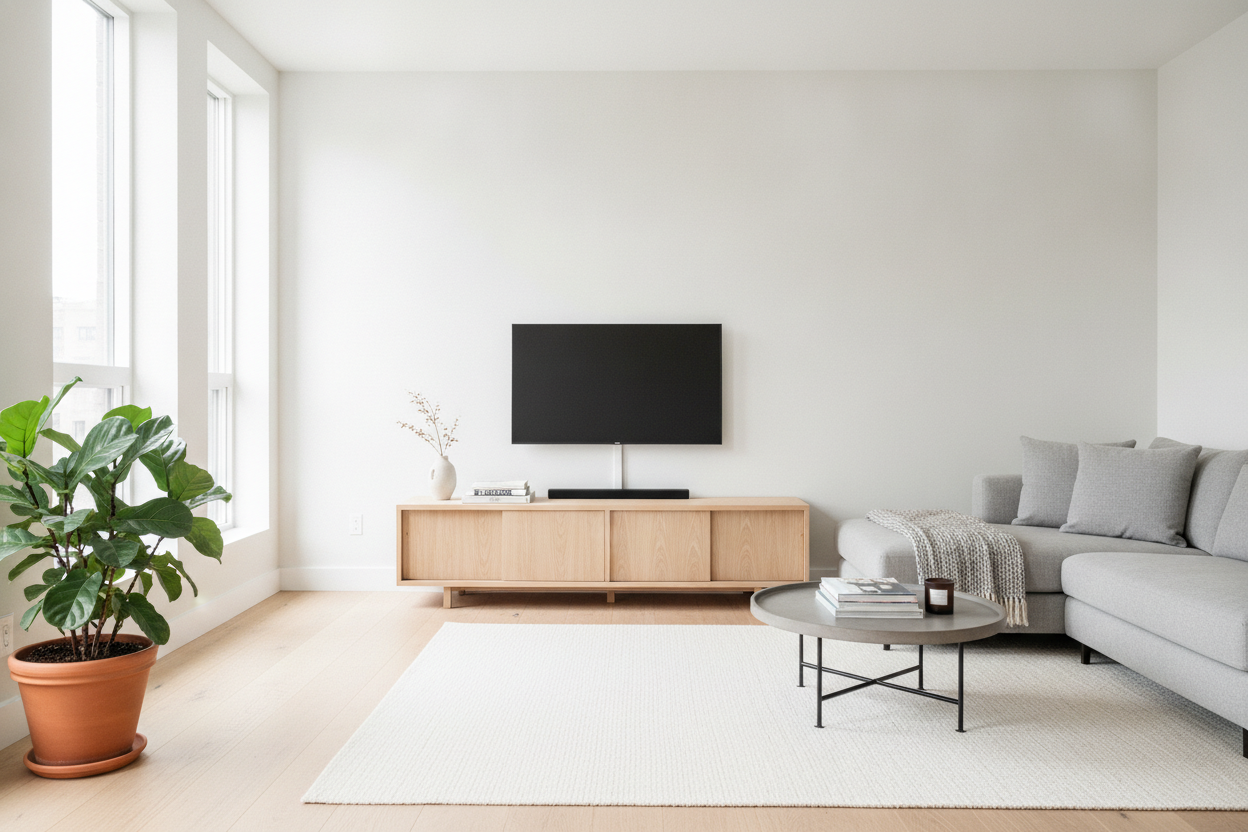
I remember the day my 70-inch oak-veneer console arrived. I lived in a 450-square-foot studio, but I insisted on having 'anchor pieces.' It anchored the room, alright—it anchored it like a lead weight in the middle of a swimming pool. I spent six months tripping over its sharp corners before I realized I didn't need a sideboard-sized monolith for a 43-inch TV. Swapping to a small media shelf was the smartest thing I did for my sanity and my floor plan.
Quick Takeaways
- Measure your TV's actual base footprint, not just the screen size.
- Vertical storage beats horizontal bulk every time in a small room.
- Open-leg designs create the illusion of more floor space.
- Hide the 'tech spaghetti' in baskets or behind one solid cabinet door.
The 'Giant Console in a Tiny Room' Trap
Buying a 60-inch traditional TV stand for a tiny apartment is a classic rookie move. We are conditioned to think we need 'storage,' but we usually end up with a dust-collecting behemoth that blocks the natural flow of the room. In a 400-square-foot space, every inch of floor is precious real estate. When you drop a massive cabinet against your longest wall, you aren't just losing floor space; you're making the whole room feel heavy and crowded.
I’ve seen too many people try to force a full-sized media center into a space that really only has room for a chair. The result? You can barely walk between your coffee table and the TV. It feels like living in a storage unit rather than a home. You don't need a massive unit to hold a device that is essentially two inches thick.
Why I Finally Downsized to a Small Media Shelf
The epiphany happened when I looked inside my old console and realized it was 80% air and 20% tangled HDMI cables I hadn't touched since 2018. I started browsing for book media storage that felt more like a curated shelf than a piece of industrial equipment. I wanted something with a smaller footprint that allowed the eye to see the floor underneath it.
The psychological relief was instant. When I replaced that monster with a streamlined short media cabinet, the room suddenly felt twice as wide. There is something about seeing the baseboards and the rug extend all the way to the wall that tricks your brain into thinking the room is larger. I stopped feeling like my furniture was closing in on me.
Finding a Short Media Cabinet That Doesn't Look Cheap
If you're hunting for a short media cabinet, please skip the $80 particleboard options that sag the moment you put a speaker on them. If it’s made of that flimsy 'wood-look' laminate, it will look like college dorm furniture within a month. Look for solid mango wood, walnut, or even powder-coated steel for a more 'grown-up' vibe.
I actually found that a small decorative cabinet can often serve double duty as a media stand if the height is right (aim for 20-24 inches for comfortable viewing). You want something with enough weight to feel substantial but enough style to not look like a generic black box under your TV.
Keep Your Media Storage Small and Intentional
Switching to media storage small forces you to be ruthless with your tech. Do you really need that dusty Wii U or the stack of DVDs you haven't watched in a decade? Probably not. I cut my cord collection down to the absolute essentials: power, one HDMI, and a charger. If it hasn't been plugged in since the last time you moved, it doesn't get a spot on the new shelf. Intentionality is the only way to make small-scale living work without it turning into a cluttered mess.
Hiding the Ugly Stuff in a Small Media Storage Cabinet
The biggest hurdle with a small media storage cabinet is the cable mess. Since you have less 'cabinet' to hide things in, you have to be smarter. I use a simple cable management box tucked behind one leg to house the power strip. For the items you absolutely can't get rid of—like the router or a gaming console—choose a unit with at least one closed door or use a stiff felt basket to corral the clutter.
If you still find yourself with overflow, placing a small standing cabinet in a nearby corner can catch the extra controllers and chargers without crowding the TV area. The goal is to keep the area around the screen as clean as possible so the room feels airy.
FAQ
How wide should my media shelf be compared to my TV?
Ideally, your shelf should be at least 2 to 4 inches wider than the base of your TV on each side. This prevents the 'top-heavy' look where the TV looks like it's about to tip over.
Can I use a regular bookshelf as a media stand?
Yes, provided it's sturdy and low enough. You may need to use a hole-saw bit to drill a 2-inch opening in the back panel for cable routing, but it’s an easy DIY fix for a custom look.
Is open storage better than closed storage for small rooms?
Open storage looks lighter and 'airier,' but it requires you to be very tidy. If you have a lot of ugly black boxes and wires, closed storage is the better move to hide the visual noise.

Laisser un commentaire
Ce site est protégé par hCaptcha, et la Politique de confidentialité et les Conditions de service de hCaptcha s’appliquent.