


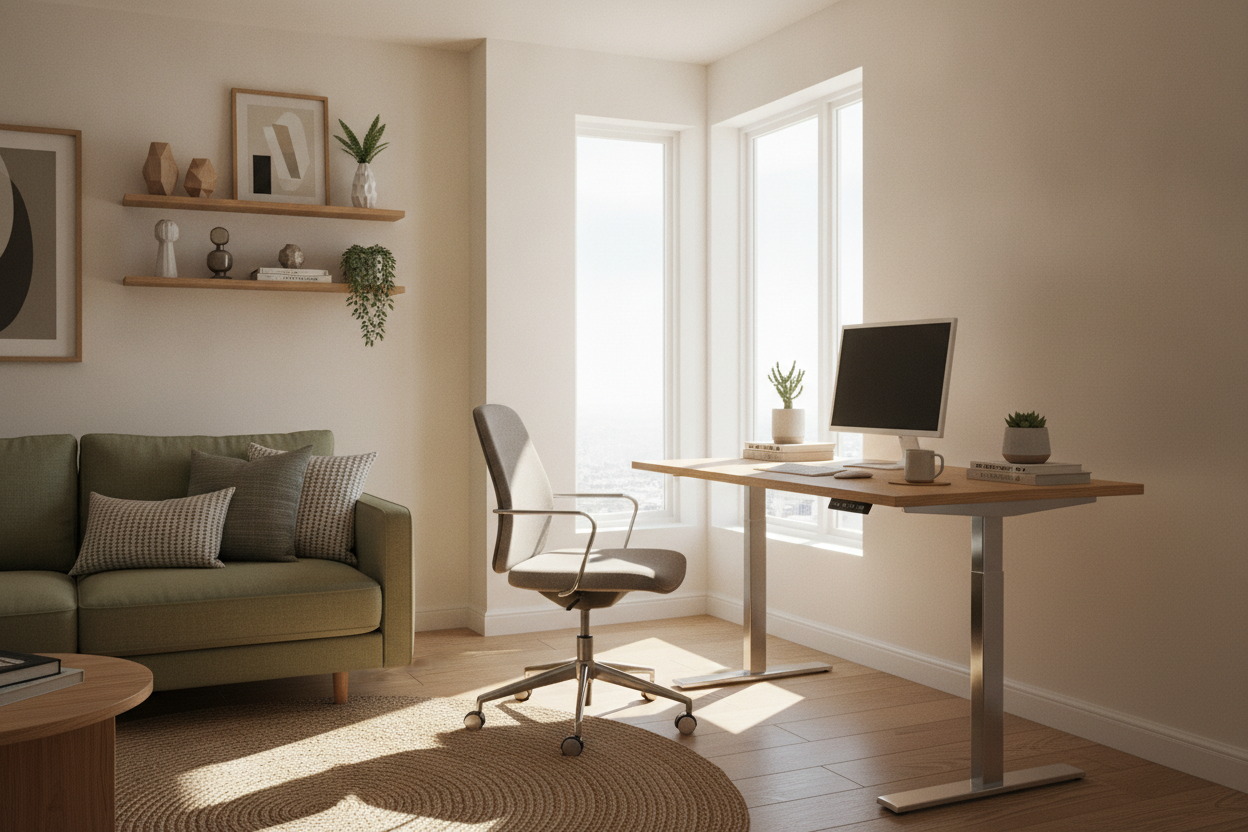
I spent three years living in a 550-square-foot apartment with a desk that took up nearly 15% of my usable floor space. It was a massive, four-legged beast that looked great in the staged showroom but felt like a parked SUV in my living room. Every time I tried to walk to the kitchen, I’d clip my hip on the corner. I was sacrifice-living for a 'professional' setup I barely used to its full capacity.
The breaking point came when I realized I was spending more time working from my sofa with a laptop overheating on my knees than actually sitting at that expensive slab of wood. I needed a single leg desk—something that didn't demand its own zip code but still offered a stable surface for my coffee and my MacBook.
- Massive space savings: You reclaim roughly 4 to 6 square feet of floor area.
- True mobility: Most single-post designs come with casters that actually roll on carpet.
- Ergonomic flexibility: You can pull the base under a sofa or bed, which four-legged desks can't do.
- Pneumatic power: No cords needed if you go with a gas-spring lift model.
The Day I Realized My Huge Desk Was Ruining My Living Room
We’ve been conditioned to think that a 'real' office requires a heavy-duty workstation. I fell for the hype and bought a Flexispot 4 leg standing desk, which is a fantastic piece of engineering if you have a dedicated room for it. But in a studio apartment? It’s basically a motorized dining table that eats your entire life. It creates a 'dead zone' where nothing else can happen.
I started measuring my actual work habits. I don't use three monitors. I don't have a printer. I have a laptop, a notebook, and a very large mug of tea. The footprint of a traditional desk is designed for the paper-heavy offices of 1995, not the digital-first reality of 2024. Switching to a single pedestal felt like admitting defeat at first, but it was actually the first step toward reclaiming my home.
Enter the Single Leg Desk (Hear Me Out)
I know what you're thinking. You're picturing a hospital bed table—the kind they use to serve lukewarm Jell-O. And yeah, the aesthetic can lean a bit clinical if you aren't careful. But once you get past the 'recovery room' vibes, the utility is undeniable. A single pedestal removes the cage of four legs that usually traps your swivel chair.
The visual lightness is the real win here. Because there is only one central column, your eyes see more of the floor. In a small apartment, seeing more floor makes the room feel ten times bigger. It’s a psychological trick that works every time. I opted for a matte black finish with a wood-grain top to kill that hospital look, and suddenly, it just looked like a minimalist side table that happened to be very tall.
Why a Single Leg Height Adjustable Table Actually Works
The magic is in the base. Most of these tables use an H-shaped or U-shaped low-profile base. This allows you to slide the bottom of the single leg height adjustable table directly under your sofa or armchair. You can finally sit with your back fully supported against the couch cushions while the desk surface sits perfectly over your lap. It is the ergonomic dream I never achieved with a standard desk.
I used to try all sorts of hacks to get my furniture to the right height, even considering desk leg risers to save my knees when my old vintage table sat too low. But a pneumatic single-leg system is better. With a simple lever, I can go from 'sofa height' to 'standing desk' in two seconds without hunting for a power outlet. The gas spring does all the heavy lifting, and it's surprisingly stable. I can type at full speed without the screen wobbling like a bobblehead.
It Weirdly Works in Literally Every Room
The mobility of this thing is what surprised me most. I don't just use it for work. On Saturday mornings, I roll it into the bedroom. It’s a much better height for propping up an iPad than a standard nightstand. I’ve even rolled it next to my partner’s large sliding lighted mirror dressing table to act as a secondary 'hot station' for hair tools so they aren't cluttering up the main vanity surface.
It’s become the ultimate utility player. Honestly, it’s basically the adult WFH equivalent of a versatile changing table, holding whatever chaotic mess I throw at it throughout the day. Whether I’m using it as a cocktail perch when friends are over or a temporary prep station in my tiny kitchen, it earns its keep in a way a 60-inch mahogany desk never could. It’s furniture that actually moves with your life instead of forcing you to move around it.
The 3 Things to Check Before You Buy One
Not all single-post desks are created equal. First, check the base weight. You want something heavy—preferably steel—to act as a counterweight. If the base is too light, the whole thing becomes a tipping hazard the moment you lean your elbows on it. I look for a base that weighs at least 15-20 pounds on its own.
Second, look at the casters. Cheap plastic wheels will chew up your hardwood floors and get stuck on the thinnest rug. Look for 'polyurethane' or 'rollerblade style' wheels. Lastly, measure your sofa clearance. If your couch sits low to the ground, make sure the desk base is thin enough to slide under it. There's nothing more frustrating than a 'mobile' desk that gets stopped an inch short by your sofa frame.
Is a single leg desk stable enough for a monitor?
For a single 24-inch or 27-inch monitor, yes. I wouldn't trust it with a 49-inch ultrawide or a dual-monitor arm setup. The physics of a single post mean it has a lower weight capacity than a four-legged frame, usually topping out around 30-40 lbs.
Does it wobble when you type?
If you buy a cheap $40 version, yes. If you spend $150-$300 on a high-quality pneumatic model with a heavy steel base, the wobble is negligible. It feels solid enough for daily professional use, though it will never be as rock-solid as a dining table.
Can I use it on carpet?
Yes, but you need larger wheels. Small 1-inch casters will sink into the pile and make it impossible to move. Look for 2-inch or 3-inch locking casters if you plan on rolling it across a rug regularly.

Laisser un commentaire
Ce site est protégé par hCaptcha, et la Politique de confidentialité et les Conditions de service de hCaptcha s’appliquent.