


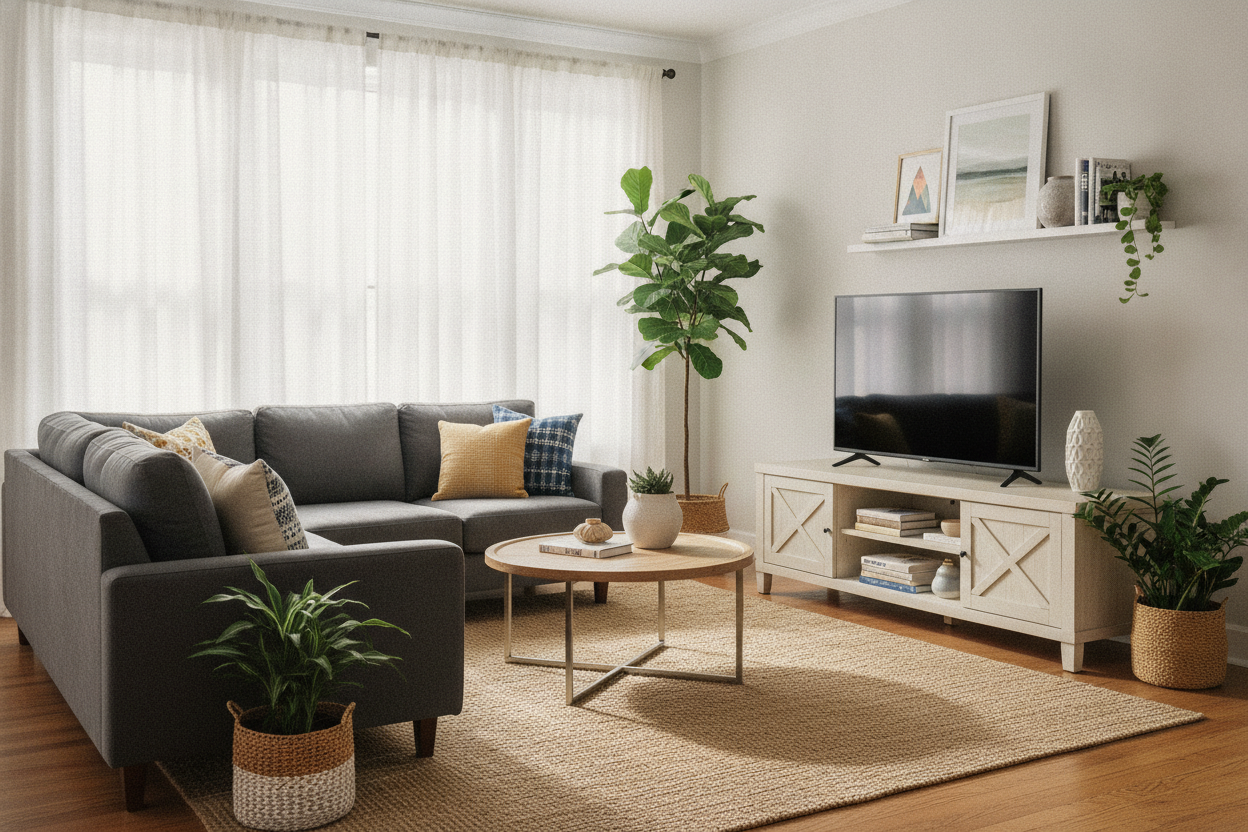
I stood in my new living room with a heavy-duty drill and a bag of plastic drywall anchors, feeling that familiar renter’s dread. My landlord is the type who considers a thumb-tack hole a 'structural violation,' and the thought of trying to find a stud behind this thick, 1920s plaster made my palms sweat. I eventually put the drill back in the junk drawer. I wasn’t going to mount my screen; I was going to find a wayfair tall tv stand that did the work for me.
- Most standard TV consoles are only 18 to 22 inches tall—way too low for a standard sofa.
- A 'tall' console should be at least 30 inches high to hit the ergonomic sweet spot.
- Always check the weight capacity; taller units can be more prone to tipping if you buy cheap materials.
- Bedroom setups require even more height (35'+) to clear the footboard of your bed.
The Anti-Mounting Manifesto (And Why Low Consoles Suck)
The furniture industry seems to think we all live in minimalist lofts with floor-cushion seating. Most consoles you see online are hilariously short. If you have a standard sofa with a 19-inch seat height, sitting in front of a 20-inch stand means you’re constantly tilting your chin down. After three hours of a Netflix binge, your neck feels like it’s been hit by a literal truck.
I spent hours scrolling through endless TV stands, getting increasingly annoyed by the 'mid-century' trend that prioritizes low-slung tapered legs over actual human biology. I don't want to look down at my TV like I'm reading a book in my lap. I want my screen to meet my eyes where they naturally rest. Plus, avoiding the drywall-anchor-and-patching cycle is worth every penny of a new furniture purchase.
My Search for a Wayfair Tall TV Stand That Doesn't Look Corporate
The problem with searching for 'tall' furniture is that you often end up in the 'Office' or 'Education' categories. I didn't want my living room to look like a high school biology classroom or a corporate boardroom with an AV cart. I needed something substantial, something with presence, but something that still felt like a home.
I eventually pivoted my search toward 'credenzas' and 'sideboards.' These are traditionally taller because they're meant for dining rooms, but they work perfectly for media. I found a stunning storage credenza with sliding glass doors that stood 34 inches high. It was a revelation. It hid my router, my dusty PlayStation, and a dozen board games, all while lifting my 65-inch Sony to the exact height I needed. It didn't look like a 'TV stand'—it looked like a piece of furniture I actually chose on purpose.
The 'Magic Number' for Sofa Viewing Height
Before you hit 'buy,' do some actual math. Sit on your couch and have someone measure from the floor to your eyes. For most people, that’s about 42 inches. Now, measure your TV and find the middle of the screen. You want the middle of that screen to be roughly at that 42-inch mark. If you have a 55-inch TV (which is about 27 inches tall), the center is 13.5 inches from the bottom. Subtract that from your 42-inch eye level, and you realize you need a stand that is about 28.5 inches tall. Anything shorter is a recipe for a chiropractor visit.
Is It Wobbly? The Truth About Top-Heavy Consoles
I’ll be honest: I was worried about the physics of it. Putting a 60-pound glass-and-plastic rectangle on top of a 35-inch tall wooden box feels like a dare to gravity. If you buy a unit made of thin, 0.5-inch MDF, it’s going to wobble. I specifically looked for a unit with a wide base and a weight capacity of at least 100 lbs on the top shelf.
If you're still nervous about stability, you might consider the TV stand with mount Wayfair keeps showing you. Those hybrid units offer the height of a wall mount with the stability of a base. However, for my money, a solid wood or high-quality veneer credenza with an anti-tip kit screwed into the back is plenty stable. Just don't skip the anti-tip kit—especially if you have a cat that thinks the top of the TV is a high-altitude perch.
The Bedroom Exception: When You Actually Need to Go Higher
The living room is one thing, but the bedroom is a completely different ergonomic nightmare. If you’re propped up on pillows, your eye level is much higher. Plus, if you have a bed with a footboard, a standard 20-inch TV stand will result in you watching the bottom third of your favorite show through a wooden slat. It’s infuriating.
For the bedroom, you really need to push into the 35-to-40-inch range. I’ve seen people try to make low stands work by stacking them on top of other things, and it looks terrible. Seriously, your high bed is ruining your neck if you don't get that screen up. A tall dresser often doubles as a great TV stand here, provided it's deep enough to hold the TV's legs securely.
FAQ
How tall is a 'tall' TV stand?
Most standard stands are 18-24 inches. A 'tall' stand usually starts at 30 inches and can go up to 42 inches for bedroom or bar-height viewing.
Can I use a dining sideboard as a TV stand?
Yes, and you probably should. Sideboards are usually 30-36 inches tall and offer much better storage than flimsy media consoles. Just check that it has wire management holes in the back.
Are tall TV stands safe for kids?
Only if they are anchored. Because they have a higher center of gravity, they are more prone to tipping. Always use the included anti-tip hardware to secure it to a wall stud.

Laisser un commentaire
Ce site est protégé par hCaptcha, et la Politique de confidentialité et les Conditions de service de hCaptcha s’appliquent.