


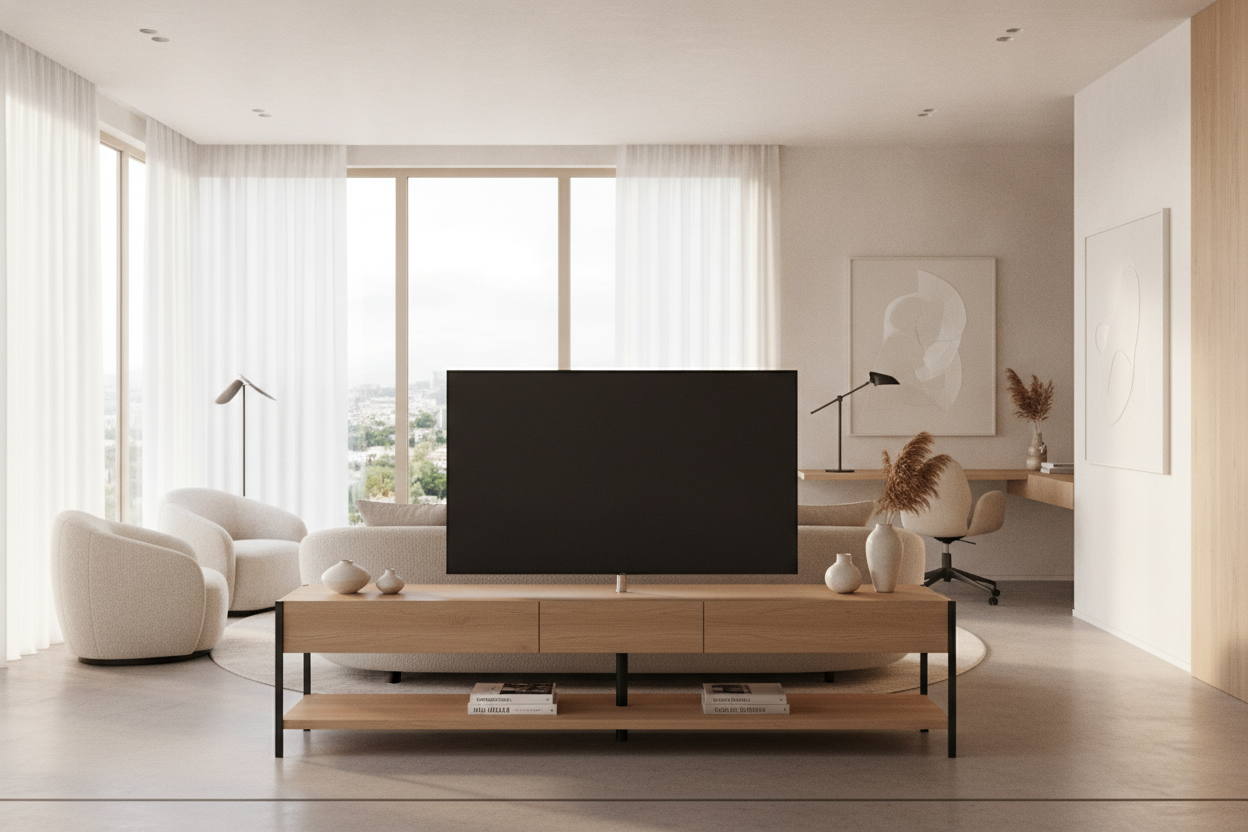
I spent three hours moving my sectional around a 12x14 living room just to realize the only 'wall' was actually a floor-to-ceiling window. It is the modern renter’s curse: great light, zero places to put a screen. After staring at my reflection in the dark glass for far too long, I finally gave up and dragged the console three feet toward the center of the rug. Putting a tv in the middle of the room felt like an interior design sin at first, but it actually saved my layout.
- Floating furniture creates natural zones in open-concept floor plans.
- A rug is non-negotiable for anchoring a floating stand.
- Cable management requires a floor outlet or a heavy-duty cord hider.
- Motorized lifts are the 'gold standard' for bedroom layouts with no wall space.
Why I Stopped Forcing My Screen Against the Wall
Modern architecture hates your TV. We have floor-to-ceiling windows, massive fireplaces, and open-concept floor plans that leave us with exactly zero usable drywall. For years, I tried to force my 55-inch screen onto a tiny sliver of wall near the kitchen, which meant I had to crane my neck 45 degrees just to watch the news. It was a ergonomic nightmare.
The mental shift happened when I stopped viewing the TV as a piece of art that needed a 'gallery wall' and started viewing it as a spatial tool. When you pull the TV into the center of the living room, you aren't just placing a screen; you are creating a boundary. It defines the lounge area without the need for a physical wall, keeping the airy feel of the room while giving you a much better viewing angle.
The 3 Rules for Floating a TV Without It Looking Weird
You cannot just plop a stand in the middle of the hardwood and call it a day. It will look like a waiting room at a tire shop. Rule number one: you must anchor the setup with a rug. The rug tells your eyes that this is a 'zone.' If the stand is floating on bare floor, it looks lost; if it is sitting on a plush 8x10 rug, it looks like a curated vignette.
Rule number two: choose furniture with visual weight. Using a wide adjustable TV stand placed directly behind a floating sofa is a pro move. It grounds the layout and provides a 'back' to the seating area. Rule number three: keep the height low. If the TV is floating and too high, it blocks the sightlines of the entire room. Keep it at eye level so the rest of the space still feels open.
You Have to Think About the Back of the TV
The biggest hurdle to a tv not against wall setup is the 'spaghetti' factor. No one wants to see a tangle of HDMI cables and power bricks. Since the back of your tech is now on full display, cable management is mandatory. I use braided cable sleeves to group everything into one 'trunk' that runs down the leg of the stand.
If you don't have a floor outlet, you'll need a low-profile cord cover that matches your flooring. I also like to place a few tall decorative objects or a hardy snake plant on the console behind the screen. It breaks up the flat plastic back of the TV and makes the whole setup look like a piece of furniture rather than a workstation.
Where to Put a TV in a Bedroom With No Wall Space
Bedrooms are even more of a puzzle. Between the closet doors, the headboard, and the windows, you are often left with no wall space for a tv in the bedroom. I’ve seen people try to mount them above the dresser at a 5-foot height, which is a great way to end up at the chiropractor. The better solution? Place the TV at the foot of the bed.
If you want to keep the room feeling serene, a hidden TV lift motorized vertical stand is the ultimate luxury for small spaces. It looks like a standard end-of-bed bench or dresser, but the screen emerges only when you need it. This solves the 'where to put a tv with no wall space' dilemma while keeping your bedroom from looking like a sports bar.
What If You Are Still Too Scared to Float It?
I get it. Floating a TV in the center of the living room feels bold, and if you have toddlers or high-energy dogs, it might feel like a disaster waiting to happen. If you can't commit to the center of the room, look at your corners. Most people ignore them, but a corner setup can actually reclaim a lot of floor space if done correctly.
The trick is getting the scale right. Understanding the geometry of fitting a 70 inch corner TV stand is vital. You want a stand that actually fills the corner rather than leaving a 'dust triangle' behind it. It’s the perfect compromise for those who need to keep the center of the room clear for foot traffic but still have zero flat wall space to work with.
FAQ
How do I hide the wires on a floating TV?
Use a cable management box to hide the power strip and a braided cord sleeve to bundle the wires. If you are a homeowner, installing a floor outlet is the cleanest long-term solution.
Is a floating TV stand stable?
Yes, provided you choose a stand with a wide, heavy base. Avoid top-heavy, thin-legged mid-century styles if you aren't anchoring them to a wall or placing them behind a heavy sofa.
What is the best furniture for a TV in the middle of the room?
Look for consoles with finished backs or 'island' style cabinets. A low-profile dresser or a long, sturdy sideboard also works beautifully as a room divider.

Laisser un commentaire
Ce site est protégé par hCaptcha, et la Politique de confidentialité et les Conditions de service de hCaptcha s’appliquent.