


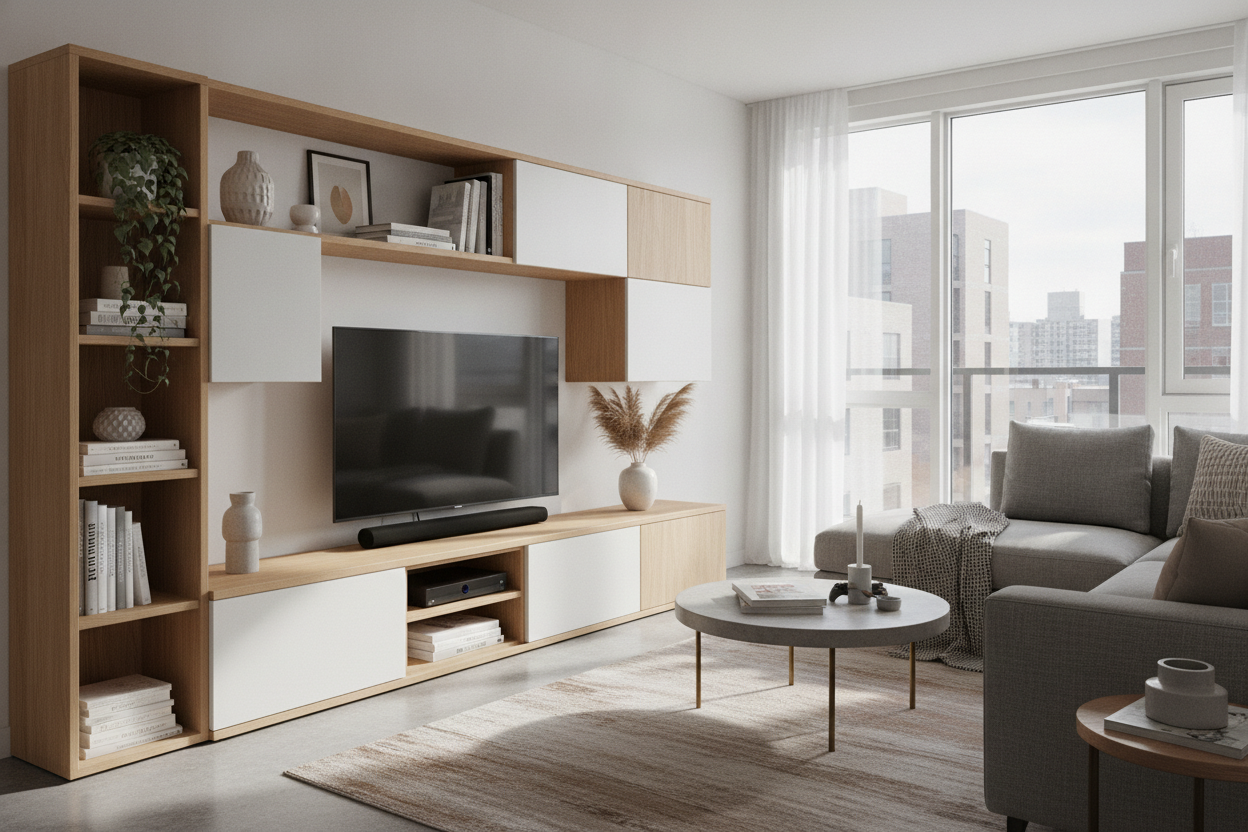
I’ve been there. You’re staring at a floor plan at 1 AM, measuring the distance between a radiator and a window frame with a piece of string because you can’t find your tape measure. Moving is a special kind of hell, but nothing makes it worse than realizing your beautiful, 80-inch solid wood credenza is exactly three inches too long for the only wall in your new living room. After my second move in two years, I realized that buying furniture for a specific room is a rookie mistake. I needed a modular tv stand that could shrink, grow, and pivot as often as my landlord raised the rent.
Quick Takeaways
- Adaptability: Modular units allow you to split, stack, or slide pieces to fit weird alcoves and tight corners.
- Future-Proofing: You aren't buying for one apartment; you're buying for the next five.
- Easy Transport: Moving three small boxes is infinitely better for your back than lugging one 150-pound beast.
- Custom Storage: You can add or remove shelving units as your tech collection (or plant obsession) evolves.
The 'Will This Fit?' Panic of Moving
There is a specific dread that hits when you realize your furniture is dictating your life. In my last place, I had this gorgeous, mid-century sideboard. It was heavy, it was expensive, and it was a total nightmare. When I moved into a 600-square-foot walk-up with a hallway that felt like a submarine corridor, that sideboard wouldn't even clear the door frame. I had to sell it on Marketplace for half what I paid just to get it out of my sight.
That was the turning point. I stopped looking for 'the one' and started looking for components. Trying to force a massive, rigid piece of furniture into a new space with offset windows and baseboard heaters is a losing game. It makes the room feel cramped and the layout feel accidental. You shouldn't have to choose between having a TV and being able to open your front door all the way.
Enter the Modular TV Cabinet (My Layout Savior)
The lightbulb moment happened when I stopped searching for 'consoles' and started looking at a modular tv unit. The concept is simple: instead of one massive block, you have sections that work together. It completely eliminates the fear of your furniture dictating your floor plan. If your new wall is narrow, you stack. If it’s wide, you spread them out. It’s like Tetris for your living room, but with fewer high-stress sound effects.
When I was browsing for a new setup, I spent hours looking through a collection of versatile TV stands to find something that didn't look like it belonged in a dorm room. The key is finding pieces that have finished sides. Many cheap units look 'unfinished' if they aren't pushed right against each other, but a high-quality modular tv cabinet should look intentional whether the pieces are touching or separated by three feet of wall space.
How I Configured Mine for Three Different Rooms
In apartment number one, I had a massive, 14-foot loft wall. I used an adjustable length media console to stretch the visual footprint. By sliding the outer sections away from the center, I filled the wall without having to buy a custom-built unit that would have cost as much as my car. It looked high-end and proportional, not like a tiny island in a sea of drywall.
Apartment number two was the 'corner of doom.' The only spot for the TV was a 45-degree angle next to a non-functional fireplace. I broke the tv unit modular setup down, using just the center base for the screen and moving the side cabinets to act as end tables for my sofa. They still matched, the room felt cohesive, and I didn't have to buy new side tables.
Currently, I’m in an asymmetrical space with a weird alcove on the left. I’m using a modular tv cabinet with shelves to create a staggered look. I have the main base for the TV and the shelving unit tucked into the alcove for my record player and books. It looks like a custom built-in. My biggest mistake in the past was thinking everything had to be perfectly symmetrical. It doesn't. Life isn't symmetrical, and your living room doesn't have to be either.
Wait, Can You Hide Cords in a Modular Setup?
This is the first thing everyone asks: 'Won't I see a mess of wires between the pieces?' If you just throw things together, yes, it’ll look like a tech explosion. But keeping a tv unit modular doesn't mean you have to embrace the cable chaos. I use braided cable sleeves that match my wall color. They bundle the HDMI and power cords into one neat line that’s barely noticeable.
Another pro tip: use heavy-duty Velcro command strips on the back of the individual modules to mount a small power strip. This way, each piece of the modular tv cabinet only has one cord running to the wall, rather than a spiderweb of wires stretching across the floor. It takes ten minutes of effort but saves you hours of visual annoyance every time you sit down to watch a movie.
When You Might Want to Ditch the Stand Altogether
Look, I love modular setups, but they aren't a magic wand. Sometimes a room is so narrow or the windows are so poorly placed that any floor-based furniture feels like an obstacle. If you’re dealing with a room that’s more 'hallway' than 'living space,' you might be better off if you swapped my TV stand for a wide storage cabinet that offers more vertical utility and a slimmer depth.
Or, if you’re fancy and want to hide the tech entirely, you could go the high-tech route. An electric vertical lift TV cabinet is the ultimate flex for small spaces where you don't want a black mirror dominating the room when it's off. But for the rest of us moving from one rental to the next, the modular approach remains the most practical, budget-friendly way to ensure your furniture actually survives the trip.
FAQ
Is modular furniture less sturdy?
Not if you buy quality. Look for kiln-dried wood or heavy-duty MDF with high-pressure laminates. Avoid the paper-thin particle board that crumbles the second you tighten a cam lock. If the individual pieces feel solid, the whole unit will too.
Can I mix and match different brands?
You can, but watch the finishes. 'Walnut' from one brand is 'Dark Oak' from another. I recommend staying within one brand's ecosystem to ensure the heights and depths match up perfectly, otherwise, it looks accidental rather than modular.
Are they hard to assemble?
Actually, they're usually easier. Assembling three small cabinets is much less intimidating than trying to flip over a 7-foot-long console by yourself without snapping the legs off. It's manageable for one person and a screwdriver.

Laisser un commentaire
Ce site est protégé par hCaptcha, et la Politique de confidentialité et les Conditions de service de hCaptcha s’appliquent.