


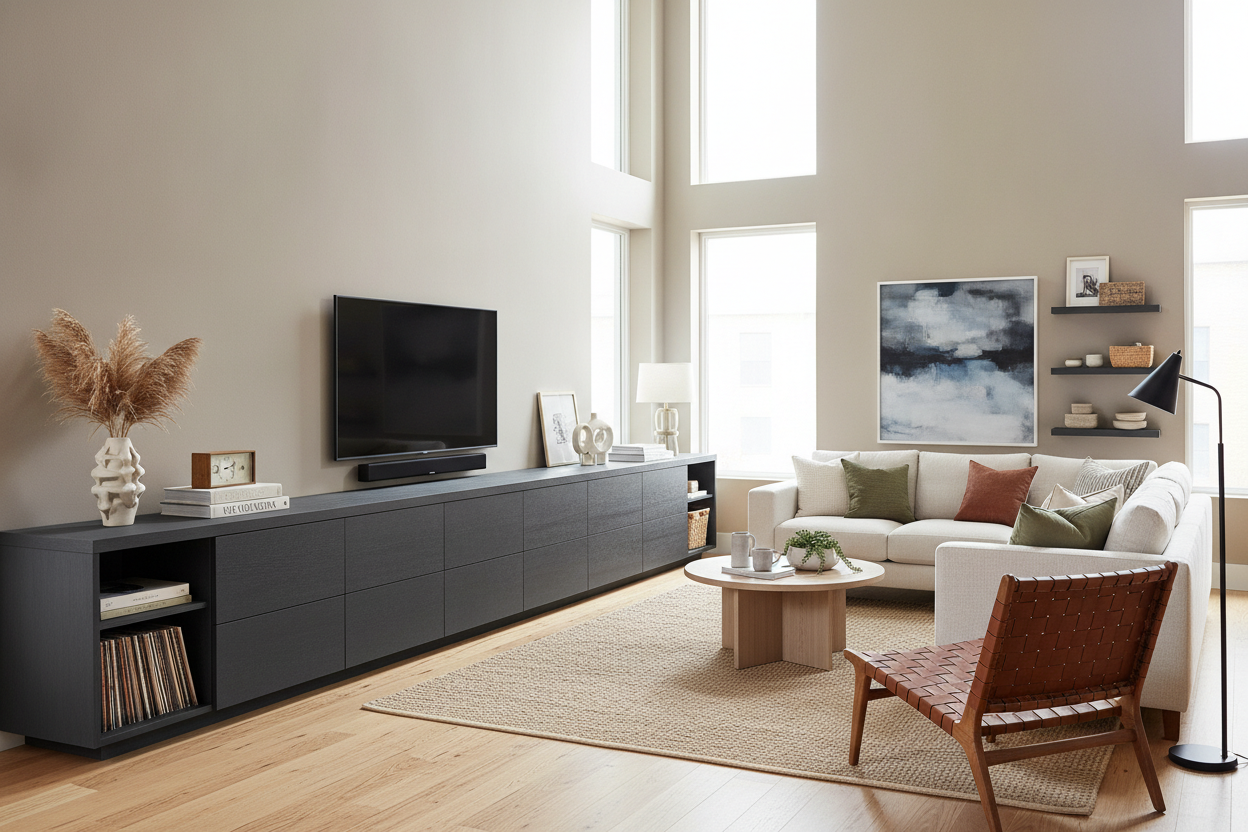
I spent three hours last Tuesday night on my hands and knees, trying to zip-tie a power strip to the underside of a walnut shelf. It was supposed to be 'minimalist.' Instead, it looked like a tech-themed horror movie with black cables cascading down my white walls. I finally admitted defeat, measured my wall, and bought a storage tv console that actually hides my life.
For years, I was obsessed with the Pinterest-perfect look of a floating TV. I thought I could live with just a screen and a dream. But then came the soundbar, the PlayStation, the mesh router nodes, and the external hard drive for my old photos. My living room didn't look sleek; it looked like a server room in a basement. Switching to a real piece of furniture changed the entire energy of my apartment.
Quick Takeaways
- Depth matters: Look for at least 16-18 inches if you have a bulky AV receiver.
- Solid doors are better than glass if you want to hide messy cable nests.
- Integrated cord management isn't a luxury; it's a requirement.
- Ventilation is the difference between a working console and a melted one.
The Minimalist Floating Shelf Delusion
We’ve all been sold the lie that a tiny, 2-inch thick piece of wood can handle a modern entertainment setup. It’s a delusion. Unless you are literally drilling into your studs and running HDMI cables through the drywall, a floating shelf is just a recipe for visible cord clutter. A basic wall mounted media storage solution works for a bedroom where you only have a remote, but for a main living area, it’s a disaster.
A proper tv stand media center needs to be more than a platform; it needs to be a disguise. When you have a chunky console, the 'visual weight' actually anchors the room. It makes the TV feel like a deliberate design choice rather than a black rectangle stuck to the wall. I realized I’d rather have a heavy, beautiful cabinet than a 'light' shelf that forced me to look at my dusty router every single day.
Why I Swallowed My Pride for a Real Storage TV Console
I used to think big furniture made a small apartment feel smaller. I was wrong. What actually makes a room feel small is visual noise. Ten different small items sitting on a shelf creates a frantic vibe. One large, clean storage tv console with closed doors creates a sense of calm. It’s the furniture equivalent of a deep breath.
I chose a piece that was 70 inches long, even though my TV is only 55 inches. That extra surface area lets me put a lamp and a plant on the ends, which stops the 'tech' from being the only thing you see. It’s about reclaiming the living room from the gadgets.
Hiding the Wi-Fi Router (And the Cable Nest)
The biggest win was the router. Routers are objectively ugly, but they need to be somewhat central for a good signal. A tv console storage cabinet with adjustable shelves allowed me to tuck the router away while still keeping it high enough to blast Wi-Fi through the kitchen. No more blinking green lights while I’m trying to watch a movie.
For the smaller stuff, I found that a wide storage cabinet with drawers is the ultimate secret weapon. I use the drawers for those 'mystery cables' we all keep—USB-C cords, old HDMI leads, and the three different remotes I only use once a month. It’s much better than a tangled 'junk drawer' in the kitchen.
The Non-Negotiables for a TV Stand With Media Storage
If you’re shopping for tv and media storage furniture, don't just look at the style. Check the back panel. If there aren't pre-drilled holes for cords, you’re going to be in a world of pain with a hole saw on assembly day. I look for pieces with 'notched' backs so the unit can sit flush against the baseboards while the cords run down behind it.
I’m a huge fan of this minimalist tv stand with hidden storage because it proves you don't need a farmhouse-style clunker to get the job done. It has soft-close hinges and enough internal clearance for a massive subwoofer, but it looks like a piece of high-end mid-century art. Always check the weight capacity, too—cheaper MDF units will sag in the middle after six months under a heavy TV.
Please, Don't Forget About Ventilation
Here is my one big warning: do not suffocate your electronics. Putting a running Xbox or PS5 inside closed tv media cabinets with storage is a death sentence for the hardware. If you must have solid doors, look for a unit with a removable back panel or slatted 'slat-style' doors that allow air to circulate. I personally left the back panel off the middle section of my console to ensure my gear stays cool.
The Unexpected Bonus: It Fits the Board Games, Too
Once I moved all the tech into my new media storage tv stand, I realized I had two entire cabinets left over. Suddenly, my Catan boxes and a stack of oversized coffee table books had a home. It cleared up my actual bookshelf, making the whole room feel more curated and less like a storage unit.
If you're struggling with clutter, look at the book and media storage collection for pieces that do double duty. A console that stores your TV, your internet, and your hobby gear is the hardest working piece of furniture you'll ever buy. I don't miss my floating shelf for a second.
FAQ
Will a large console make my small room look crowded?
Actually, the opposite. One large, cohesive piece of furniture usually looks cleaner than three small, mismatched storage units. It reduces visual clutter.
How do I know if my receiver will fit?
Always measure the depth of your receiver *including* the knobs and the space needed for the plugs in the back. You usually need at least 2 inches of 'cord room' beyond the actual depth of the device.
Are glass doors better for remotes?
Only if you use old-school IR remotes. Most modern remotes (Apple TV, Roku, Fire Stick) use Bluetooth or RF, which works perfectly fine through solid wood doors.

Laisser un commentaire
Ce site est protégé par hCaptcha, et la Politique de confidentialité et les Conditions de service de hCaptcha s’appliquent.