


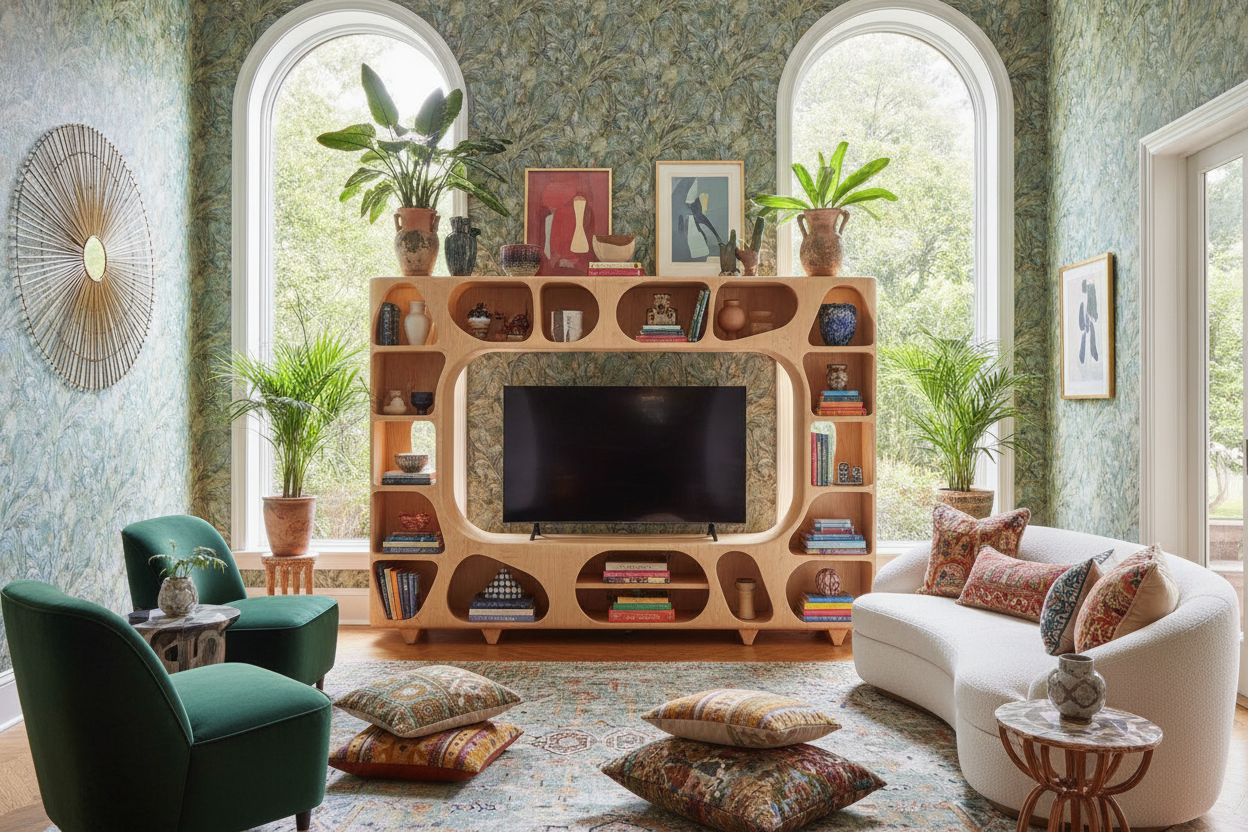
I spent three months hunting for the perfect vintage Kilim rug. I finally found one in a dusty corner of a warehouse, brought it home, and realized my entire living room vibe was being held hostage by a soul-crushing black particleboard box. It’s the curse of the modern living room: we spend thousands on velvet sofas and lighting, then park a 55-inch plastic rectangle on top of something that looks like it belongs in a cubicle. Finding a truly artsy tv stand was the only way to stop my home from feeling like a Best Buy clearance aisle.
Quick Takeaways
- Prioritize texture over flat surfaces—think fluted wood, cane, or carved patterns.
- Asymmetrical silhouettes help break the 'tech' focus of the room.
- Check the depth of sideboards; many work better than actual media consoles.
- If a piece lacks cord holes, a $15 hole saw bit and a power drill can fix it in two minutes.
Why Do We Accept Such Boring Living Room Furniture?
It’s wild how much effort we put into curating a space only to give up at the finish line. Most people spend months testing sofa cushions for the right sink-in-to-bounce ratio, then just grab the first utilitarian unit they see online. The problem is that most traditional Tv Stands are designed for function first and 'soul' never. They are built to hold a heavy box and hide some wires, usually resulting in a sterile, low-profile rectangle that adds zero personality to your home.
I’ve seen too many people ruin a $4,000 living room with a $60 piece of flat-pack garbage. We accept it because we think the TV is the star, so the stand should be invisible. But the TV is a giant black void when it's off; you need something with visual weight and texture to balance that emptiness. A media unit shouldn't just be a shelf; it should be a piece of furniture you’d actually want in the room even if the TV didn't exist.
What Actually Makes a Unique TV Stand Design Work?
An artsy tv stand works because it tricks the eye. Instead of seeing a 'media station,' you see a sculptural element. I look for pieces with fluted wood details or tambour doors. These vertical lines create a rhythm that distracts from the flat, glass surface of the screen above it. Material choice is also huge—mixing metals with warm woods or opting for a white media center wall unit can make the whole setup feel like a gallery pedestal rather than a tech hub.
The goal is to find a unique tv stand design that challenges the 'low and long' standard. Look for hardware that feels intentional—heavy brass pulls or integrated wooden handles. If the piece has legs, make them interesting. Tapered mid-century legs are fine, but chunky plinth bases or architectural steel frames offer much more character. You want amazing tv stands that invite people to run their hands over the wood grain, not just look at the screen.
Choosing Shape Over Raw Storage Space
I’ll be honest: I’ve stopped caring about having twelve drawers for my electronics. Most of us just have a streaming stick and a soundbar now. When you stop obsessing over maximizing storage, you open yourself up to unique media stands with asymmetrical shelving or open-air designs. I’d rather have a beautiful curve or an offset shelf for a piece of pottery than a cavernous cabinet filled with old HDMI cables I’ll never use again. Sometimes, the most unique media center is the one that dares to leave some negative space.
The Logistics of a Unique Media Center (Where Do the Wires Go?)
The biggest fear with 'artsy' furniture is the cable nightmare. Standard units have those ugly punch-out holes, but a vintage sideboard or a custom piece usually has a solid back. Don't let that stop you. I keep a 2-inch hole saw bit in my toolbox specifically for this. If you find a piece you love, just drill your own cord management holes in the back panel. It takes two minutes and stays hidden behind the gear anyway.
If you really hate cables and your unique media center is more of a decorative table, consider a wall mounted media console. By floating the unit, you keep the floor line clean, which is a classic designer trick to make a small room feel twice as big. It also allows you to run the wires through the wall, leaving your sculptural furniture to look like art rather than a workstation.
My Go-To Strategies for Finding Unique TV Stands for Sale
Stop searching specifically for 'TV stands.' That’s how you end up with the boring stuff. Instead, search for 'credenzas,' 'sideboards,' or 'buffets.' These pieces are usually built to a higher standard (think kiln-dried hardwoods instead of MDF) and offer much more interesting silhouettes. I once used a 1920s apothecary chest as a media unit, and it’s still the most-complimented thing in my house.
When looking for unique tv stands for sale, check out local vintage resellers or custom makers on social media. If you prefer buying new but still want that 'designer' edge, look for a stylish black tv stand that uses texture—like reeded glass or matte charcoal oak—to provide depth. Avoid anything with a high-gloss finish; it just reflects the TV glare and looks cheap under living room lights.
Personal Experience: The Height Mistake
I once bought a gorgeous, hand-carved chest to use as a stand. It was 36 inches tall. I thought it looked like a museum piece, but within a week, my neck was killing me. I forgot the golden rule: your eyes should hit the bottom third of the screen when you're sitting down. If you buy an artsy piece that’s too tall, you’ll end up hating it, no matter how pretty it is. Now, I stick to pieces between 18 and 24 inches tall for the best viewing angle.
FAQ
Can I use a dresser as a TV stand?
Yes, but measure the height first. Most dressers are around 30-34 inches, which might be too high for a large TV. Also, make sure the top is deep enough—most modern TVs need at least 14-16 inches of depth for their legs to sit securely.
How do I hide a gaming console in an artsy stand?
Look for units with 'infrared-friendly' glass or slatted wood doors (tambour style). These allow the remote signal to pass through and provide airflow so your console doesn't overheat while you're playing.
Is a floating stand better for small rooms?
Absolutely. Seeing the floor continue all the way to the wall creates an optical illusion of more space. It also makes vacuuming way easier, which is a win in my book.

Laisser un commentaire
Ce site est protégé par hCaptcha, et la Politique de confidentialité et les Conditions de service de hCaptcha s’appliquent.