


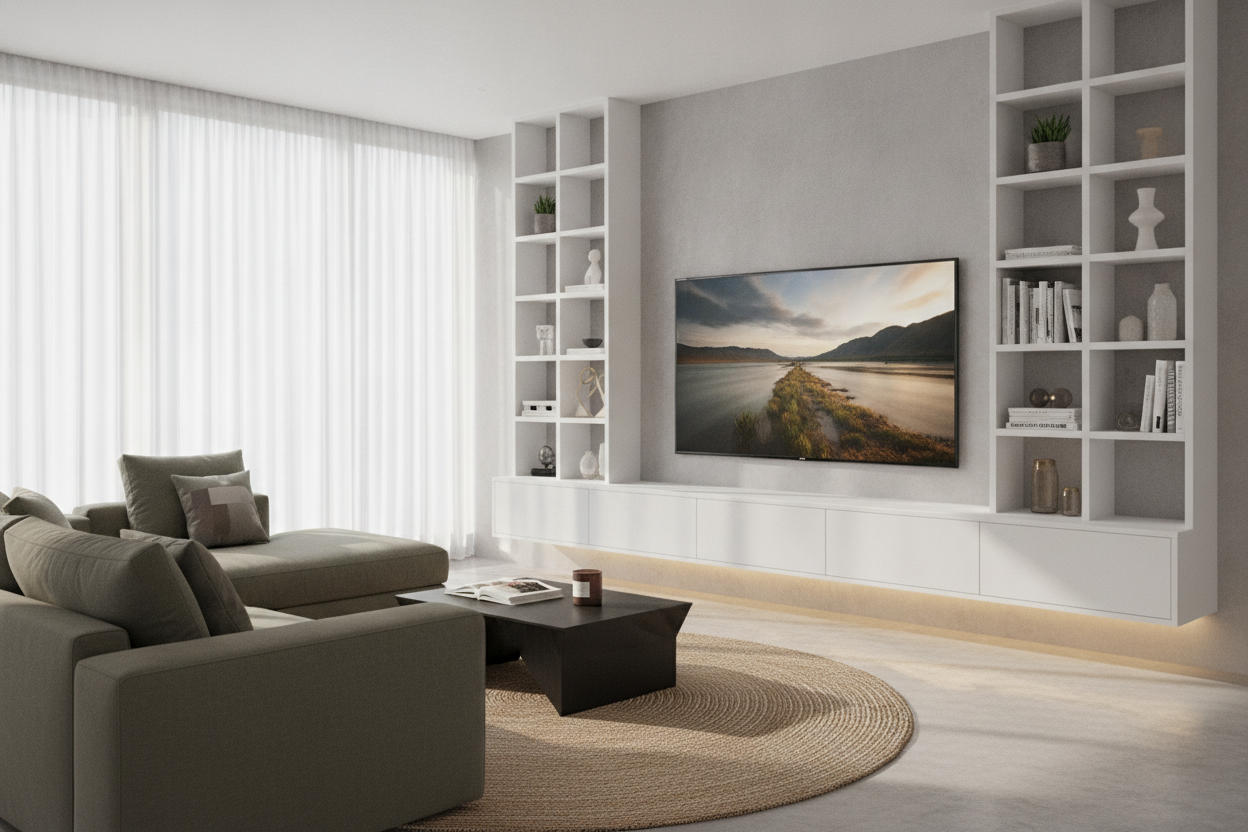
I stood in my new living room staring at a 20-foot expanse of drywall that felt less like a home and more like a high school gymnasium. I’d already tried moving my old media console against it, but the poor thing looked like a postage stamp on a billboard. It was clear that standard modern TV stands weren't going to cut it; I needed something with enough visual weight to actually anchor the room.
That’s when I started obsessing over a 100 inch floating tv stand. I wanted that seamless, floor-to-ceiling architectural look, but I didn't have the five-figure budget for a custom carpenter to spend three weeks sawing MDF in my driveway. I needed a shortcut that looked like a million bucks.
- Scale is King: If your wall is over 15 feet, anything under 80 inches will look like an accident.
- Stud Finder Required: You are hanging a heavy piece of furniture; do not trust drywall anchors with your life or your electronics.
- Dark Paint Magic: Painting the wall the same color as the console creates a 'built-in' shadow effect.
- Wire Management: If you see a single cord, the illusion of luxury is dead.
The Massive Blank Wall Dilemma
There is a specific kind of panic that sets in when you realize your furniture is 'out-scaled' by your architecture. My living room has these soaring ceilings and a wall that just keeps going. Most furniture manufacturers seem to think we all live in tiny studio apartments, offering 'large' units that top out at 60 inches.
On a massive wall, a small stand creates a 'floating island' effect that makes the whole room feel unanchored and cold. It makes the space look like a cavern instead of a home. I spent weeks looking at 47 different browser tabs, trying to find a way to fill the horizontal space without it looking cluttered or cheap.
The Real Cost of Custom Cabinetry (Spoiler: It's Bleak)
I called three local contractors for quotes on custom built-ins. The lowest bid came in at $8,400, and that didn't even include the paint. One guy actually laughed when I asked if he could get it done before the holidays. I love my home, but I don't 'eight thousand dollars for some shelves' love it.
I needed a way to get that high-end, wall-to-wall look without the 'I just bought a used Honda' price tag. That is when I pivoted to the DIY approach: using high-quality ready-to-assemble units to mimic the lines of a custom build.
Enter the 100 Inch Floating TV Stand
The lightbulb moment happened while scrolling through architectural digests. All the high-end homes had these long, low-profile consoles that seemed to grow out of the wall. By choosing a 100 floating tv stand, I realized I could mimic that exact horizontal line for a fraction of the cost.
If you have an even larger space, you might even consider the 110 floating high gloss TV stand. The extra ten inches can be the difference between 'nice furniture' and 'architectural feature.' The goal is to make the stand feel like part of the house, not just something you bought and plopped down.
Finding the Perfect Proportions
Here is a hard truth: your TV stand must be wider than your TV. If you have an 85-inch screen, a floating tv stand 100 inch setup is your absolute baseline. If the stand is the same width as the TV, the whole setup looks top-heavy and precarious. It feels like a giant head on a tiny neck.
I’ve used budget-friendly smaller TV stands in my guest bedrooms where space is tight, but the main living area demands drama. You want at least 6-10 inches of 'breathing room' on either side of the screen to keep the proportions balanced and professional.
How We Pulled Off the 'Built-In' Illusion
The secret isn't just the stand; it's the prep. I painted the entire focal wall a deep, matte charcoal. When I mounted the black 100-inch console, the edges blurred into the wall, making it look like a custom architectural bump-out. It’s a trick I learned from high-end staging: minimize the contrast between the furniture and the wall to create a sense of permanence.
Then came the cable management. A wall mounted media console only looks expensive if it’s clean. I ran all the power and HDMI cables through the wall using a brush-plate kit. If I had left those black cords dangling down, the 'built-in' illusion would have vanished instantly. It took an extra two hours of sweating and fishing wires through insulation, but it was the most important part of the job.
Was Mounting a 100 Floating TV Stand Worth the Sweat?
I’m not going to lie—lifting a 100-inch piece of furniture and trying to level it while my spouse shouted directions was stressful. There was a moment where I thought the whole thing might rip the studs out of the wall because I didn't trust my own measurements. But once it was locked in and the LED under-lighting was turned on, the room finally felt finished. I saved about $7,500 compared to the custom route, and honestly? Nobody can tell the difference.
FAQ
Can one person install a 100-inch stand?
Absolutely not. These units are heavy and awkward. You need at least two people—one to hold and level, one to drive the screws into the studs. Don't risk your wall or your toes trying to be a hero.
Do I really need to find the studs?
Yes. Drywall anchors are great for pictures, but a massive media console filled with electronics will eventually pull through the paper. Use a high-quality stud finder and long lag bolts to hit the center of the wood.
How high should I mount it?
The biggest mistake people make is mounting them too high. Aim for the 'sweet spot' where the center of your TV is at eye level when you are sitting on the sofa. Usually, that means the stand sits about 12-18 inches off the floor.

Laisser un commentaire
Ce site est protégé par hCaptcha, et la Politique de confidentialité et les Conditions de service de hCaptcha s’appliquent.