


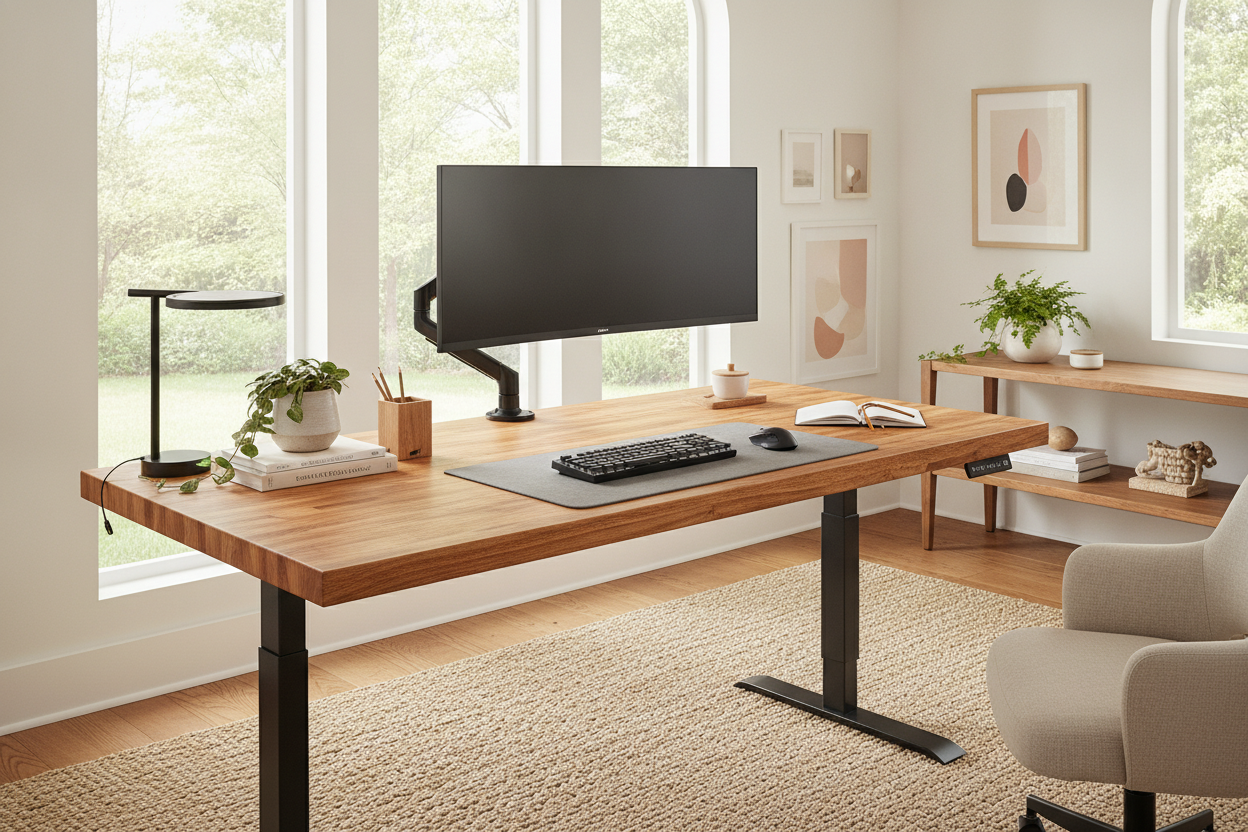
I’ve spent the last decade staring at 47 browser tabs of home office setups at 1 AM, trying to find a desk that doesn't feel like a temporary solution. Most motorized desks arrive in a box that feels suspiciously light, only for you to realize the 'wood' top is actually two pieces of particle board held together by a seam and a prayer. If you want a workspace that feels permanent, heavy, and actually looks like a piece of furniture, you need to buy a height adjustable desk kit and bring your own wood.
Quick Takeaways
- Butcher block is significantly more durable and stable than standard laminate tops.
- A DIY frame kit allows you to choose your exact wood species and finish.
- Dual motors are essential for handling the 80-100 lb weight of a solid wood slab.
- Assembly only requires a power drill, a tape measure, and about 90 minutes.
The Problem With Most Off-the-Shelf Standing Desks
The sit-stand market is flooded with 'affordable' options that look great in filtered Instagram photos but feel like a cubicle from 1998 once they’re in your room. Most of these desks use a laminate top—essentially a thin sticker of wood grain over compressed sawdust. They’re prone to peeling at the edges, they wobble when you type, and they usually come in two pieces to save on shipping costs. That seam in the middle of your desk? It’s a crumb magnet and a constant reminder that you settled for a mass-produced compromise.
If you were shopping for a standard, static writing computer desk, you’d have endless options for solid oak, walnut, or reclaimed pine. But for some reason, as soon as you add a motor to the mix, manufacturers assume you’ve lost your taste for real materials. They sell you on the 'tech' while skimping on the actual surface where you spend eight hours a day. By separating the frame from the top, you stop paying for a mediocre surface and start investing in a frame that can actually support the weight of real timber.
I’ve tested the $300 all-in-one specials. They’re fine if you’re just checking emails on a MacBook Air. But if you have dual monitors, a heavy desktop PC, or you just like to lean on your desk while you think, those cheap frames will groan. The motors start to whine, the legs get jerky, and eventually, the whole thing feels like it's going to tip. It’s a frustrating cycle of buying, realizing it’s flimsy, and wishing you’d just built it right the first time.
What Exactly is a Sit Stand Desk Kit?
A sit stand desk kit is the mechanical skeleton of your workspace. When you buy a kit, you aren't getting a finished product; you're getting the heavy-duty components that do the literal heavy lifting. It typically includes two or three-stage telescoping legs, a crossbar that connects them, a control box (the 'brain'), and a handset to adjust the height. These kits are designed to be modular. Because the crossbar is usually adjustable in width, you can mount a top that is 48 inches wide or 80 inches wide on the exact same frame.
The real magic is in the dual-motor system. Cheap desks often use a single motor and a hex rod to turn the other leg, which is a recipe for uneven lifting and mechanical failure. A high-quality kit puts a dedicated motor in each leg. This ensures that even if your butcher block is slightly heavier on one side—maybe because of a monitor arm—the desk rises perfectly level every single time. You’re buying the industrial-grade internals without the markup of a low-quality desktop included.
My Butcher Block Build: Choosing the Right Slab
For my latest build, I went with a 60-inch birch butcher block from a local hardware store. You have three main paths here: the hardware store (Home Depot or Lowe’s), IKEA, or a local lumber yard. If you go the IKEA route, be careful—the popular Karlby is actually a veneer over particle board. It looks great, but it’s not 'real' wood. If you want something you can sand down and refinish for the next twenty years, you want a solid slab of birch, acacia, or walnut.
Standard butcher blocks usually come in 1.5-inch or 1.75-inch thicknesses. This is the sweet spot. It’s thick enough to feel like a tank, but not so heavy that it exceeds the 250-350 lb weight limit of a good frame. Before you even look at the frame, you need to prep the wood. I spent a Saturday sanding my birch block from 80 grit up to 220 grit. It’s boring work, but it’s the difference between a desk that feels like a workshop bench and one that feels like a premium piece of furniture.
For the finish, skip the cheap hardware store stains. I used a hard-wax oil (Rubio Monocoat is my go-to). It’s a single-coat process that bonds with the wood fibers rather than sitting on top like a plastic film. It smells like honey, it’s non-toxic, and if you scratch the desk later, you can just rub a little more oil on the spot to fix it. Measure your room twice—nothing kills the vibe of a home office like an 80-inch desk that prevents the door from opening all the way.
Don't Ruin Your Wood: Specs to Check Before Buying the Frame
This is where most DIYers mess up. You cannot put a 100-pound piece of solid walnut on a frame designed for a 30-pound laminate top. Before you buy, you need to check the weight capacity. A solid acacia block that is 72 inches long weighs about 110 lbs. Once you add two 27-inch monitors, a mounting arm, a laptop dock, and maybe some studio speakers, you’re pushing 160-180 lbs. If you buy an underpowered frame, the motors will burn out in six months.
I always recommend looking at a Vari Sit-Stand Desk vs. a Budget Standing Motorized Desk comparison to see how motor quality impacts long-term performance. A budget frame might claim a 200 lb limit, but it will wobble like a leaf at standing height. You want a frame with 'T-style' or 'C-style' legs made of heavy-gauge steel. If the frame itself weighs less than 60 lbs, it’s probably not going to be stable enough for a heavy wood top.
Another critical factor is the width of the frame’s 'shoulders.' The brackets that screw into the wood need to support enough of the depth so the wood doesn't cup or warp over time. If your butcher block is 30 inches deep, make sure the frame brackets are at least 20-24 inches deep. Also, consider your storage. Before you drill a single hole, check the 3 Things to Check Before Buying a Sit Stand Desk With File Cabinet. You need to ensure the crossbar of the frame doesn't sit so low that you can't fit a standard rolling cabinet underneath. I once mounted a frame too far forward and realized I couldn't sit comfortably because my knees kept hitting the motor housing.
The Assembly Reality: Is It Actually Hard to Build?
People get intimidated by the idea of 'building' a desk, but if you can use a tape measure and a power drill, you’re qualified. The process is straightforward: flip your finished wood slab upside down on a carpeted floor, center the frame, and mark your holes. For a reliable foundation, I suggest using something like the Ergonomic Home Office Sit Stand Up Desk With Memory Preset Controller. It’s one of the few kits that feels intuitive to put together and doesn't require a degree in mechanical engineering.
The biggest mistake you can make is skipping the pilot holes. Butcher block is dense. If you try to drive a screw directly into solid oak or birch without a pre-drilled hole, you will either snap the screw head off or crack the wood. Use a drill bit that is slightly smaller than the screw, and wrap a piece of painter's tape around the bit to act as a depth gauge so you don't accidentally drill through the top of your beautiful new desk.
Once the frame is on, cable management is your final boss. Since you have a solid wood top, you can screw cable trays and power strips directly into the underside. This is the 'pro' move that makes DIY desks look so much cleaner than store-bought ones. When you finally flip it over and hit that 'up' button, the silence and smoothness of a high-quality motor lifting a heavy slab of real wood is incredibly satisfying. It’s a desk that doesn't just hold your computer; it anchors the entire room.
FAQ
Can I use any piece of wood for this?
Technically, yes, but avoid hollow-core doors or thin plywood. You want something at least 1 inch thick so the screws have enough 'meat' to grab onto without poking through the top. Solid wood or high-quality plywood are your best bets.
How do I know if the frame is centered?
Measure from the edge of the frame to the edge of the wood on all four sides. Don't eyeball it. If it’s off by even half an inch, the weight distribution will be weird and it might cause the motors to work harder than they need to.
Do I need to oil the wood forever?
If you use a hard-wax oil like Rubio or a polyurethane sealer, no. If you use a basic 'butcher block oil' (mineral oil), you'll need to reapply it every few months to keep the wood from drying out. For an office desk, I always recommend a permanent sealer like poly or hard-wax oil.


Laisser un commentaire
Ce site est protégé par hCaptcha, et la Politique de confidentialité et les Conditions de service de hCaptcha s’appliquent.