


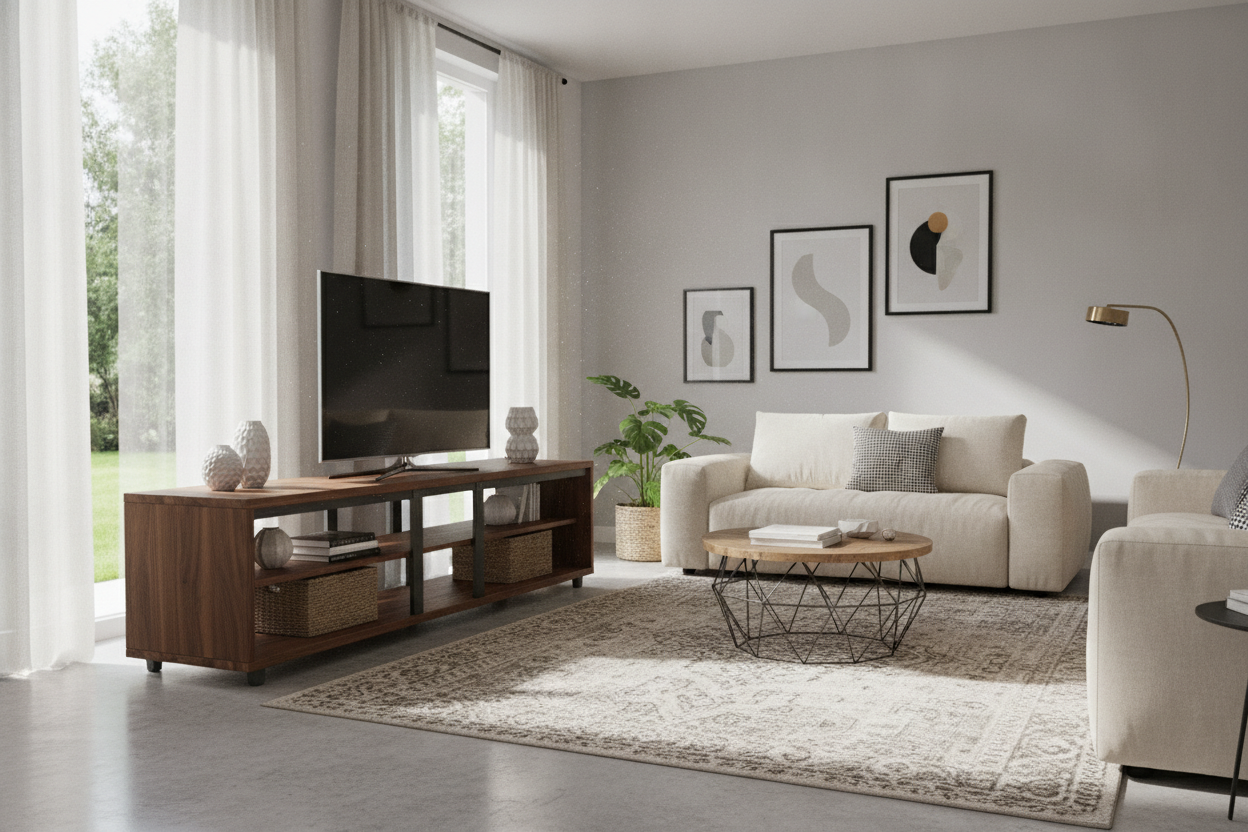
I’ve spent too many late nights scrolling through 47 browser tabs of media consoles. You see a amazon 60 inch tv stand that looks stunning in a staged photo, but I know the reality. Three months after assembly, that sleek top panel starts to bow under the weight of your 65-inch screen, and suddenly your living room looks like a DIY disaster.
I’ve assembled and eventually trashed more flat-pack furniture than I care to admit. Buying a 60 inch tv stand amazon offers means dodging the 'disposable furniture' trap. You need to know which specs are real and which are just marketing fluff before you pull the trigger.
- Center Support: Never buy a 60-inch unit without at least one middle leg.
- Material Density: Avoid 'hollow-core' boards; look for high-density MDF or solid wood.
- Hardware: Cam-locks should be metal, not plastic.
- Depth: Ensure the stand is at least 2 inches deeper than your TV's base for stability.
The Particleboard Problem (Why Big Consoles Always Bow)
Most budget-friendly consoles are made of 'engineered wood,' which is a fancy way of saying wood chips and glue. The problem isn't the material itself, but how it's used. A 60-inch span is a long way for compressed wood chips to travel without support. If the manufacturer used 'hollow-core' construction—basically a paper honeycomb sandwiched between thin veneers—it will sag within six months.
You can sometimes survive your 55 inch tv stand amazon search with lighter materials because the span is shorter and the weight is lower. But once you hit that 60-inch mark, physics stops being your friend. You need a top panel that is at least 1 inch thick and made of high-density furniture board. If the listing doesn't specify the thickness, they’re usually hiding something flimsy.
3 Non-Negotiables When Scrolling Amazon 60 Inch TV Stand Listings
Don't just trust the pretty renders. You have to be a detective in the review section and the product diagrams. Here are the three things I check before I even think about hitting 'Add to Cart.'
1. The Mandatory Hidden Center Leg
A 60-inch console supported only by four legs at the corners is a recipe for a 'frowny-face' TV stand. Gravity is relentless. You need a fifth leg—or better yet, a sixth—hidden under the center of the unit. This transfers the weight of the TV directly to the floor instead of forcing the bottom shelf to carry the entire load.
Pro tip: Check the customer photos in the reviews. Sometimes the 'center leg' in the product photo is actually an inch off the ground because of poor manufacturing tolerances. If it isn't touching the floor, it isn't doing its job. I once had to shim a center leg with three quarters and a piece of cardboard just to stop a wobble.
2. Decoding the 'Weight Capacity' Lie
When a listing says it holds 150 pounds, they usually mean 'evenly distributed' weight. Your TV doesn't distribute weight evenly. It sits on a pedestal or two small feet. If you have a 60-pound TV with a center pedestal, all 60 pounds are pressing on one tiny square foot of the top panel.
If the top panel is hollow, it will crunch or warp. I always look for a weight capacity that is at least double what my TV actually weighs. It gives you a safety buffer for when you inevitably add a heavy soundbar or a collection of heavy coffee table books.
3. Cord Management That Doesn't Look Like an Afterthought
There is nothing worse than a beautiful wood-look console with a messy bird's nest of black cables hanging out the back. Cheap units just drill a raw, jagged hole in a piece of cardboard backing. It looks terrible and the rough edges can actually fray your cables over time.
Look for units that feature plastic or metal grommets to finish the holes. Even better? Look for routed channels or management systems that let you hide the power bricks for gaming consoles. If the back panel is just a thin sheet of folded cardboard held on by tiny nails, it’s a sign the rest of the build quality is lacking too.
When to Ditch the Two-Day Shipping for Real Wood
I get the appeal of the two-day shipping and the low price point. But if you’ve moved three times in three years and your furniture looks like it’s been through a war, it’s time to stop the cycle. Particleboard doesn't handle being taken apart and put back together. The screw holes strip, the finish peels, and the whole thing gets 'the leans.'
I finally hit my breaking point after a move where my budget stand literally crumbled in the truck. Honestly, my TV looked ridiculous until I got a 60 inch oak TV stand that actually had some heft to it. It didn't just hold the TV; it made the whole room feel anchored. If you can swing the extra cost, it's worth it to browse higher-quality TV stands made from kiln-dried wood or heavy-duty metal frames. You'll spend more upfront, but you won't be buying a replacement in 2026.
FAQ
Will a 60-inch TV fit on a 60-inch stand?
Technically yes, but it looks cramped. TV screen sizes are diagonal, while stands are measured width-wise. A 60-inch TV is usually about 53 inches wide, leaving you only a few inches of clearance on each side. I prefer a stand that is at least 6 inches wider than the TV for better visual balance.
How do I stop my TV stand from wobbling?
Check the level of your floor first—old houses are notorious for being slanted. Most decent Amazon stands have adjustable feet. If yours doesn't, use felt pads or plastic shims. Also, tighten those cam-locks every few months; they loosen with the vibrations of your soundbar.
Is MDF better than particleboard?
Yes. MDF (Medium Density Fiberboard) is much denser and smoother than standard particleboard. It holds screws better and is less likely to chip or sag. If you're going the manufactured wood route, MDF is the standard you should aim for.


Laisser un commentaire
Ce site est protégé par hCaptcha, et la Politique de confidentialité et les Conditions de service de hCaptcha s’appliquent.