
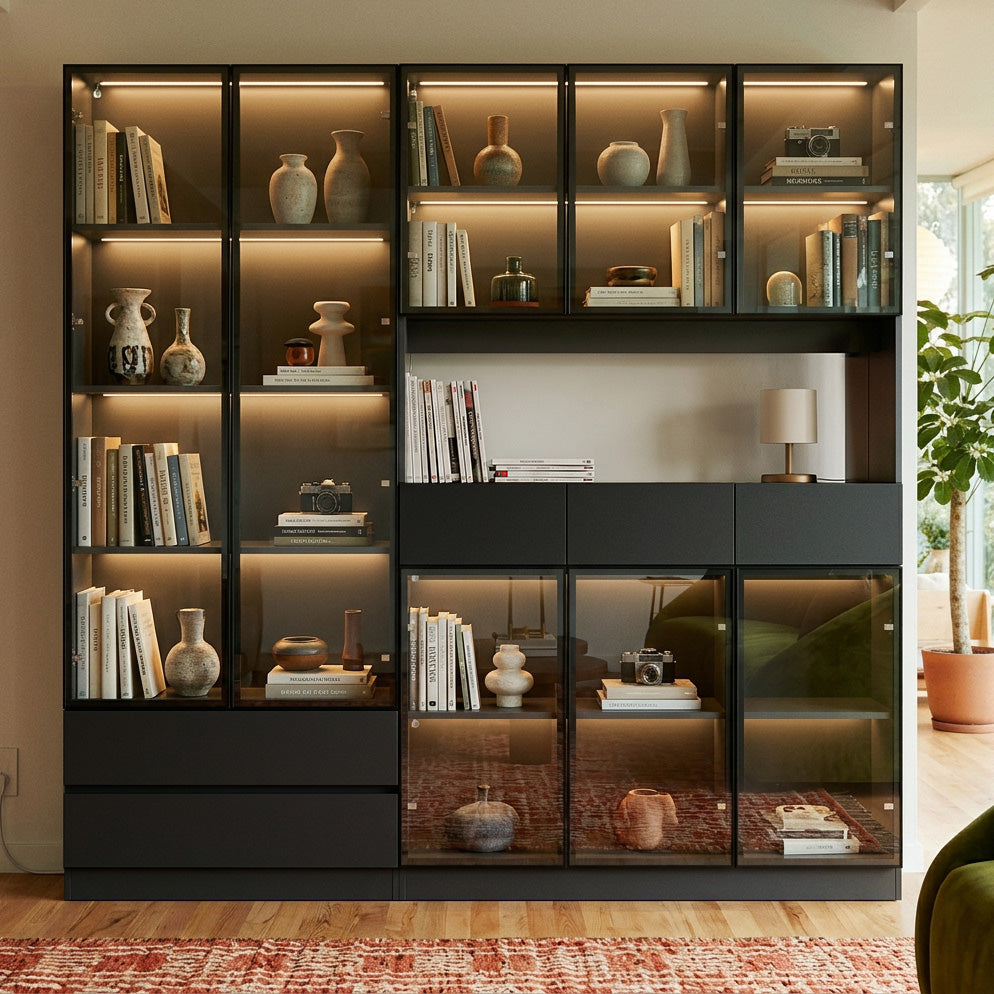
To arrange a display cabinet, start with an empty, clean cabinet, set the shelf heights around your tallest pieces, and put the largest and heaviest items on the lower shelves. Then place one focal point per shelf at eye level, group smaller items in odd numbers at varying heights, layer from back to front, and leave some empty space so each piece can be seen. Finish by adjusting the lighting and stepping back to edit.
The steps below work for glass display cabinets, curios, china cabinets and display bookcases alike, whether you want to style fine china, figurines, trophies or a mix of books and decor. If you're still choosing a cabinet, browse our bookcases and display cabinets collection for sizes and shelf layouts.
1. Start With a Clean, Empty Cabinet
Take everything out. Wipe the glass, shelves and back panel, and check that doors and lights work. Lay all the items you want to display on a table so you can see the whole collection at once. A helpful trick: mark the shelf width and depth on the table with masking tape, then arrange each shelf inside the tape outline before moving it into the cabinet.
Write down the inside measurements of each shelf. For example, the shelf openings in the Varda 79" bookcase with 3-color lights measure 15" H x 31.5" W x 14" D, and the Vila 31.5" display cabinet has 15" H x 31" W x 15" D shelves. Knowing the exact space keeps you from overfilling.
2. Decide on a Theme or Color Palette
A display cabinet looks calm when the objects inside share something: a color, a material, a period, or a story. Limiting the palette to two or three colors creates visual harmony even when the objects are different shapes. Sort items into groups such as white ceramics, glassware, travel keepsakes or family heirlooms, and give each group its own shelf or section. Grouping similar items creates a sense of order and makes the whole display more visually appealing. Match the style to the room, too: modern rooms suit fewer, bolder pieces, while traditional rooms suit layered collections.
3. Set Shelf Heights and Respect Weight Limits
Adjust shelves before you place anything. Leave about 2–3 inches of clear space above the tallest item on each shelf so it is easy to lift in and out and the shelf doesn't look cramped.
| What you're displaying | Suggested clear shelf height | Best shelf type |
|---|---|---|
| Small figurines, cups, crystal | 8–11" | Glass (light loads) |
| Stemware and standard books | 11–13" | Glass or wood |
| Plates on stands, tall vases, trophies | 14–16" | Wood |
| Large serving pieces, art books, pottery | 16"+ or bottom shelf | Wood, lowest level |
Check the shelf rating too. Many glass shelves in lighted display cabinets carry around 11 lb, while most wood shelves in our range carry 20–33 lb. Heavy pieces belong on lower shelves, which also keeps the center of gravity low; CPSC tip-over guidance gives the same advice to keep heavier items on lower shelves.
4. Place Focal Points First
Choose one standout object for each shelf, such as a large bowl, a trophy or a framed photo, and place it before anything else. The middle shelves, roughly at eye level, are the prime display areas and should hold the pieces that capture attention. Put larger items on lower shelves to create a stable visual foundation, and keep the top shelf lighter so the cabinet doesn't look top-heavy. If your cabinet has closed storage below, use it for items you don't want on display so the glass section stays uncluttered.
5. Group Items in Odd Numbers and Vary Heights
Groups of three or five tend to look more natural than pairs, which is why odd numbers come up in almost every styling guide. Arrange each group in a loose triangle: taller ones at the back or side, shorter ones in front. Avoid lining up objects of the same height in a row; mixing different heights prevents a flat appearance. Asymmetrical arrangements often look more relaxed than perfectly mirrored ones, but keep the overall weight balanced across the shelf.
Use risers and stands
Plate stands, small boxes or a short stack of books can lift smaller items so they aren't hidden. With 14–16" of shelf depth, you can comfortably layer two rows: taller items at the back, smaller items in front.

6. Layer Textures and Use Contrast
Mixing textures like wood, ceramic, metal and glass adds dimension. Contrast also helps: white porcelain stands out against a dark background, while dark pottery looks sharper in a white cabinet. A mirrored back reflects light and makes a small collection look fuller, which is why many curio cabinets use one. The 18.1" black display cabinet with a mirrored back is a good example. If a plain back panel blends into the walls, a painted board or removable wallpaper behind the shelves can create contrast and make the items inside more visible. If you have open shelves alongside glass, display books upright in some sections and stacked horizontally in others for visual interest.
7. Use Lighting to Highlight, Not Flood
In a glass display cabinet, lighting from above minimizes shadows and makes glass and crystal sparkle. If your cabinet has glass shelves, top lighting will carry down through several levels; with wood shelves, each level needs its own light. Warm white suits wood, ceramics and books; cooler white makes crystal, silver and modern pieces look crisp. Cabinets with 3-color or multi-color LEDs, like the 15.7" black display cabinet with 3-color adjustable lights, let you test both. For more on choosing fixtures, see our article on LED strip lighting versus puck lights.
Keep the cabinet away from a sunny window and out of direct sunlight. The Library of Congress notes that light damage is cumulative, causing fading and yellowing over time, so turn display lights off when you aren't in the room and rotate fragile paper or textile items.
8. Leave Negative Space and Edit
A cluttered cabinet makes it hard to see anything. A useful rule is to fill about two-thirds of the shelf space and leave the rest empty so the eye can rest. Step back across the room, take a photo, and look for gaps or crowded spots. Remove one item from any shelf that feels busy. Then rotate pieces seasonally, which keeps the display fresh and gives you a reason to dust.
Display Case Ideas by Collection Type
| Collection | How to arrange it |
|---|---|
| Fine china and plates | Stand plates upright on stands at the back, stack bowls in front, and put serving pieces on the bottom shelf |
| Glassware and crystal | Group by shape, keep the same height on one shelf, and light from above; glass shelves work well |
| Figurines and models | Use risers for depth, group by theme or scale, and keep them at eye level |
| Trophies and memorabilia | Tallest piece in the center, smaller awards on each side, and frames or medals behind |
| Books and decor | Alternate upright and stacked books, with one object on top of each stack |
| Travel keepsakes | Group by trip or color, and add a small framed photo for context |
Not sure whether your piece is a curio, china or display cabinet? Our comparison of curio cabinet vs china cabinet explains how each is meant to be used.
Keep the Display Safe
Before you fill a tall display cabinet, anchor it. A loaded cabinet with glass doors is heavy at the top, and the restraint kit included with most FUFU&GAGA cabinets only works once it's installed. Follow our step-by-step guide on how to anchor a bookcase to the wall, and see AnchorIt.gov for CPSC's safety tips. In a hallway or other tight spot, choose a slim display case and leave enough room in front of it for easy access, so doors can open fully without bumping furniture.
Looking for a cabinet that makes arranging easier? Adjustable shelves, built-in LED lighting and glass doors are standard across many pieces in our display bookcase and glass display cabinet collection, including the 47.2" white display cabinet with LED lighting, whose wood shelves are rated at 55 lb each.
FAQ
What is the 3-5-7 rule in decorating?
It means grouping decorative objects in odd numbers, usually three, five or seven, because odd groupings look more natural and lead the eye around the arrangement. In a display cabinet, groups of three are the easiest to balance on one shelf.
How do I make a display cabinet look good?
Stick to a theme or limited color palette, give each shelf one focal point, vary heights, layer items from back to front, and leave empty space. Good lighting from above and a clean glass front make the biggest difference.
Should a display cabinet be completely full?
No. Filling about two-thirds of each shelf usually looks better than packing it. Negative space lets individual pieces stand out and makes the cabinet easier to clean.
Where should heavy items go in a display cabinet?
On the lowest shelves and toward the back. This keeps the cabinet stable, protects glass shelves from overloading, and gives the arrangement a solid visual base.


Laisser un commentaire
Ce site est protégé par hCaptcha, et la Politique de confidentialité et les Conditions de service de hCaptcha s’appliquent.