


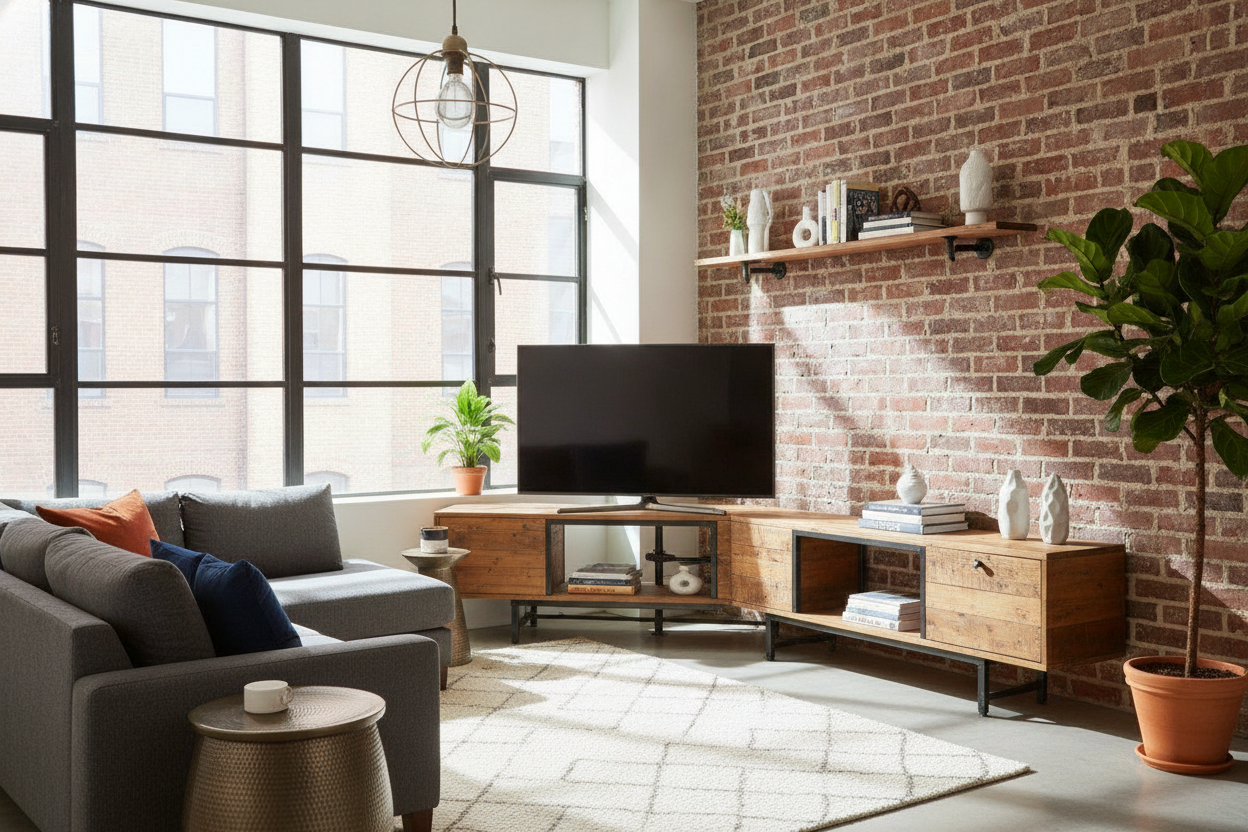
I spent three weeks staring at my living room floor plan like it was a logic puzzle I was failing. Between the radiator, the balcony door, and the hallway entrance, there wasn't a single wall long enough for a standard media console without someone tripping over a cord or losing a shin to a sharp corner. My apartment was a classic 'too many doors' nightmare where furniture placement goes to die.
That is when I stopped trying to fight the architecture and looked at the one dead corner I had ignored. Tucking an industrial corner tv stand into that 90-degree angle didn't just solve the layout; it actually made the room feel like a home instead of a high-traffic waiting area. It turns out, when you stop trying to force a rectangular peg into a circular room, things finally start to click.
- Corner units reclaim about 4-6 square feet of dead floor space in small rooms.
- The industrial aesthetic uses open metal frames that prevent the corner from looking 'heavy' or claustrophobic.
- Measure your TV's total width, not just the diagonal screen size, to avoid an awkward overhang.
- Check your baseboard depth before buying to ensure the unit actually sits flush against the wall.
The Nightmare of the 'Too Many Doors' Living Room
My apartment is one of those charming pre-war builds where the architect apparently hated walls. Every time I tried to place a standard 60-inch console, it either blocked the path to the kitchen or made it impossible to open the closet door more than halfway. I tried the 'floating' look, I tried the 'TV on a dresser' look, and I even considered just mounting it to the ceiling like a sports bar. Everything felt cluttered and forced.
The problem with standard flat-wall consoles in a small, doorway-heavy room is the 'flow-killer' effect. They jut out 18 to 20 inches from the wall, narrowing your walking paths and making the whole space feel like an obstacle course. When your living room is also your hallway, every inch of floor space is precious. I realized I needed a solution that utilized the one area no one ever walks through: the corner.
By shifting the focal point to the corner, I suddenly had a clear, straight path from the front door to the kitchen. The room felt four feet wider instantly. It wasn't just about the TV; it was about reclaiming the 'energy' of the room. Instead of everything being pushed against the long walls, the room opened up, allowing the natural light from my single window to actually reach the dark corners.
Why Go Industrial in a Tight Space?
When most people think of corner furniture, they picture those bulky, dated oak cabinets from the 90s that look like they belong in a basement. But the industrial look—black powder-coated steel paired with reclaimed-style wood—is a secret weapon for small apartments. Because industrial units often feature open shelving instead of solid doors, they don't 'eat' the light in the room.
I chose a unit with a matte black metal frame and a darker walnut-toned top. The thin legs allow you to see the floor underneath, which is a classic designer trick to make a small room feel larger. If I had gone with a solid white or black painted MDF block, that corner would have felt like a heavy monolith. Instead, the metal mesh shelves keep things airy. You can style it without looking cold by stacking a few oversized art books or a trailing Pothos plant on the lower levels to soften the hard edges of the steel.
The durability is also a major plus. I’ve owned enough 'paper-wrapped' particle board furniture to know that the edges peel the moment you look at them wrong. Real industrial-style pieces usually use a higher-grade laminate or actual solid wood planks that can handle the heat from a console or the weight of a heavy 55-inch screen without bowing in the middle after six months.
Finding the Right Fit (Without Blocking the Windows)
Shopping for a corner unit is trickier than a standard one because you aren't just measuring width; you’re measuring depth and 'wing' span. I learned the hard way that a stand labeled for a 50-inch TV doesn't always fit a 50-inch TV if the screen has wide-set feet. You need to measure the footprint of your TV's base specifically. If your TV has a center pedestal, you're golden. If it has 'duck feet' on the ends, they might hang off the tapered edges of the stand.
Another pro tip: check your baseboards. My apartment has those chunky, 5-inch tall historic baseboards. If the TV stand doesn't have a slight 'overhang' on the back or adjustable feet, it won't sit flush against the wall, leaving a weird 2-inch gap where your phone or remote will inevitably disappear forever. I specifically looked for corner adapted storage options that accounted for this, ensuring the back of the unit was cut at a true 90-degree angle with enough clearance for the trim.
Don't forget about height. Because the unit is tucked in a corner, it might be closer to a window than a central unit would be. I made sure my stand was low-profile—about 22 inches high—so the top of the TV didn't clip the bottom of my curtain rod. It sounds like a small detail, but when a TV blocks even two inches of a window, the whole room feels cramped again.
What About the Fireplace Dilemma?
I’ll admit, I spent a late night with a glass of wine almost clicking 'buy' on a version that had a built-in electric fireplace. My apartment is drafty, and the idea of a glowy corner was incredibly tempting. An industrial fireplace TV stand can actually look quite sophisticated if you find one with a realistic 'log' and a matte finish rather than something that looks like a cheap space heater from a big-box store.
Ultimately, I decided against it because I needed the extra shelf space for my record player and a basket of controllers, but if you don't have a ton of tech, the fireplace route is a great way to make a 'dead' corner the coziest spot in the house. Just make sure the unit has a dedicated cord management hole; you don't want a messy tangle of black wires ruining the vibe of your 'flickering fire.'
Opening Up the Center of the Room
Once the TV was tucked away, the 'dead zone' in the middle of my living room vanished. I was able to swap my tiny, useless side table for a real, substantial coffee table because I no longer needed a wide-open 'lane' for walking past the TV. The whole seating arrangement shifted from a rigid line to a cozy L-shape that actually invites conversation.
Moving the TV to the corner also stopped it from being the 'altar' of the room. It’s there when I want to watch a movie, but it doesn't dominate the entire visual landscape the moment you walk in. While I might eventually move to a place with massive blank walls and want to browse full size TV stands again, for this specific, awkward apartment, the corner unit was the only logical choice. It’s proof that sometimes, the best way to move forward is to literally back yourself into a corner.
FAQ
Will a 55-inch TV fit on a corner stand?
Usually, yes, but check the 'width' of the stand versus the actual width of the TV. A 55-inch TV is typically about 48 inches wide. If the stand is only 42 inches wide, the edges of the TV will hang over the sides, which can look a bit top-heavy and leave the screen vulnerable to being bumped.
How do I hide cables on an industrial stand with open shelves?
Use black Velcro cable ties to strap the cords to the metal legs of the stand. Since most industrial frames are black, the cords blend right in. You can also use a small decorative basket on the bottom shelf to house your router and power strip.
Are corner TV stands stable?
Yes, but because they have a smaller footprint, they can be more prone to tipping if you have kids or pets. Always use the included wall-anchor kit. Because it's in a corner, anchoring it is actually easier and more discreet than on a flat wall.

Laisser un commentaire
Ce site est protégé par hCaptcha, et la Politique de confidentialité et les Conditions de service de hCaptcha s’appliquent.