


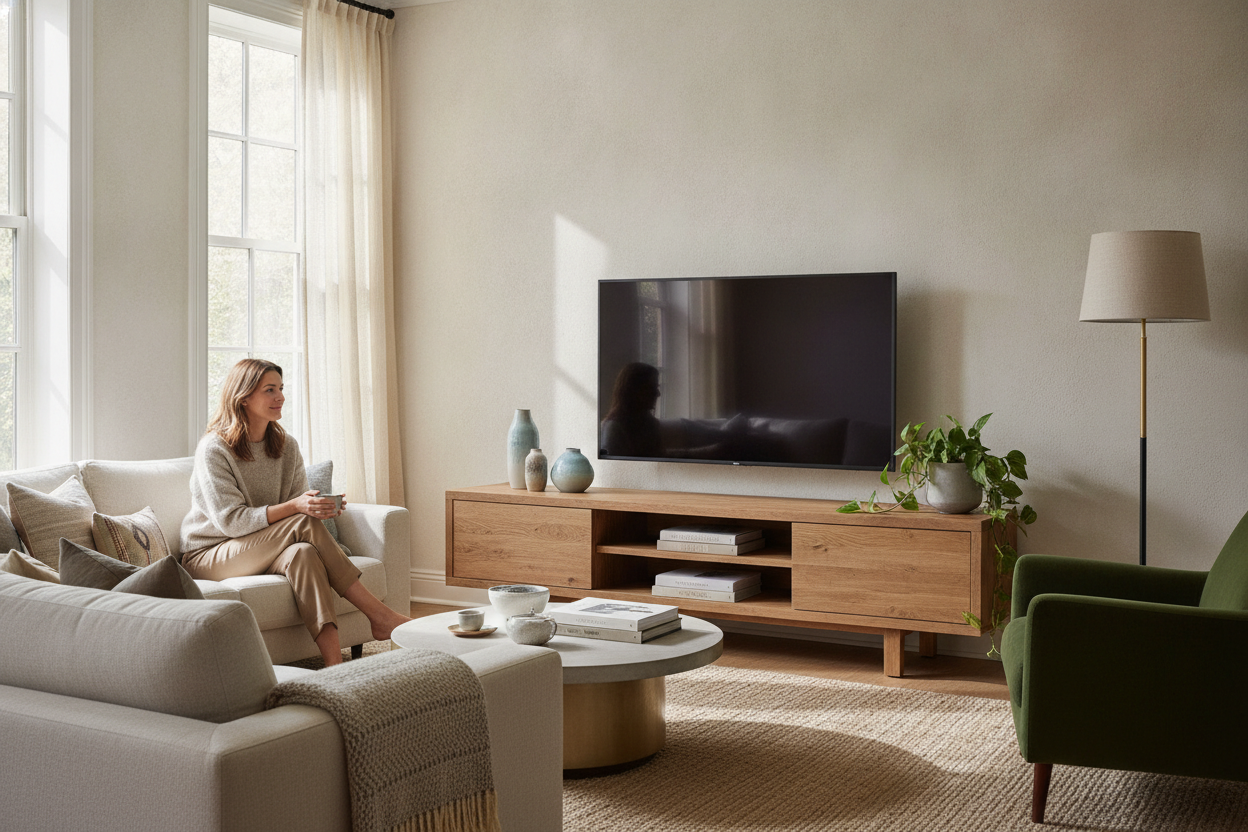
I stared at my living room setup for twenty minutes before realizing the screen wasn't crooked—the furniture was. My $90 'deal' from a major online retailer had developed a noticeable one-inch sag in the center. My 65-inch TV was basically performing a slow-motion trust fall into a pile of sawdust and laminate.
I’d spent years in a cycle of buying flat-pack furniture, struggling with hex keys for three hours, and then throwing the whole thing in a dumpster two years later when I moved. But staring at that 'middle dip' was the breaking point. I decided to actually leave my house and look for a homemakers tv stand that didn't feel like it was made of hardened crackers.
Quick Takeaways
- Particle board has a weight limit; solid construction doesn't 'smile' under your screen.
- Physical showrooms let you test drawer glides and door hinges before you commit.
- Real cable management is built into the frame, not punched out of a cardboard backing.
- Buying quality once is significantly cheaper than buying 'cheap' three times.
The Sagging Particle Board Breaking Point
We’ve all been there. You see a sleek, minimalist console online for a price that seems too good to be true. You ignore the reviews mentioning 'flimsy' and 'wobbly' because the photos look like a million bucks. Six months later, the doors don't close right because the frame has warped under the weight of your soundbar and TV.
Most budget furniture is made of low-density fiberboard. It’s essentially glue and wood chips. While it’s fine for a decorative shelf, it’s a disaster for media centers. A 75-inch TV can weigh anywhere from 60 to 90 pounds. Add in a receiver, a gaming console, and some decor, and you’re asking a lot from a piece of furniture held together by cam locks and hope.
My old stand reached its limit when I noticed the sliding doors were jumping their tracks. The top board had bowed so much that the gap for the doors had shrunk. I was done with the 'fast furniture' cycle. I wanted something with a kiln-dried frame and actual structural integrity.
Braving the Massive Homemakers TV Stand Section
Walking into a massive showroom is a completely different vibe than scrolling through 47 browser tabs at 1 AM. It’s overwhelming, sure, but you can’t 'stress test' a thumbnail image. When I started browsing the massive selection of Tv Stands, I wasn't just looking at colors. I was shaking the displays.
If I can make a console wobble with one hand, it’s not coming home with me. I spent a good hour opening and closing every cabinet door I could find. You can feel the difference in a soft-close hinge versus a cheap metal bracket that’s going to squeak within a month. There’s a tactile satisfaction in feeling the weight of a solid wood door.
I also realized that scale is impossible to judge on a phone screen. A stand might look huge in a staged photo but end up looking like a toy in your actual living room. Seeing these pieces next to actual TVs—not just Photoshop renders—saved me from making a massive sizing mistake. I almost bought a 50-inch stand for a 65-inch TV, which would have looked ridiculous.
Three Details That Make a 'Real' Console Stand Out
When you move away from the 'flat-pack' world, you start noticing the details that justify a higher price tag. First: the hardware. Cheap furniture uses plastic handles and thin metal tracks. Quality pieces use heavy-duty steel or brass. If the handle feels cold and heavy, it’s usually a good sign of what’s inside.
Second, look at the joinery. Are the drawers dovetailed, or are they just stapled together? Dovetail joints are the gold standard for a reason—they don't pull apart after a year of use. I particularly liked the look of the 66 W Tv Stand Storage Credenza With Sliding Glass Doors because it used glass to keep the dust off my electronics while still letting the remote signals through.
Third, check the weight capacity. A high-quality stand will often be rated for 150 pounds or more. This isn't just about the TV; it’s about the longevity of the piece. A stand built to hold twice what you need will never sag, never warp, and will survive being moved to a new apartment without falling apart in the U-Haul.
Wait, What About Cable Management?
The biggest lie in budget furniture is the 'cable management' hole. Usually, it's a single, jagged circle punched into a piece of cardboard that’s taped to the back. It’s ugly, and it never fits more than two plugs. If you have a PS5, a Nintendo Switch, and a soundbar, that cardboard back is going to look like a rat's nest in ten minutes.
Better furniture treats tech like an integrated part of the design. Look for pieces like the Mid Century Modern Tv Stand With Slatted Doors Open Shelves And Cable Management. The slatted doors aren't just for that '70s aesthetic—they allow for airflow so your console doesn't overheat. Plus, the cable routing is usually built into the wood frame itself, with multiple exit points for different shelves.
I’ve learned the hard way that if you don't have enough ventilation, your gaming console will sound like a jet engine taking off. High-end furniture designers actually think about heat dissipation. It’s the difference between a piece of furniture that just holds stuff and a piece that actually works with your lifestyle.
Was Ditching the Online Cart Actually Worth It?
Yes. A thousand times, yes. I ended up paying about $200 more than I would have for a budget online option, but the difference in my living room is night and day. There’s no wobble. No sag. The finish doesn't peel off if I spill a drop of water on it. It feels like a 'grown-up' piece of furniture that I’ll still have ten years from now.
Sure, you have to deal with delivery or hauling a heavy box yourself, but that’s a one-time inconvenience for a decade of stability. If you're still on the fence about what size or style you need, I’d suggest reading up on Choosing The Perfect Tv Stand For Style And Function before you pull the trigger. It helped me realize I needed more depth for my receiver than I originally thought.
Stop wasting money on furniture that has an expiration date. Your TV deserves better, and honestly, your floor does too. There’s nothing more stressful than wondering if your expensive electronics are going to end up on the carpet because a piece of glue-and-sawdust gave up the ghost.
FAQ
How much wider should my TV stand be than my TV?
Ideally, you want at least 3 to 6 inches of clearance on either side of the screen. This prevents the 'top-heavy' look and protects the corners of your TV from being bumped as people walk by.
Can I put a 75-inch TV on a stand rated for a 65-inch?
Check the weight, not just the screen size. Some 75-inch TVs are lighter than older 65-inch models. However, the physical width is the bigger issue—you don't want the TV overhanging the edges of the stand, as it’s a major tip hazard.
What is the best material for a TV stand?
Solid wood or high-quality plywood with a real wood veneer are the best for weight-bearing. Avoid MDF or particle board for the main top shelf if you have a heavy TV or a lot of peripheral equipment.

Laisser un commentaire
Ce site est protégé par hCaptcha, et la Politique de confidentialité et les Conditions de service de hCaptcha s’appliquent.