


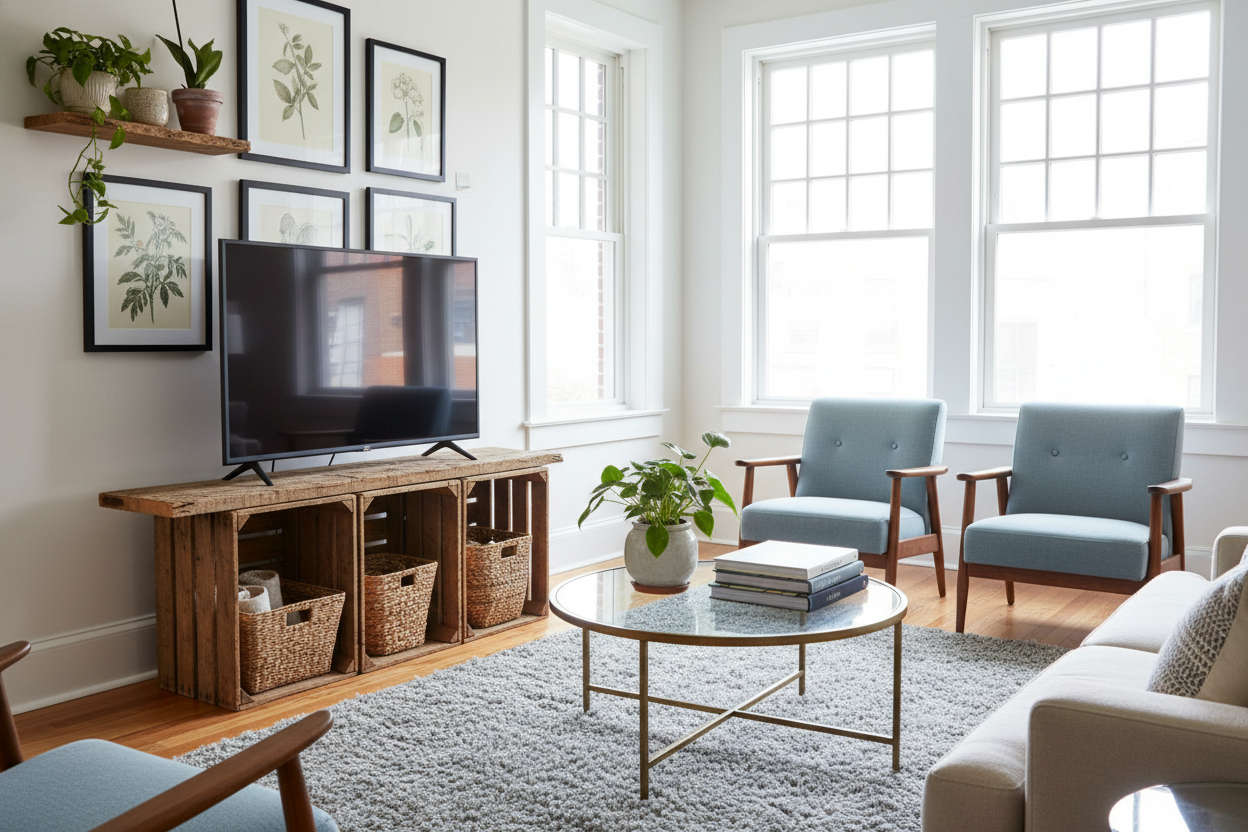
The Trap of the 'Need It Right Now' Furniture Run
I was sitting on a camping chair in my new living room, staring at a 55-inch OLED resting on its own cardboard box. It looked pathetic. The temptation to sprint to the nearest big-box store and grab the first $150 particle board console I saw was overwhelming. My brain was screaming for a sense of normalcy, even if that normalcy came in the form of 'grey-wash' laminate that would inevitably peel within six months.
This is the 'Moving Day Panic.' It’s that desperate state where you buy furniture not because you love it, but because you’re tired of living out of boxes. I almost pulled the trigger on a console that was 3 inches too short for my eyeline and far too wide for the alcove. Had I bought it, I would have been stuck with it for years out of sheer guilt. Instead, I opted for a temporary tv stand. It felt like a failure at the time, but it ended up being the smartest design move I made in that apartment.
Resisting the urge to panic-buy gave me three weeks to realize that the wall I thought was perfect for the TV actually caught a brutal glare from the west-facing window every afternoon. If I had mounted a permanent console or bought a heavy piece of furniture, I would have been miserable every time I tried to watch a movie at 4 PM. A makeshift setup isn't a sign of an unfinished home; it's a strategic pause.
- Don't buy permanent furniture in a state of exhaustion.
- Use what you have to test viewing heights and glare angles.
- A temporary setup prevents 'fast furniture' waste.
- Wait at least two weeks to see how light moves through the room.
3 Temporary TV Stand Ideas That Actually Look Intentional
If you are looking for temporary tv stand ideas, stop browsing the 'ready-to-assemble' aisles and start looking at what’s already in your moving truck or your local hardware store. You can create a setup that looks like a deliberate 'industrial-chic' choice rather than a 'just moved in' accident.
One of my favorite hacks is the Cinder Block Console. You grab six cinder blocks from the garden center for about $12 and a piece of finished 2x12 lumber. Stack them to your desired height, and you have an incredibly sturdy, perfectly sized media center. It’s a lifesaver when strict leases forbid drilling holes for wall mounts. Plus, the open cavities in the blocks are great for storing a remote or a small router.
If you want something with more character, I’ve seen people use weird ideas for a tv stand like vintage steamer trunks or even a sturdy wooden bench. A bench is particularly great because it’s low profile and can be easily repurposed as entryway seating once you find your 'forever' console. Just make sure the surface is deep enough—most modern TV feet need at least 10 to 12 inches of depth to sit securely.
Lastly, don't overlook the humble bar cart or kitchen island. If it has locking wheels, it’s actually a brilliant way to test different locations in the room. You can wheel your setup from the corner to the center wall to see which layout feels most natural for your sofa placement. It’s the ultimate 'try before you buy' for your living room floor plan.
The Cable Nightmare: Surviving the In-Between Phase
The biggest downside to a makeshift setup is the 'spaghetti monster'—that tangled mess of HDMI cables, power strips, and router cords that usually hide behind a solid back panel. When you’re using a bench or cinder blocks, those cables are out in the open, and they look messy. It’s the one thing that will make your temporary setup feel like a frat house.
My trick? Velcro ties and a strategically placed houseplant. Don't use plastic zip ties; they’re a pain to cut off when you finally move things. Velcro ties allow you to bundle the cables tightly against the leg of your bench or behind the cinder blocks. If the mess is still visible, a leafy Pothos or a Snake Plant in a floor pot can do wonders for camouflaging the 'tech' side of the room.
I once spent an entire afternoon trying to hide cables behind a stack of books, only to realize I’d blocked the IR sensor on my cable box. Learn from my mistake: keep the sensors clear, but group the wires. Even a temporary setup looks 100% more professional when the cables follow a straight line down to the outlet rather than draping across the floor like a tripwire.
Ready to Commit? How to Choose Your Forever Piece
After a month of living with your makeshift setup, you'll have a data-driven list of requirements. You’ll know if you need drawers to hide your PS5 controllers or if you prefer open shelving for your record collection. Most importantly, you’ll know the exact height you need. I realized my temporary bench was 18 inches high, and I was constantly looking down. For my permanent piece, I knew I needed something closer to 24 inches.
When you're ready to invest, look for quality materials. Avoid the 1.5 lb/ft³ density foam in cheap sofas and the flimsy plywood in budget consoles. You want something with a kiln-dried hardwood frame or high-quality MDF with a real wood veneer. Maybe you finally realize that a 70-inch mid-century modern tv stand is the only thing that will balance out your oversized sectional.
Don't be afraid to spend a bit more on the piece you actually want. If you’ve survived the 'in-between' phase with a temporary setup, you’ve earned the right to be picky. When the time comes to stop pretending your coffee table is a media center, you can shop for permanent tv stands with the confidence that you won't be returning them a week later. You’ve tested the layout, you’ve managed the glare, and you’ve avoided the $500 panic-buy mistake.
How high should my TV be?
Your eyes should ideally hit the bottom third or the center of the screen when you're sitting on your couch. If you're craning your neck up, it’s 'r/TVTooHigh' territory, and you’ll regret it during your next Netflix binge.
Can I use a coffee table as a temporary stand?
Usually, no. Most coffee tables are 16-18 inches high, which is fine for a massive 75-inch TV but too low for a standard 50-inch screen. You’ll end up with a neck ache from looking down.
Are cinder blocks safe for hardwood floors?
Only if you’re careful. They will scratch hardwood or laminate in a heartbeat. Always put heavy-duty felt pads or a scrap piece of rug underneath the bottom layer of blocks to protect your security deposit.

Laisser un commentaire
Ce site est protégé par hCaptcha, et la Politique de confidentialité et les Conditions de service de hCaptcha s’appliquent.