


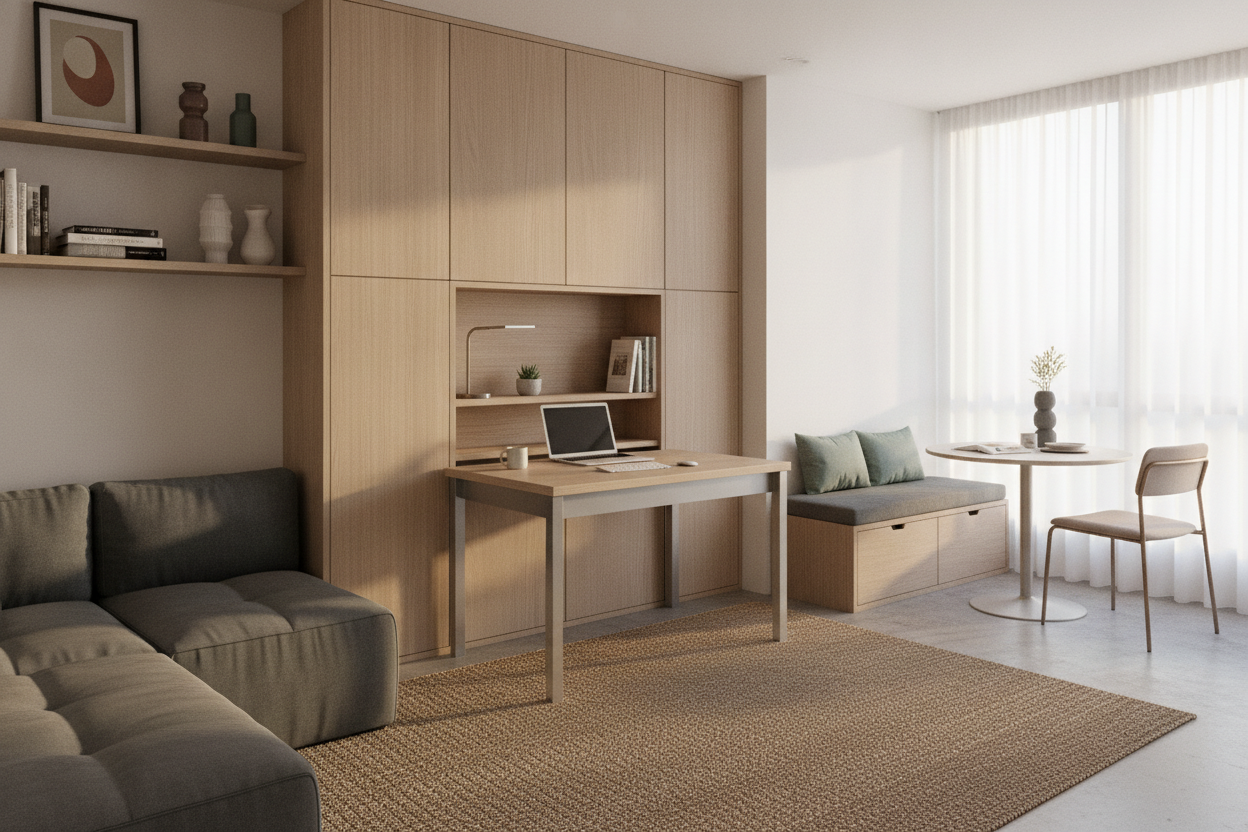
I’ve spent the last three years in a 380-square-foot studio where my bed is exactly four feet from my dual-monitor setup. For months, I felt like I was sleeping in a cubicle. Every time I tried to relax with a book or a movie, my work gear loomed over me like a deadline I couldn't escape. I realized that a retractable standing desk wasn't just an ergonomic choice—it was a psychological necessity.
Quick Takeaways
- Visual boundaries are the only way to survive working from a small apartment.
- Retractable desks allow you to 'hide' your office under existing furniture or windows.
- Motorized memory presets are essential for the daily transition.
- Sturdiness matters more than portability when you have heavy gear.
The 'Always On' Problem of Tiny Apartments
The biggest lie about working from home is that you’re always 'at home.' When your desk sits in the middle of your living room, you’re actually always 'at work.' I spent months staring at my keyboard while eating dinner, my brain stuck in a loop of unfinished emails. A standard writing computer desk usually has a footprint that demands to be seen. It’s a static block of wood and metal that anchors your room in 'office mode' 24/7.
In a studio, that physical presence is exhausting. You can’t just close a door. You need furniture that can retreat. My old desk was a beautiful mid-century piece, but it was a permanent monument to my job. I needed something that could shrink, lower, and effectively disappear when the clock hit 5 PM.
What Actually Is a Retractable Stand Up Desk?
When most people hear 'standing desk,' they think of a health tool. But in a small space, a retractable stand up desk is actually a storage hack. The 'retractable' part refers to the desk’s ability to drop to a height significantly lower than a standard sitting desk—often as low as 24 or 25 inches.
This allows the entire desktop to slide under a window sill, a custom shelving unit, or even a lofted bed frame. It’s not just about standing to work; it’s about the desk having the range of motion to tuck itself into a corner of the room where it’s no longer the focal point. Think of it as a Murphy bed, but for your laptop and monitors.
The 5 PM Disappearing Act
My workday ends with a ritual. I clear my coffee mug, dock my laptop, and press a single button. Because I invested in a desk with memory preset controller, I don't have to hold the button down or guess the height. One touch sends the desk gliding down to its 'home' position—tucked neatly under my deep window ledge.
That physical movement signals to my brain that the office is closed. By lowering the desk, I reclaim the vertical space in my room. The monitors are no longer at eye level when I’m sitting on my sofa. It sounds small, but removing that visual clutter changed how I felt about my apartment. It stopped being a workspace with a bed and started being a home again.
Why I Didn't Just Buy a Rolling Cart
I’ve tried the mobile route. I looked at every rolling counter table-stand up desk on the market. While those are great for light laptop work, they usually fail the 'real furniture' test. Most rolling carts are built with 1.5mm steel frames that wobble the second you start typing with any enthusiasm. If you have a 27-inch monitor or a heavy mechanical keyboard, those carts feel like they’re going to tip over.
A real retractable frame uses heavy-duty lifting columns and a thick desktop—usually 1-inch thick MDF or solid wood. I wanted something that felt like a permanent fixture when I was using it, not a hospital tray. The extra weight of a real desk frame provides the stability needed for precision work, while the motorized legs handle the heavy lifting for me.
The Clearances You Must Measure First
Before you buy, grab a tape measure. You need to know the 'collapsed height' of the desk. Most standard desks sit at 29 or 30 inches. A retractable model can go much lower, but you have to ensure your cables have enough slack to move with it. I learned the hard way that a short monitor cable will snap if the desk lowers too far without enough lead.
Also, be wary of the cheapest options. I’ve seen a budget standing motorized desk lack basic safety features like collision detection. If you’re retracting your desk into a tight spot—like under a shelf—and there’s a stray book or a trash can in the way, a cheap motor will keep pushing until something cracks. Spend the extra $100 for a motor that senses resistance and stops automatically.
FAQ
Can I fit a retractable desk under a standard window?
Usually, yes. Most window sills are about 30 inches from the floor. A desk that retracts to 25 inches gives you plenty of clearance to tuck it away, provided your monitor arms can also tilt down or fold flat.
Is it loud enough to wake up a roommate?
Modern dual-motor desks are surprisingly quiet—usually under 50 decibels. It sounds like a soft hum, much quieter than a microwave or a vacuum. You won't bother anyone in the next room.
How do I manage cables if the desk is always moving?
Use a cable spine or a flexible tray. You want all your wires to converge into one 'snake' that has enough slack to reach both the highest standing position and the lowest retracted position without tension.


Laisser un commentaire
Ce site est protégé par hCaptcha, et la Politique de confidentialité et les Conditions de service de hCaptcha s’appliquent.