


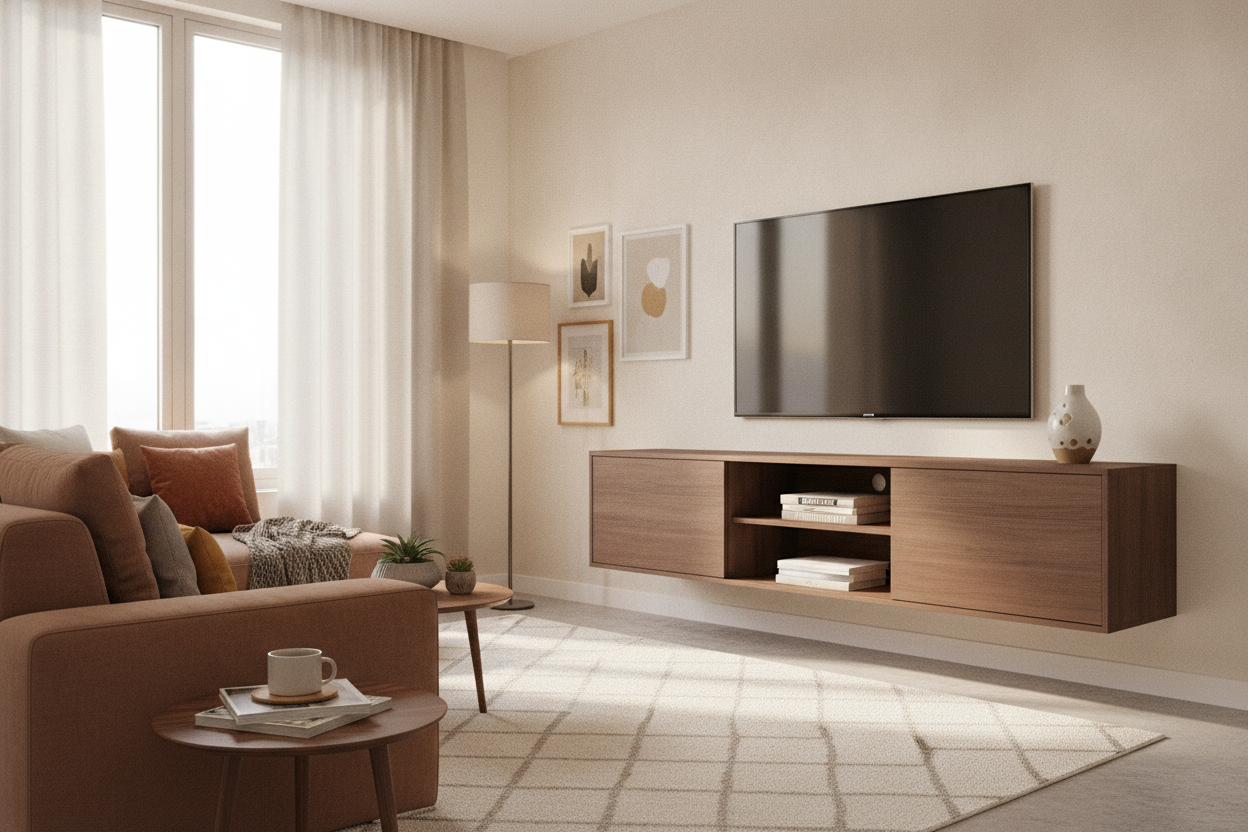
I spent three weeks staring at a mess of tangled HDMI cables and dust bunnies under my old media console. Living in a 600-square-foot apartment means every inch of floor space is a premium, but I was terrified of the 'floating' look. I didn't want my living room to feel like a doctor's waiting room or a minimalist tech startup. I finally caved and started hunting for a brown floating tv stand to see if I could save my floor without losing the soul of my home.
- Reclaims floor space to make small rooms feel significantly larger.
- Wood tones prevent the 'sterile' look common with modern wall-mounted units.
- Hiding cables inside the wall is a weekend project that pays off for years.
- Mounting into studs is non-negotiable for safety.
The Problem with Most Wall-Mounted Consoles
When I first started browsing a collection of TV stands, I almost closed the tab. Most floating options look like they were designed for a spaceship. They are often thin, white, and aggressively glossy. While a high gloss TV stand might look incredible in a futuristic loft with floor-to-ceiling windows, it looked completely out of place next to my velvet sofa and thrifted rug.
The issue is the 'weight' of the design. A white or black console often feels like an appliance rather than a piece of furniture. I wanted something that felt permanent and grounded, even if it wasn't actually touching the floor. I needed a piece that had texture and grain—something that felt like it had a history, even if it was actually a flat-pack delivery. I realized that the coldness wasn't coming from the floating design itself, but from the lack of organic materials.
Why a Wood-Toned Floating Unit Just Works
Choosing a brown floating entertainment center was the turning point. Wood is inherently warm. It absorbs light instead of bouncing it around like plastic or glass. When you lift that warmth off the floor, you get this weirdly satisfying design tension: it looks light because it's hovering, but it feels heavy because of the wood grain. It’s the ultimate hack for 'warm minimalism.'
I opted for a unit with a thick frame—about 12 inches deep. This depth is crucial. If the unit is too slim, it looks like a floating shelf that’s struggling to hold your PlayStation. If it’s too deep, it eats into the room. A medium-toned wood grain helps hide the inevitable dust that settles on top, and it blends beautifully with other wood elements in the room, like my oak coffee table. It makes the tech—the big black rectangle of the TV—feel like it’s part of a curated wall rather than a giant electronic intruder.
Finding the Right Shade for Your Space
Not all browns are created equal. If you go too light, like a bleached oak, you risk looking a bit too 'Scandi-nursery.' If you go too dark without enough grain, it just looks like a black void from across the room. I’ve found that a dark brown floating tv stand provides the best contrast against lighter walls, especially if you have standard 'apartment beige' or off-white paint. It creates a focal point that draws the eye upward, which actually makes your ceilings feel higher.
I used to be afraid that dark wood would swallow the light in my small space. I was wrong. I actually wrote about how espresso floating TV stand options can anchor a room better than lighter shades because they provide a visual 'stop' for the eye. A rich walnut or espresso finish feels sophisticated and expensive, even if the unit itself was a budget-friendly find. It’s about that balance of rich color and the 'airiness' of the open space underneath.
The Installation Anxiety (And Why It's Worth It)
I’m not going to lie: I stared at my drill for forty minutes before making the first hole. Mounting a wall mounted media console is a commitment. You aren't just hanging a picture; you're hanging a 60-pound piece of furniture that will hold another 40 pounds of gear. My biggest mistake was trying to use drywall anchors for the main support. Don't do that. You must find the studs. I ended up using a magnetic stud finder and marking my spots three times before I felt confident.
Once I got the floating tv stand brown box secured to the wall, the transformation was instant. Being able to see the floorboards run all the way to the baseboard makes the room feel four feet wider. It’s a psychological trick—the more floor you see, the bigger the room feels. Plus, my robot vacuum can finally clean the entire living room without getting stuck in a graveyard of power strips and dust.
Styling Your Console Without the Clutter
A floating tv stand dark brown can easily become a glorified junk drawer if you aren't careful. Since you’ve gone to the trouble of floating the unit, don't ruin the look by having a 'tail' of black wires hanging down to the outlet. I used a simple cable management kit that hides the wires behind the drywall. It took an extra hour, but it’s the difference between a professional look and a DIY disaster.
On top, I keep it simple. A couple of stackable art books, one trailing plant (pothos are great for this), and maybe a small ceramic bowl for remotes. You want to leave some 'white space' on the surface of the console so the wood grain can actually show through. The goal is to make it look like a floating piece of art that just happens to hold your Netflix machine.
FAQ
Will a floating stand hold a heavy 75-inch TV?
Most floating stands are rated for weight, but the real limit is your wall. If you are bolted into at least two or three studs, they can easily handle 100+ pounds. Always check the manufacturer's specs before buying.
How high should I mount it?
The biggest mistake is mounting it too high. The center of your TV should be at eye level when you are sitting on your sofa. Usually, the bottom of the console should be 12 to 18 inches off the floor.
What if I have plaster walls instead of drywall?
Plaster is trickier and more brittle. You’ll need specific masonry bits and heavy-duty anchors, or better yet, find the original lath or studs. If you're in an old pre-war building, consult a pro first.

Laisser un commentaire
Ce site est protégé par hCaptcha, et la Politique de confidentialité et les Conditions de service de hCaptcha s’appliquent.