


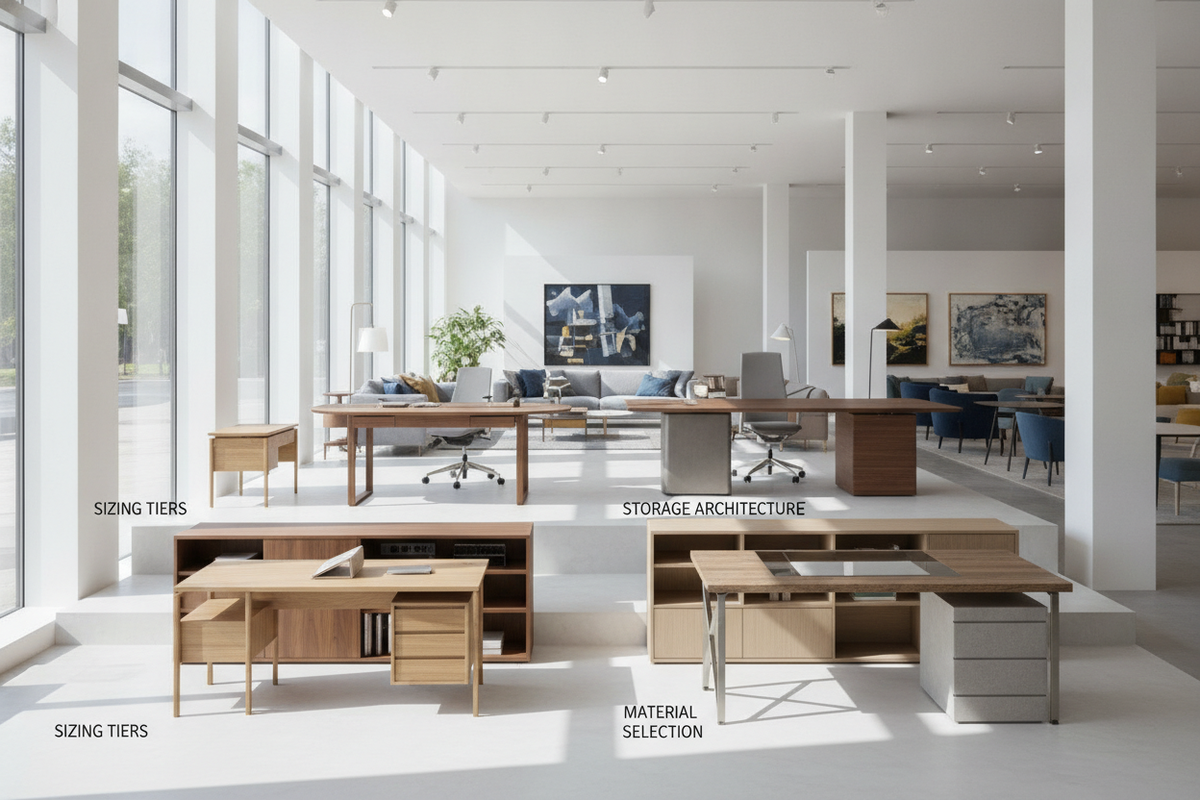
Navigating Furniture Stores Desks: The Spatial Sizing Framework
Browsing through modern showrooms or online collections reveals a broad spectrum of surface options. Selecting the right piece from among furniture stores desks requires mapping the physical footprint of the workstation directly to the volume of your room. Rather than evaluating a desk solely by finish, categorizing options into distinct dimensional tiers ensures that the piece supports daily tasks without overwhelming your living environment.
Compact Workstations for Nooks and Hybrid Living Spaces
When searching for furniture stores that sell desks to furnish multifunctional guest rooms, apartment living zones, or hallway alcoves, compact writing tables provide focused utility. These streamlined profiles prioritize a shallow depth and a modest width, allowing sufficient space for a laptop, a writing pad, and minimal desktop lighting. By maintaining slender legs and open under-desk space, compact desks preserve visual lightness and prevent smaller rooms from feeling crowded.
Mid-Scale Desks for Dedicated Home Offices
A standard residential workstation designed for dedicated study rooms balances surface utility with ergonomic breathing room. When exploring an office desk furniture store, mid-scale options offer deeper worktops that accommodate secondary monitors, desktop organizers, and standard peripherals. This dimensional category provides ample knee clearance, allowing users to move freely while keeping core reference materials within arm's reach.
Expansive Executive and Corner L-Shaped Configurations
For individuals managing complex workflows, extensive documentation, or dual-monitor configurations, an L-shaped or executive workstation delivers substantial zoning capacity. Utilizing a corner computer desk with ample storage allows you to designate one wing strictly for screen-based tasks while reserving the adjacent surface for paperwork, planning, or creative projects. This geometry captures previously underutilized corner real estate while creating an efficient wrap-around workstation.
Room Flow and Layout Dynamics for the Desk Office Room
Positioning a workstation within a desk office room requires careful attention to spatial circulation, entry sightlines, and natural light sources. A well-planned layout balances functional ergonomics with an inviting interior environment.
Perimeter Wall Placements vs. Floating Centerpiece Layouts
Aligning a desk against a perimeter wall maximizes central floor space and simplifies cable routing toward wall outlets. This layout is especially effective in shared spaces or narrower rooms. In contrast, a floating arrangement positions the desk facing the room entrance, establishing a commanding focal point in larger private offices. When adopting a floating layout, consider curating inspiring workspace accents to create a polished aesthetic from both the seated view and the approach angle.
Corner Geometry and Transit Zone Clearances
Maintaining adequate clearance around your desk prevents transit bottlenecks. Plan sufficient space behind the desk for full task chair push-back and swivel clearance. Additionally, leave generous clearance between the desk perimeter, room doorways, and adjacent cabinetry so that cabinet doors and drawers can open fully without obstructing walkways.
Storage Architecture: Built-In Pedestals vs. Modular Cabinet Synergy
Storage management is central to sustaining an organized work environment. When shopping at a furniture store with desks, consider whether an integrated, all-in-one workstation or a decoupled, modular system best matches your organizational habits.
Integrated Drawers, File Pedestals, and Hidden Wire Channels
Desks featuring integrated drawer pedestals provide immediate organization for stationary, filing folders, and sensitive paperwork. An integrated multi-drawer office storage desk consolidates supply storage, filing compartments, and primary tabletop space into a single cohesive unit. Integrated modesty panels and interior cable grommets further assist in concealing power strips and wire runs, maintaining clean lines throughout the room.
Pairing Desks with Modular Credenzas and Vertical Shelving
If you prefer an open desk subframe with maximum legroom, pairing a minimalist desk with matching freestanding credenzas, mobile file caddies, or wall-mounted shelving offers exceptional flexibility. Reviewing above-desk storage planning concepts can help you utilize vertical wall space for reference books and decorative display, keeping the main work surface entirely clear for active projects.
Material Dynamics and Structural Integrity in Residential Desks
Material construction influences both tactile comfort and everyday durability across residential desks. Evaluating the build method helps ensure long-term satisfaction.
Engineered Wood, Laminate Finishes, and Veneers
Modern engineered wood cores paired with high-pressure laminates or durable melamine surfaces offer smooth, uniform textures that resist daily scuffs, moisture rings, and light scratches. For those seeking natural wood grain patterns at a practical weight, wood veneers deliver organic texture and warmth while maintaining structural stability across seasonal humidity changes.
Solid Hardwoods and Powder-Coated Metal Frames
Solid timber surfaces provide rich grain depth and classic character that develop a gentle patina over time. When paired with heavy-gauge powder-coated steel legs or trestle frames, the desk gains substantial rigidity and resistance to lateral wobble. Metal subframes also lend a clean, architectural aesthetic well-suited to industrial, transitional, and contemporary home interiors.
Furniture Store Office Desk Evaluation: Assembly, Transit, and Longevity
Before completing an order for a furniture store office desk, a systematic assessment of assembly requirements and maintenance practicalities ensures smooth installation and enduring performance.
- Joinery and Hardware Quality: Check for robust cam-lock systems, metal-to-metal threaded inserts, and full-extension drawer glides to ensure fluid movement and sturdy joinery.
- Subframe Stability: Look for crossbars, corner gussets, or integrated modesty panels that prevent side-to-side racking under daily use.
- Surface Maintenance: Select finishes that can be easily wiped clean with standard microfiber cloths and mild wood or laminate cleaners.
- Cable Integration: Incorporating practical workspace accessories such as under-desk cable trays and adhesive routing clips preserves a tidy, organized workspace over time.


Laisser un commentaire
Ce site est protégé par hCaptcha, et la Politique de confidentialité et les Conditions de service de hCaptcha s’appliquent.