


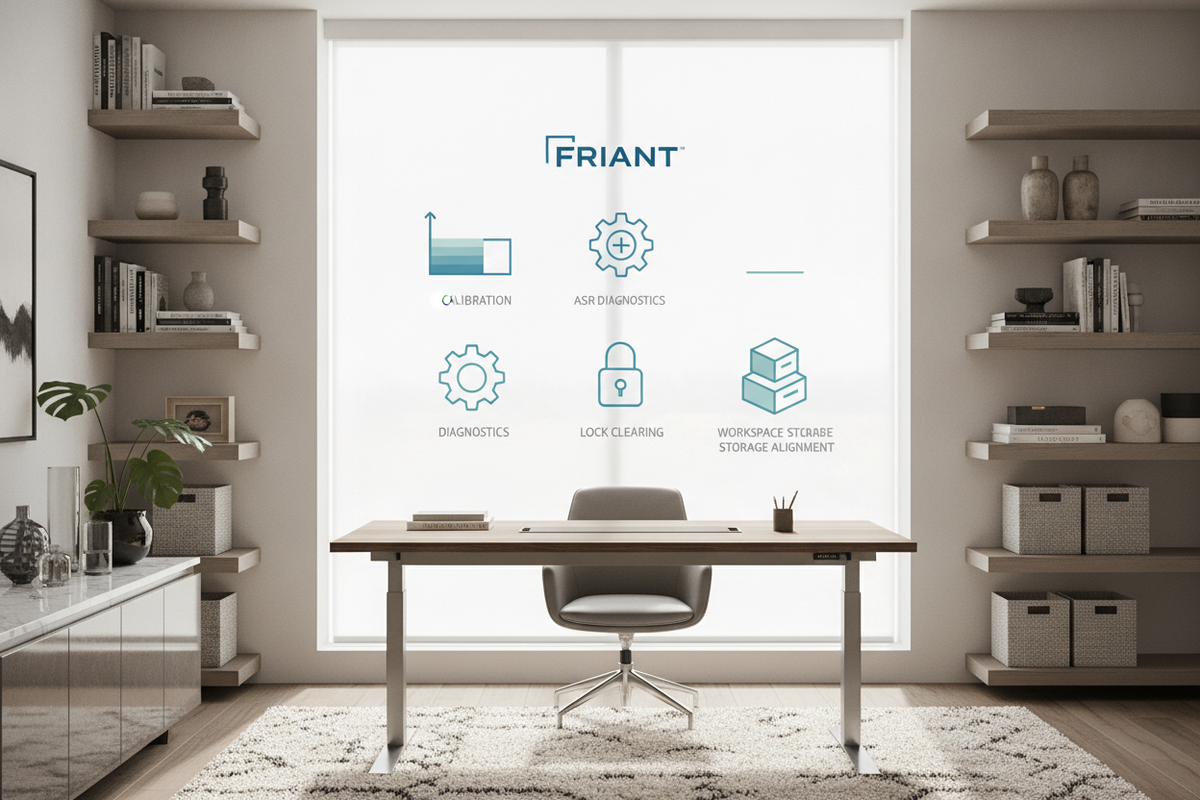
Height-adjustable office workstations rely on synchronized electronic control systems to maintain smooth vertical travel. When an electric lift system encounters an unexpected voltage drop, uneven load distribution, or a physical obstacle along its path, the internal control module frequently enters a protective state. For users operating a Friant My-Hite workstation or comparable dual-motor setup, understanding the diagnostic routine turns an unexpected operational pause into a straightforward maintenance task. Incorporating thoughtful ergonomic furniture and maintaining an organized work area, as explored in this standing desk guide, helps keep motorized desks functioning reliably throughout daily use.
Understanding the Friant My-Hite Electronic Drive System and Reset Triggers
Modern electric sit-stand desks operate using two synchronized lift columns driven by a centralized control box. The control unit constantly monitors internal revolutions and current draw across both lifting legs. If the control box detects an imbalance between the columns, an interruption in main power, or an unexpected spike in resistance, it temporarily disables upward motion to protect the internal drive shafts and electronics.
Common triggers that prompt a necessary recalibration include:
- Sudden loss of wall power or unplugging the power cord while the desk is in motion.
- Physical contact with nearby furniture, such as an adjacent mobile file cabinet or windowsill.
- Uneven surface weight distribution causing one motor to work harder than the other.
- Unseated motor interconnect cables or loose connections at the control box terminal.
- Activation of the internal safety lock on digital handset models.
Step-by-Step Friant Standing Desk Reset Procedure
The standard recalibration routine returns the lift columns to their absolute baseline, allowing the control box to establish a synchronized reference point across both drive legs. If you are familiar with contemporary systems like an adjustable height standing desk with electric lift system, the homing procedure follows a very similar logic.
- Clear Surrounding Obstructions: Check beneath and immediately around the work surface to ensure no power cords, waste bins, or storage units obstruct downward travel.
- Initiate Downward Motion: Press and hold the Down arrow button on your handset. Continue holding the button as the desk moves toward its lowest physical position.
- Engage the Calibration Cycle: Once the desk reaches the bottom, do not release the button. Maintain continuous pressure on the Down button for several seconds until the frame performs a subtle downward bump and slight rebound.
- Confirm Completion: Release the button once the display flashes a confirmation or reverts to standard height numerical readouts. Test upward motion to verify that both lifting columns ascend in tandem.
Resolving the ASR Display Code and Error Indicators
Many digital handsets paired with Friant My-Hite desks display three letters when a reset is required: ASR (often referring to Alignment / Automatic System Reset). When the screen shows ASR, the control box restricts upward elevation and will only respond to the baseline homing command. Workstations with expansive surface spans, such as a 71 inch wide height adjustable desk, particularly benefit from proper homing cycles to preserve uniform frame alignment.
To clear the ASR screen indicator:
- Press and hold the Down button continuously. The desk may descend slightly or remain at the bottom if already lowered.
- Keep the button pressed until the display transitions from ASR to a baseline numerical measurement.
- If the ASR prompt persists after releasing the button, perform a brief system power cycle by disconnecting the main power plug for two minutes before repeating the downward hold.
How to Lock and Unlock the Friant Standing Desk Handset
Digital programmable handsets frequently feature an integrated button lockout function. This mode prevents accidental height adjustments caused by passing arm movement, routine desktop cleaning, or shared office environments. Spacious setups, including a super-sized standing desk with electric lift, make good use of keypad locking to prevent unintended shifts during heavy collaborative sessions.
Depending on the specific digital handset generation installed on your Friant workstation, toggle the safety lock using one of these common sequences:
- Method 1 (Dedicated Key Hold): Press and hold the M (Memory) or S (Set) button for approximately five to eight seconds until the digital read-out shows LOC or a key icon. To unlock, repeat the same long press until standard numeric digits reappear.
- Method 2 (Dual-Button Sequence): Press and hold the Up and Down arrows simultaneously for five seconds. The display will indicate a locked status. Hold both arrows together again to restore full manual control.
- Method 3 (Memory Combination): On select four-button programmable interfaces, hold the S button while tapping the number 1 preset to toggle the display between locked and active operation.
Hardware Checks: Control Box Connections, Power Cycles, and Cable Strain
If standard keypad reset steps fail to restore mobility, inspect the underlying hardware components beneath the desktop. A loose terminal clip or excessive cable tension can interrupt the low-voltage communication line between the motor columns and the central processor.
- Terminal Reseating: Disconnect the primary AC power cable from the wall outlet. Carefully unplug and firmly reseat the motor cables leading from each leg column into ports M1 and M2 on the control box. Ensure the locking tabs click securely into position.
- Handset Cable Inspection: Check the modular RJ or keyed plug connecting the display keypad to the control box port marked 'HS' or 'Handset'. Verify that no pins are bent or compressed.
- Dynamic Cable Slack: Ensure that all power and communication cords have adequate slack throughout the entire vertical range of the desk. Cords pulled taut at standing height can partially unseat connectors, causing intermittent resets.
- Full Power Drain: Leave the desk unplugged from main power for at least two full minutes to allow the control box internal capacitors to discharge completely before re-plugging and running the homing sequence.
Spatial Clearance and Surrounding Storage Architecture
Motorized height-adjustable desks require thoughtful layout planning to avoid collision-induced error states. When a descending desktop meets the rigid top edge of a mobile pedestal or credenza, the resistance triggers anti-collision safety protocols, often putting the desk directly into an ASR recalibration state. Planning thoughtful spatial arrangements, as detailed in our guide on designer ideas for standing desk layouts, preserves both furniture integrity and everyday workflow.
To protect your workstation and surrounding storage pieces:
- Maintain Lateral Perimeter Gaps: Position freestanding lateral file cabinets, bookcases, and adjacent desks with sufficient perimeter space so desktop edges do not rub against vertical furniture during transit.
- Under-Desk Pedestal Clearance: If using under-desk storage drawers, choose models that sit comfortably below the lowest travel threshold of the desk frame, or place them entirely outside the downward trajectory of the crossbeams.
- Monitor Arm and Wall Separation: Allow adequate distance between rear-mounted monitor brackets and the wall behind the desk to prevent pinch points as the desktop ascends or descends.
- Integrated Cable Management Trays: Route power strips and surplus cable length into under-desk management channels to eliminate hanging loops that could catch on drawer handles or low-profile shelving.

Laisser un commentaire
Ce site est protégé par hCaptcha, et la Politique de confidentialité et les Conditions de service de hCaptcha s’appliquent.