


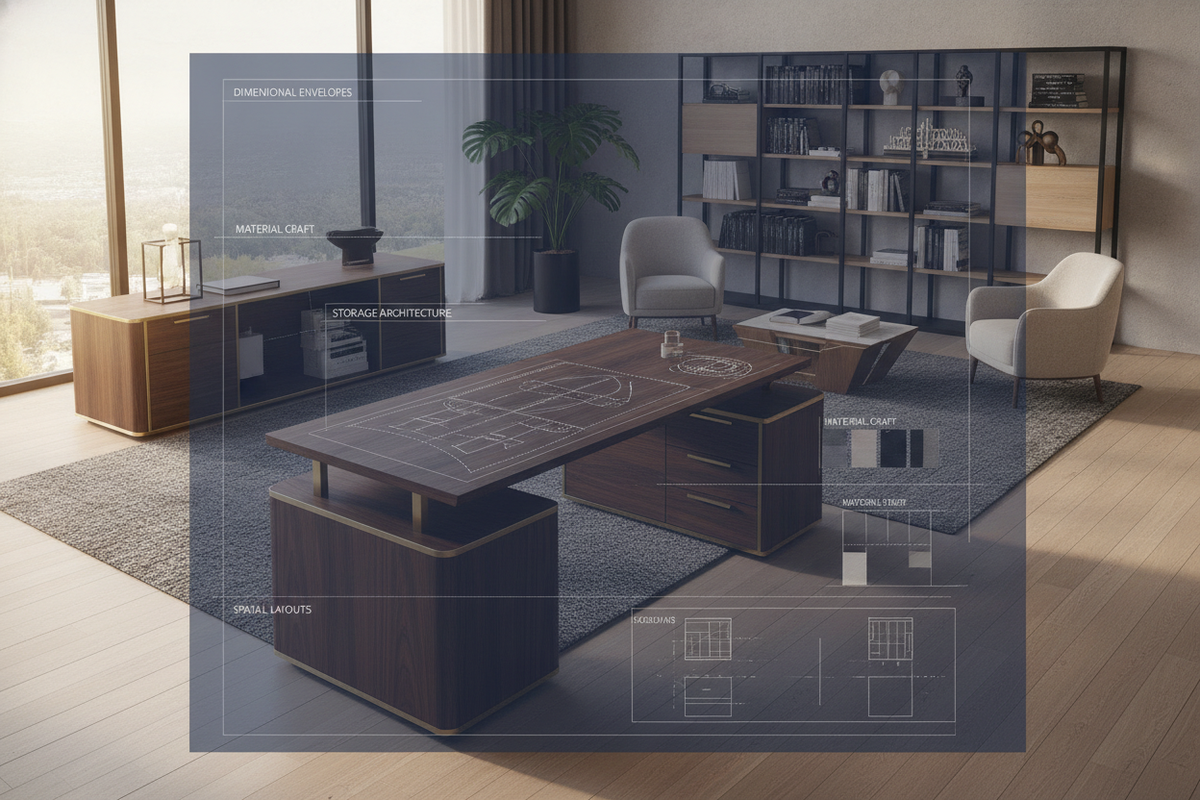
The Evolution of the Executive Standing Desk
Traditional executive suites have long communicated stability through broad desktop expanses, substantial modesty panels, and anchored pedestal cabinetry. However, modern professional workflows demand physical adaptability throughout long working hours. The sit to stand executive desk bridges this gap by pairing authoritative architectural presence with motorized height adjustability, allowing users to transition between seated focus and standing presentations without sacrificing workspace surface area or executive styling.
Integrating kinetic movement into an executive suite shifts how an office functions. Rather than viewing an executive sit to stand desk as a purely utilitarian piece of office equipment, thoughtful interior design treats it as the central anchor of a coordinated professional suite. Balancing substantial visual mass with fluid vertical transitions requires careful evaluation of lifting geometries, finish palettes, and peripheral storage coordination.
Workstation Archetypes: Pedestals, Modesty Panels, and Open Frames
Choosing an executive standing desk begins with selecting an archetype that complements both your room layout and daily workflow requirements:
- Suspended Pedestal Desks: A standing executive desk with drawers utilizes suspended storage units mounted directly beneath the desktop frame. As the desk rises, the drawers travel upward alongside the desktop, keeping high-frequency supplies, notebooks, and devices readily accessible at any elevation.
- Dual-Tier L-Shape Return Combos: An executive standing desk combo often pairs a primary motorized height-adjustable work surface with a stationary lateral credenza or return. This setup creates a functional distinction between active digital tasks on the primary lift surface and static storage or peripheral equipment on the stationary return.
- Open-Frame Architectural Desks: A modern executive standing desk embraces clean, linear silhouettes, relying on structural steel lifting columns and minimalist crossbars. These open designs pair seamlessly with freestanding mobile filing carts or matching perimeter credenzas to maintain a light, uncluttered room aesthetic.
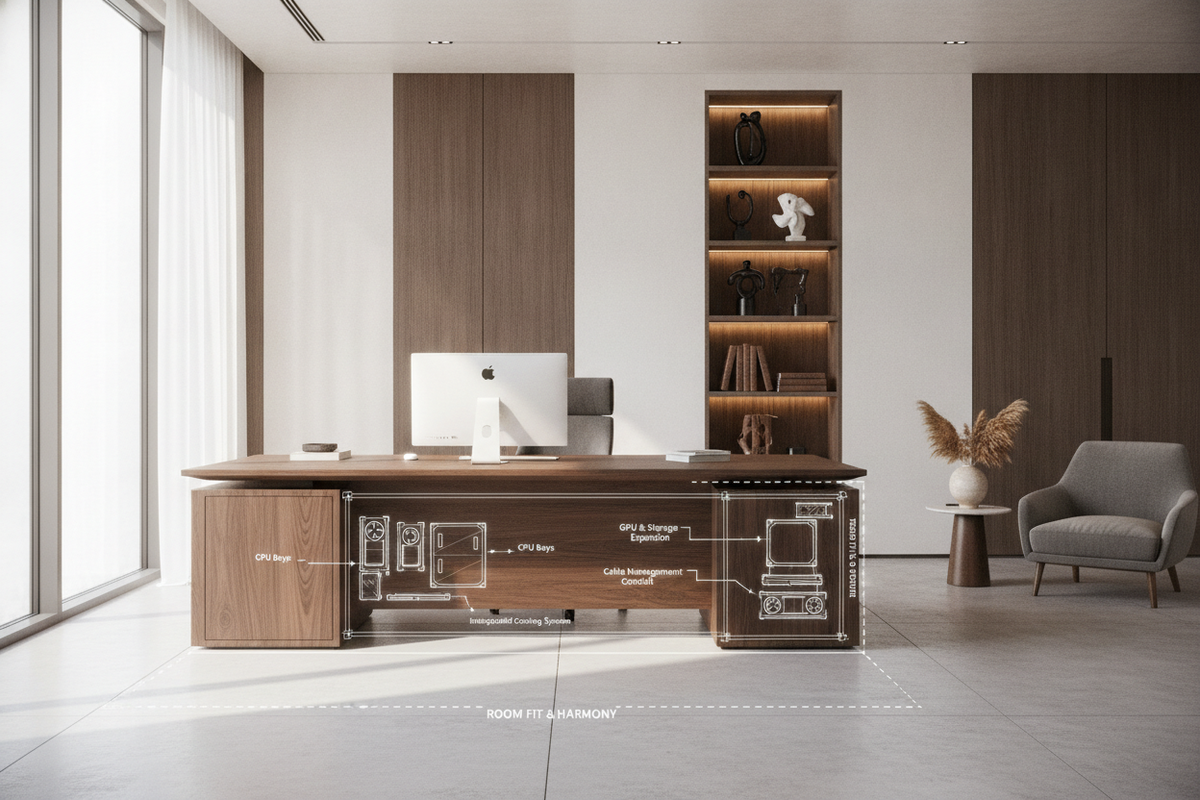
- Integrated Modesty Panel Suites: For desks positioned in the center of an office, an executive desk with standing option featuring an articulated or floating modesty panel conceals knee-well cabling and power hubs, maintaining visual privacy regardless of working height.
Dimensional Fit and Kinetic Clearance Frameworks
An executive height adjustable desk demands broader spatial envelopes than conventional static furniture. Desktop depths often range substantially deeper than standard utility workstations to accommodate multiple large monitors, desk pads, and conferencing peripherals. When positioning your workspace, you must account for both the horizontal footprint and the vertical kinetic envelope.
To ensure smooth travel, maintain ample clearance between the desk perimeter and surrounding architecture. Placing a moving desktop too close to window sills, wall sconces, or tall bookcases risks snagging wires or creating pinch points during elevation adjustments. Exploring a dedicated adjustable height standing product provides clear insight into how multi-stage lifting columns and programmable height presets facilitate smooth, repeatable daily transitions.
Integrated Storage Architecture vs. Dynamic Lift Mechanics
Managing weight distribution is a central engineering challenge in any adjustable height executive desk. Traditional executive furniture relies on heavy solid pedestals resting on the floor. In contrast, an executive adjustable standing desk must lift the work surface, mounted hardware, accessories, and all stored contents simultaneously.
When configuring an executive standing desk with drawers, assess how storage modules are anchored to the subframe. Symmetrical weight distribution across dual or triple lifting columns promotes long-term motor synchronization and prevents uneven mechanical wear. For configurations that combine utility trays, vertical organizers, and modular compartments, reviewing a specialized modern electric height product illustrates how upper organizational tiers and under-desk compartments can be arranged without impeding legroom or dynamic lifting performance.
Material Craft, Structural Rigidity, and Aesthetic Harmony
Visual authority and physical stability define an exceptional adjustable executive desk. Because standing desks extend upward on telescoping columns, joint rigidity and base engineering become paramount at full elevation. Dual-motor mechanisms housed within heavy-gauge steel legs minimize micro-wobble during typing or handwriting.
Desktop substrates and surface finishes dictate the tactile quality of your office. Durable high-pressure laminates offer robust resistance against daily abrasion, spills, and ring marks, while natural wood veneers and rich woodgrain textures bring organic warmth to formal office environments. Beveled edge profiles, softly radiused corners, and concealed motor housings elevate a functional executive desk standing into an elegant design statement.
Room Layout Archetypes and Office Flow
Positioning an executive standing desk adjustable height within a private office or shared executive suite shapes traffic patterns and natural sightlines. Consider two primary spatial strategies:
- The Commanding Central Anchor: Positioning the desk facing the room entrance conveys leadership authority. In this orientation, a finished modesty panel and clean underside cable routing are essential to ensure the workstation presents a polished appearance from all viewing angles.
- The Perimeter Workflow Suite: Positioning the primary lift desk along an open wall allows direct wall-mounted cable runs and easy pairing with surrounding perimeter cabinetry. Integrating an adjustable collection along adjacent walls creates a unified aesthetic, providing deep shelving for reference books, decorative accents, and archival binders while keeping the primary standing surface clear.
Cable Routing, Kinetic Power Management, and Assembly Planning
Power management represents a critical operational factor for any executive electric standing desk. Because executive workstations often support multiple displays, docking stations, task lighting, and conferencing hubs, cables must move smoothly through dynamic elevation changes without binding or pulling.
Implement these cable management and setup best practices:
- Articulated Cable Spines: Route all main power drops through flexible, articulated vertebrae tracks or expandable mesh sleeves that flex predictably between the desktop undercarriage and baseboard power outlets.
- Undersurface Power Distribution: Mount multi-outlet surge protectors directly to the desktop subframe so monitor, laptop, and accessory cords remain static relative to the tabletop during height adjustments.
- Service Loop Provisioning: Always leave a generous slack loop in main supply cables when raising the desk to its maximum height setting before securing tie-downs.
- Two-Person Assembly: Due to the substantial weight of wide executive desktops and motorized steel subframes, schedule assembly with two people to ensure safe alignment and avoid damaging precision motor components during flipping.
Executive Selection Matrix: Matching Workflow to Architecture
Identifying the best executive standing desk for your space requires balancing functional requirements against architectural constraints. When planning your investment, evaluate the following decision factors:
- Daily Equipment Load: Account for total desktop payload, including heavy multi-monitor arms, desktop audio, and stored paperwork, ensuring your chosen frame provides sufficient lifting capacity.
- Storage Requirements: Decide between integrated floating under-desk drawers for rapid access or stationary lateral credenzas for high-capacity file archiving.
- Visual Cohesion: Coordinate tabletop tones, leg frame powder-coating, and handle hardware with existing room elements such as bookcases, door trim, and executive seating.
- Height Adjustment Range: Confirm that the minimum lowered height accommodates comfortable seated typing postures with relaxed shoulders, while the top elevation matches your standing forearm angle.
By approaching your workstation selection through the lens of structural balance, spatial flow, and refined material finishes, an executive lift desk becomes a lasting cornerstone for professional productivity and executive presence.

Laisser un commentaire
Ce site est protégé par hCaptcha, et la Politique de confidentialité et les Conditions de service de hCaptcha s’appliquent.