


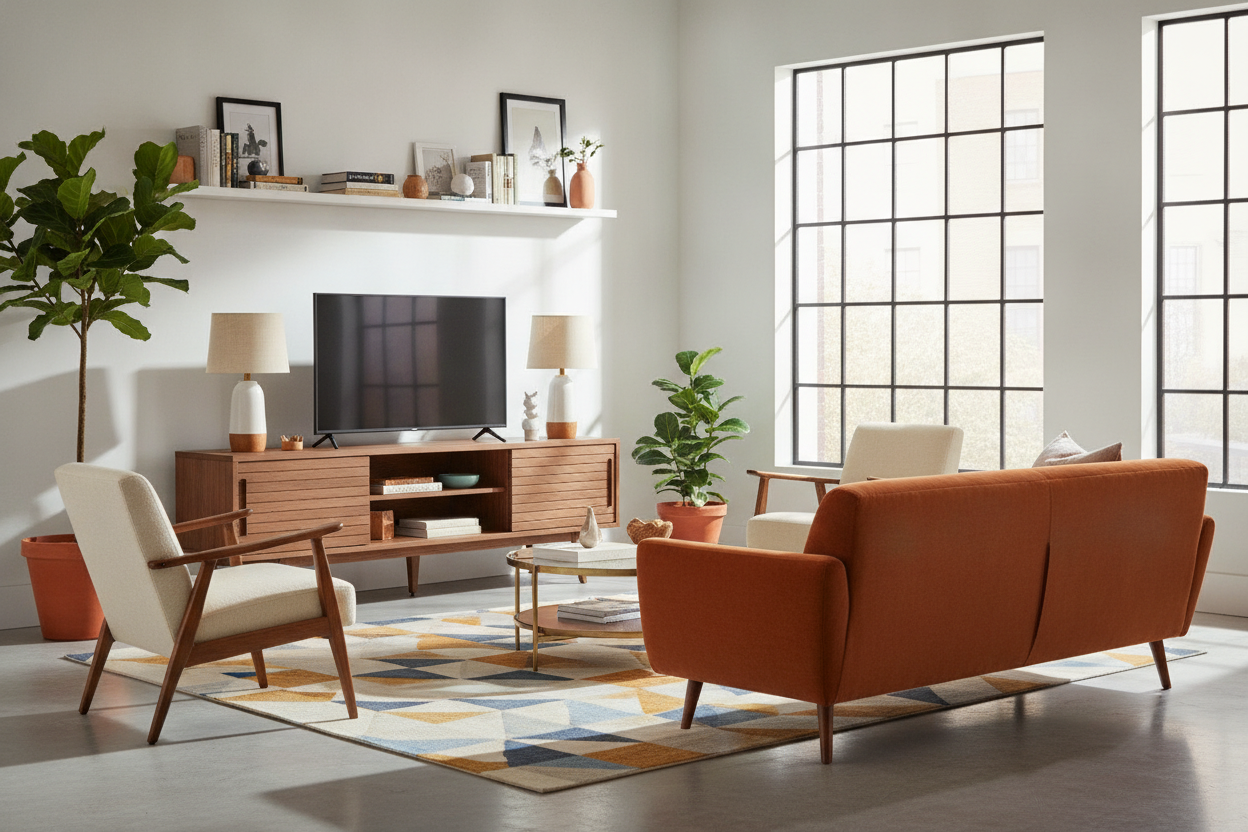
I spent three months refreshing Facebook Marketplace for a 1960s sideboard, only to find 'distressed' ruins or pieces priced like a down payment on a house. My living room was a mess of tangled HDMI cables and a temporary IKEA stool that definitely wasn't meant to hold a 55-inch screen. I finally caved and bought the manhattan comfort liberty tv stand to see if a flat-pack could actually scratch that retro itch without falling apart in six months.
Quick Takeaways
- The Legs: Solid wood and splayed perfectly—the most authentic part of the build.
- The Finish: It is a wood-grain laminate, so it has a slight sheen that vintage teak doesn't.
- Assembly: Plan for about 90 minutes and keep a vacuum nearby for the Styrofoam explosion.
- Storage: The mix of open cubbies and hidden doors is a lifesaver for hiding ugly routers.
Why I Finally Gave Up on Sourcing Vintage Consoles
Let’s be real: the 'MCM Tax' is out of control. Five years ago, you could find a decent walnut credenza at a thrift store for $200. Now, dealers are snagging them within minutes and relisting them for $1,800. For a renter like me who moves every two years, spending two months' rent on a heavy, fragile piece of history just doesn't make sense. I needed something that looked the part but wouldn't break my heart (or my back) during the next move.
I realized that shopping for modern TV stands was the only way to get the functionality I actually need—like cable cutouts and adjustable shelves—without the antique store drama. The Manhattan Comfort Liberty kept popping up in my searches because it hits those specific visual cues: the tapered legs, the low profile, and that distinctive rectangular silhouette that defines the era. It’s a compromise, sure, but a calculated one for anyone who wants a curated look on a real-world budget.
Unboxing the Manhattan Comfort Liberty TV Stand
The box arrived looking like it had gone ten rounds with a heavyweight boxer, which is par for the course with heavy flat-pack furniture. It weighs about 70 pounds, so don't try to haul this up three flights of stairs alone unless you're looking for a chiropractor bill. Once I got it open, I was greeted by a literal blizzard of Styrofoam. Pro tip: have a trash bag ready immediately, or you'll be finding white flecks in your rug until 2026.
First impressions of the materials? It’s heavy-duty MDF, not flimsy particle board. The manhattan comfort liberty uses a fairly thick laminate that feels durable, though the edges are a bit sharp right out of the box. The legs, however, are the real deal—solid wood with a nice weight to them. Seeing those first gave me hope that the whole thing wouldn't look like a cheap college dorm relic once it was standing.
Does the Retro Vibe Actually Translate in Person?
Once it’s fully assembled, the silhouette is undeniably sharp. Those splayed legs do a lot of heavy lifting for the aesthetic. If you’re comparing it to a high-end mid century modern TV stand with hand-carved slatted doors, you’ll notice the difference in the texture. The Liberty has a smoother, more uniform finish that lacks the deep grain of real walnut, but from six feet away on your sofa, it looks incredibly chic.
The hardware is minimal—no bulky handles to ruin the lines. The doors use a simple 'push-to-open' mechanism or recessed grips, which keeps the face of the console looking clean. One thing that surprised me was the height. It sits lower than your average modern media console, which is actually better for neck health if you’re sitting on a standard-height sofa. It grounds the room without dominating the wall, a key trick to making small apartments feel larger.
The Cord Chaos Test (And How It Handled My Tech)
A vintage sideboard looks great until you realize there’s nowhere for the wires to go, and you end up drilling a jagged hole through 60-year-old wood. The Liberty is built for the 21st century. It has pre-drilled cable management holes that are actually large enough to fit a standard power strip plug through—a detail many designers inexplicably miss. I managed to tuck my PS5, a mesh router, and a mess of charging cables into the closed compartments, leaving the open cubbies for the 'pretty' stuff like coffee table books and a vintage camera.
If you want to style a Manhattan Comfort TV stand so it doesn't scream 'I bought this online,' balance the tech with organic shapes. I put a trailing Pothos plant on one end to soften the hard angles and a ceramic tray for remotes. The open shelving is great for airflow, so my gaming console hasn't sounded like a jet engine taking off, which is a huge win over completely enclosed cabinets.
Final Verdict: Who Should Actually Buy This?
If you are a purist who only wants kiln-dried hardwood and dovetail joints, keep saving your pennies for an authentic Knoll. But for the rest of us living in the real world, this stand is a total win. It’s sturdy enough to hold a 65-inch TV without bowing in the middle—a common fail point for cheaper brands—and it captures the MCM spirit perfectly. It’s the ideal piece for renters who want a 'grown-up' living room without the permanent investment of heirloom furniture.
Frequently Asked Questions
Is the Manhattan Comfort Liberty hard to assemble?
It’s a medium-difficulty build. The instructions are mostly diagrams. If you’ve built IKEA furniture before, you’ll be fine, but use a real screwdriver instead of the tiny one they provide to save your hands.
Can it hold a 65-inch TV?
Yes, but check the width. The 62-inch model fits a 65-inch TV with just an inch or two of overhang on the sides. If you want the TV to sit entirely within the frame, stick to a 55-inch screen.
Are the legs adjustable for uneven floors?
The legs themselves don't have screw-in levelers. If your floors are slanted (hello, old apartments), you’ll need to use some felt pads or small shims under the feet to keep it from wobbling.

Laisser un commentaire
Ce site est protégé par hCaptcha, et la Politique de confidentialité et les Conditions de service de hCaptcha s’appliquent.