


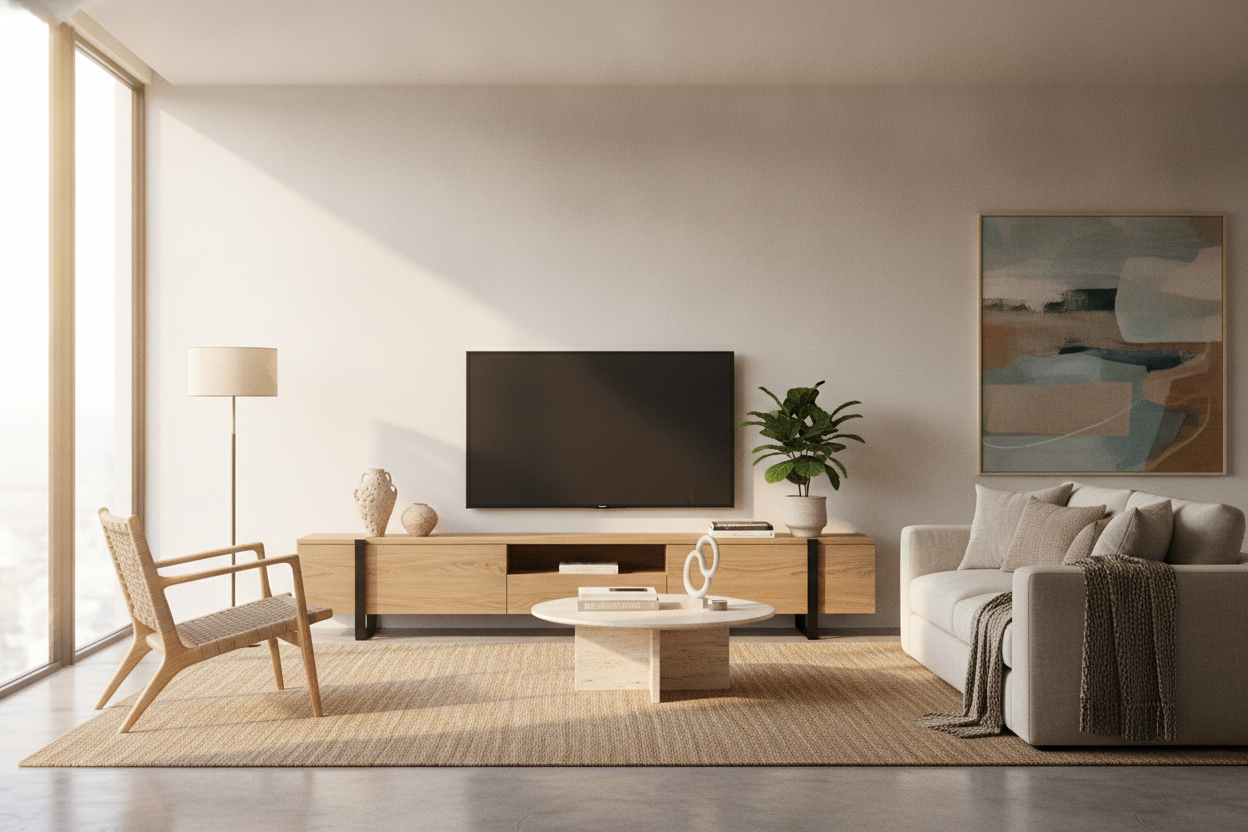
I recently spent three hours scrolling through Pinterest, and I realized something depressing: most media rooms look like the lobby of a dentist’s office from the year 2008. We’ve been conditioned to think that a tv modern stand has to be a sterile, high-gloss white rectangle that looks like it belongs in a server room rather than a home. It’s the furniture equivalent of a hospital gown—functional, sure, but nobody actually wants to live in it.
We have all been there, staring at forty-seven open browser tabs at 1 AM, trying to find a unit that doesn’t scream 'I only care about tech.' I want a living room that feels like a place where people actually hang out, not a showroom for a flat-screen. If you are tired of the cold, plastic aesthetic, there is a better way to do contemporary design without losing the soul of your home.
- Prioritize natural wood grains like walnut or oak to balance sharp geometric lines.
- Always choose a stand at least 10 inches wider than your TV screen.
- Hidden cable management is the difference between 'modern' and 'messy.'
- Matte finishes feel more expensive and are far easier to keep clean than high-gloss.
The 'Glossy White Box' Epidemic
The biggest mistake I see people make when they start to browse contemporary tv stands is defaulting to the cheapest, shiniest option they find. There is this weird obsession with high-gloss MDF. It looks okay in a studio-lit photo, but the moment it hits your living room, it becomes a fingerprint magnet. Every speck of dust and every smudge from your hand shows up like a neon sign. It’s frustrating because you want that sleek, low-profile look, but you end up with a piece of furniture that feels like a disposable office credenza.
I’ve assembled my fair share of these 'modern' units, and most of them are made of flimsy 1.2 lb/ft³ particle board that sags the moment you put a heavy soundbar on top. If you want a contemporary aesthetic that actually lasts, you have to look for substance. Real modernism isn't just about being thin or white; it’s about intentionality. You want clean lines, yes, but those lines should be executed in materials that have some weight to them. Look for kiln-dried hardwoods or high-quality veneers. If the box it comes in weighs less than the TV you’re putting on it, that’s a red flag.
What Actually Makes a Modern Design TV Stand Work?
A successful modern design tv stand isn't just a platform for your electronics; it’s an architectural anchor for the entire room. The secret is the balance of 'hard' and 'soft.' If you have a massive black screen and a bunch of plastic gaming consoles, you need a unit that introduces some organic texture. This is why I’m a huge fan of pieces like a stylish black TV stand entertainment center. The dark, moody finish grounds the room, but the texture of the wood grain keeps it from feeling like a black hole in the corner of the space.
Think about the legs, too. A lot of contemporary tv stands sit flat on the floor, which can make a small room feel cramped. Opting for a unit with tapered legs or a recessed plinth base creates a shadow line that makes the piece feel like it’s floating. It’s a simple visual trick that opens up the floor plan. Also, pay attention to the hardware. Or rather, the lack of it. Integrated finger pulls or push-to-open doors are the hallmarks of a truly contemporary tv console design. Anything with bulky, silver-painted plastic handles is going to look dated before the warranty even expires.
Why You Need a Contemporary TV Stand With Storage
We’ve all seen those ultra-minimalist floating shelves on Instagram. They look incredible when there’s exactly one vase and zero wires. In reality? They are a nightmare. You have a router, a cable box, a Nintendo Switch, and a tangled web of HDMI cables that look like a nest of snakes. This is why a contemporary tv stand with storage is a non-negotiable for me. You need a place to hide the guts of your entertainment system.
I’ve personally tested the modern minimalist TV stand with hidden storage, and it’s a total lifesaver for anyone who hates visual clutter. The soft-close hinges mean you aren’t waking up the whole house when you put a controller away, and the internal shelving is actually deep enough to fit a standard AV receiver. Most 'slim' modern units are so shallow you can't even plug in a cord without it hitting the back panel. Look for units with ventilated backboards so your electronics don't overheat while they’re tucked away. It’s the boring stuff—cable ports and airflow—that actually makes a piece of furniture usable in the long run.
My Favorite Contemporary TV Console Design Tricks
Once you have the unit, the biggest hurdle is making it look like it belongs in a home and not a Best Buy. A contemporary tv console design can feel a bit 'cold' if you don't style it correctly. My rule of thumb is the 60/40 rule: 60% of the surface should be for the tech, and 40% should be for 'human' things. Don't just center the TV and call it a day. Offset the screen slightly to one side and balance the other side with a stack of oversized art books or a tall ceramic vase.
I also love using trailing plants, like a Pothos or a Philodendron, to soften the edges of a sharp, rectangular stand. The organic, messy growth of a plant is the perfect foil for the rigid lines of a modern unit. If your stand is low to the ground, try leaning a large piece of art against the wall behind it. It draws the eye up and prevents the TV from being the only focal point. Just make sure you aren't blocking the IR sensor on your TV—I’ve made that mistake more times than I care to admit, and waving a remote around like a magic wand just to change the volume is a quick way to kill the 'cool' vibe.
Wait, What if You Ditch the Floor Unit Entirely?
If you’re working with a really tight space or you just want that 'wow' factor, there’s always the option to go off the floor entirely. I actually swapped my TV stand for a modern wall cabinet in my last apartment, and it completely changed the energy of the room. When you can see the floor running all the way to the baseboard, the room feels twice as big. It’s a very 'European' look that works incredibly well in minimalist settings.
However, be warned: wall-mounting a cabinet is a commitment. You have to find the studs, you have to hide the wires inside the wall (unless you want a plastic cord cover ruining the look), and you have to be sure about the height. I once mounted a cabinet two inches too high, and I spent six months with a literal pain in my neck until I finally moved it. If you’re a renter, a floor-based tv table modern design is usually the safer bet, but for homeowners, a floating cabinet is the ultimate contemporary flex.
How to Keep Your TV Table Modern Design Look Intentional
Proportions are everything. The biggest 'tell' of an amateur living room is a TV that is wider than the stand it’s sitting on. It looks top-heavy and accidental. For a tv table modern design to look intentional, the stand should extend at least 5 to 10 inches past the edges of the TV on both sides. This creates a visual 'buffer' that makes the screen look like part of the furniture rather than something just plopped on top.
Think about the height, too. Your eyes should be level with the middle of the screen when you're sitting on your sofa. If you have a low-slung, modern sofa, you need a low-profile stand. If you buy a 'standard' height stand for a low sofa, you'll feel like you're in the front row of a movie theater. It’s these small, boring measurements that separate a room that feels 'designed' from one that just feels 'furnished.' Modern design is about the harmony of the whole space, not just one flashy piece.
Personal Experience: The Glass Mistake
Years ago, I bought this stunning glass and chrome tv modern stand. It looked like a million bucks in the shop. Three days later, I hated it. Every single cable was visible through the glass. The dust was so apparent I had to wipe it down every morning. But the worst part? My robot vacuum kept slamming into it because the sensors couldn't 'see' the clear legs. I eventually sold it on Craigslist and bought a solid walnut unit with doors. I haven't looked back. Modern doesn't have to mean fragile or high-maintenance.
FAQ
How wide should my TV stand be?
Your stand should be at least 10 inches wider than the actual width of your TV (not the diagonal screen size). This prevents the 'mushroom' look where the TV overhangs the base.
How do I hide cables in a modern stand?
Look for units with built-in cable management holes. If your stand doesn't have them, use adhesive cable clips on the back of the legs to route wires out of sight.
What is the best material for a contemporary TV stand?
Solid wood or high-quality plywood with hardwood veneers are best. Avoid cheap particle board, as it will sag under the weight of modern 65-inch+ televisions over time.

Laisser un commentaire
Ce site est protégé par hCaptcha, et la Politique de confidentialité et les Conditions de service de hCaptcha s’appliquent.