


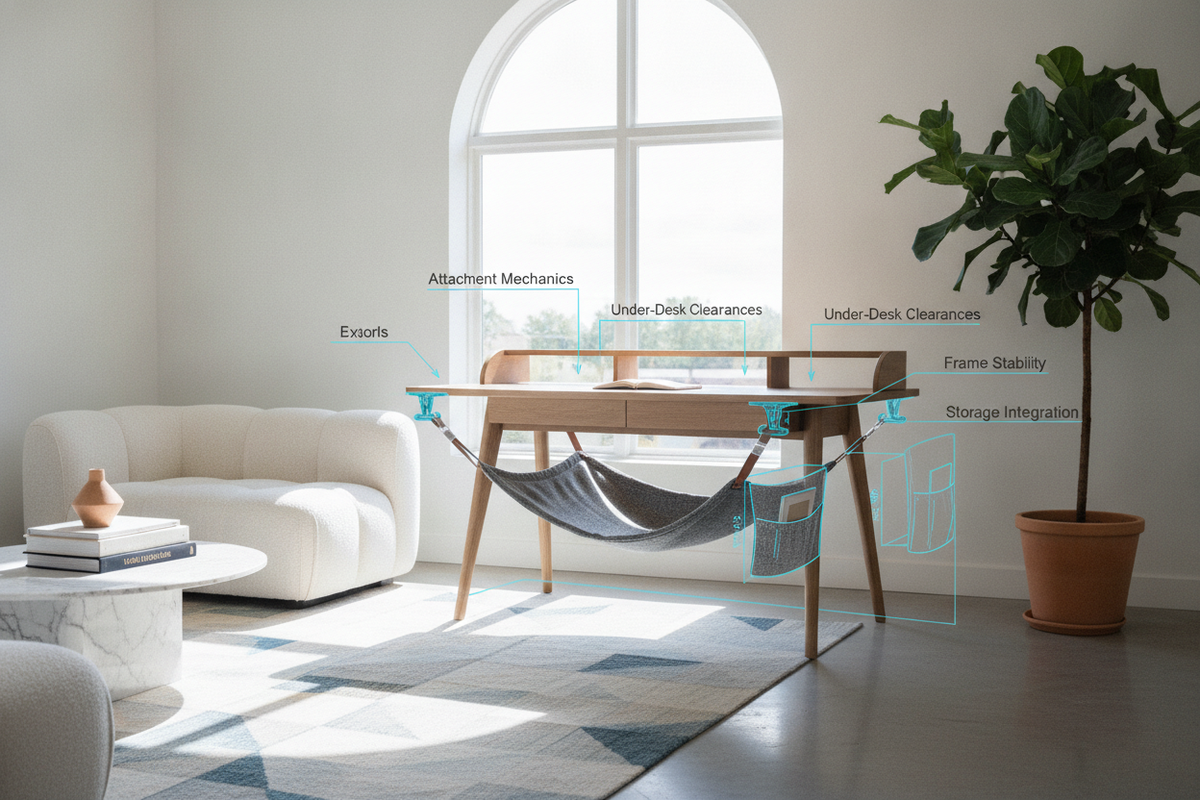
Understanding the Desk Foot Hammock: Typologies and Workstation Roles
Modern desk layouts frequently incorporate dynamic accessories to support comfortable postures during long work sessions. Among these accessories, the desk foot hammock has become a popular addition for users seeking varied leg positions while seated. Designed to suspend the feet slightly above the floor, an under-desk sling allows for subtle micro-movements, alternating between flat-footed stances and elevated resting angles.
When planning a workstation, it is helpful to distinguish between two broad categories of under-desk suspension systems:
- Compact Foot and Leg Slings: Narrow fabric bands suspended by cords from the desk edges or frame legs. These are designed primarily to support the feet or lower calves during standard seated task work.
- Full-Length Resting Hammocks: Larger fabric slings designed to attach across wide, heavy-duty standing desk frames when the desk is elevated to full height, providing a reclined rest zone during work breaks.
Integrating a feet hammock for desk setups can complement thoughtful ergonomic furniture choices. When combined with a balanced work desk office guide, adding dynamic foot support provides flexibility in how you position your legs throughout changing daily tasks.
Attachment Mechanics and Desk Frame Compatibility
Before installing a foot hammock under desk surfaces, examining the mounting method is crucial to protect both the furniture and the user. Attachment systems generally fall into clamp-on edge brackets, frame hooks, or dedicated underside anchor plates.
Desktop edge clamps are the most common solution. These clamp mechanisms fit over the side edges of the tabletop, relying on downward tension to hold the suspension cords in place. When considering a clamp-on foot desk hammock, evaluate the desktop edge profile. Tables with square edges accommodate standard clamps securely, whereas beveled, rounded, or chamfered edges may cause standard clamps to slip under lateral tension.
For motorized adjustable workstations, structural stability requires careful evaluation. Fastening accessories to an office stand desk product involves checking the crossbar layout and leg column placement. The horizontal pull created by a suspended foot sling exerts subtle inward side-loads on the frame legs. High-rigidity steel frames with reinforced crossbeams resist this tension effortlessly, preventing frame wobble or column deflection.
Under-Desk Spatial Geometry: Clearances, Depth Zones, and Leg Well Layouts
An effective under desk foot hammock installation requires adequate spatial clearance within the knee well. If the lower desk area is crowded, suspension cords may snag on chair armrests, modesty panels, or structural center beams.
To establish a functional layout, consider these clearance factors:
- Suspension Span: The horizontal distance between attachment points must allow the sling to hang with a gentle arc rather than taut tension, ensuring natural foot cradling.
- Hanging Depth: Adjustable cord lengths allow you to calibrate elevation. A lower hanging height suits upright typing postures, while a higher lift accommodates reclined reading or conference calls.
- Knee-Well Clearance: Desktops with broad open spans between the legs offer unobstructed swing paths, preventing your feet or shoes from striking back walls or frame supports.
Maintaining clear travel paths between your rolling chair base and the hammock cords ensures smooth entry and exit from the workstation without tangling casters.
Storage and Cable Management Integration Around Foot Hammocks
Workstations require practical storage and clean wire routing, both of which share spatial volume beneath the desktop. Adding an under desk hammock for feet means coordinating storage pedestals and cable baskets to avoid physical interference.
Power strips and slack wiring should be mounted securely to the underside of the desktop or routed through enclosed wire channels placed above the foot travel envelope. Loose, hanging cords pose a snagging hazard when legs shift inside a desk leg hammock. Utilizing organized cord channels keeps the suspension zone safe and visually uncluttered, a technique emphasized in our customer work office guide.
For storage furniture, position mobile file pedestals, CPU holders, and low drawer units along the outer flanks of the workstation rather than directly in the central footwell. This preserves legroom while keeping daily office supplies accessible.
Material Selection, Durability, and Daily Maintenance
The materials used in a desk with hammock setup determine its longevity, breathability, and ease of care. Common textiles include heavy cotton canvas, reinforced polyester weave, and layered mesh fabrics.
- Canvas and Reinforced Cotton: Offer a firm, supportive feel with classic texture, suitable for climate-controlled indoor offices.
- Breathable Mesh: Provides continuous airflow, making it comfortable for warmer environments and all-day use.
- High-Tensile Cordage and Hardware: Braided suspension ropes and rubber-padded steel brackets protect wood finishes from scuffs while withstanding continuous movement.
Routine care involves periodic inspection of clamp tightness and cord knots. Dusting the mounting hardware and spot-cleaning the fabric helps maintain a clean, intentional workspace aesthetic, aligning with the principles in our desk office work guide.
Workstation Selection and Layout Framework for Hammock Accessories
To successfully integrate an under-desk sling into your home or corporate office, follow this structured evaluation process:
- Assess Tabletop Geometry: Measure top thickness and inspect edge profiles to confirm clamp hardware fits firmly without surface damage.
- Verify Frame Load and Rigidity: Ensure the desk structure features stable leg joinery and wide footings to counter side-tension smoothly.
- Calibrate Cord Height: Set suspension lengths so your legs rest comfortably without placing pressure beneath the thighs or against chair edges.
- Clear Lower Work Zones: Relocate bulky bins and secure all power cables above the foot swing path to preserve an open, functional leg well.


Laisser un commentaire
Ce site est protégé par hCaptcha, et la Politique de confidentialité et les Conditions de service de hCaptcha s’appliquent.