


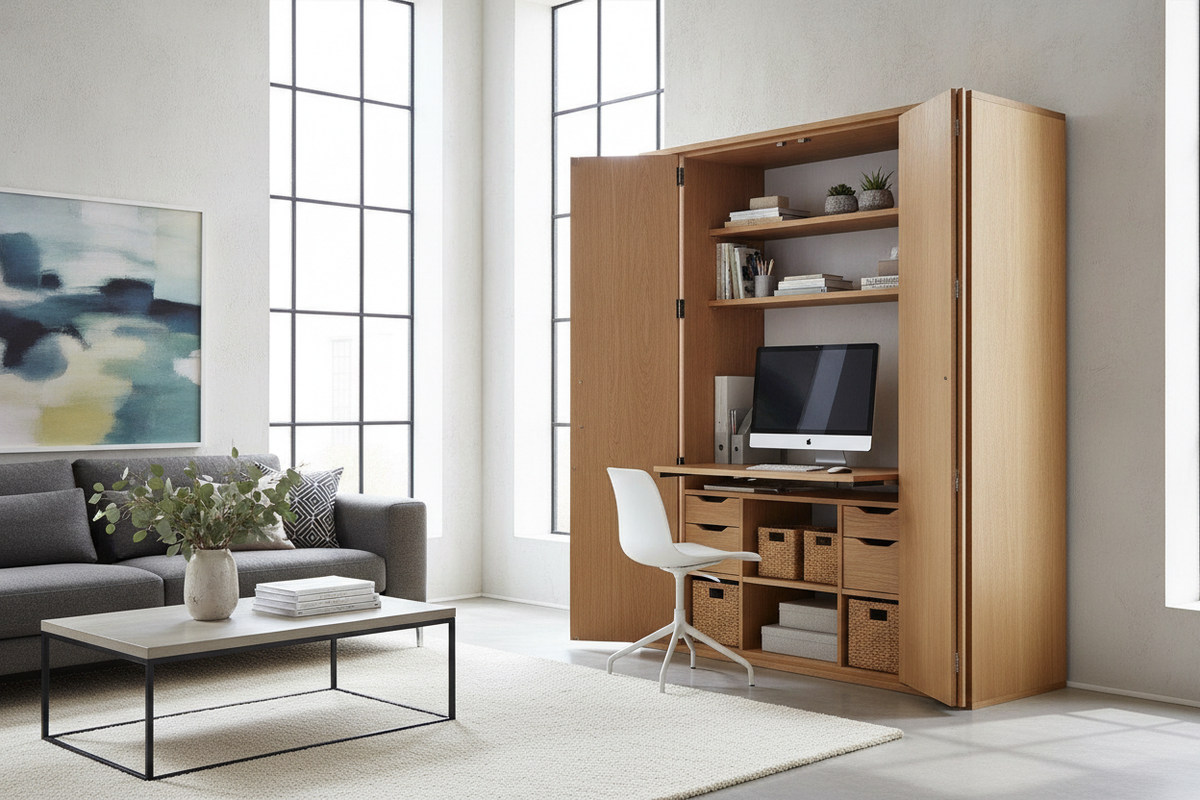
The Appeal of the Concealed Workstation: Why Choose a Desk Armoire?
The modern home office frequently shares square footage with living areas, bedrooms, or dining zones. In multipurpose environments, an open desk piled with cables, paperwork, and monitors can create visual noise that disrupts domestic relaxation. A desk armoire ikea setup offers an architectural solution by integrating an active workspace inside an enclosed cabinet structure. When the workday concludes, closing the doors conceals monitors, task lighting, and office clutter, restoring clean visual lines to the room.
Beyond aesthetics, enclosed workstations help establish psychological boundaries between professional tasks and home life. For individuals seeking a balanced home environment, an armoire computer desk ikea guide highlights how concealing screens at the end of the day supports spatial separation and mental decompression.
Core Architectural Formats: Dedicated Units vs. Wardrobe Retrofits
Concealed desks generally fall into two categories: compact drop-front secretary desks and full-height wardrobe conversions. Deciding between them depends on the equipment you plan to house and the available floor space.
Drop-Front Secretary Desks
Traditional drop-front desks feature a hinged front panel that opens downward to form a desktop while revealing shallow interior organizers. These units excel in tight footprints because they do not require deep interior clearance when closed. They work best for laptop users, writing tasks, and compact administrative setups. However, because the drop-down leaf relies on interior support hinges, they are suited for lightweight accessories rather than heavy multi-monitor configurations.
Full-Height Cabinet & Wardrobe Conversions
For more demanding desktop setups, converting a freestanding storage wardrobe or tall cabinet provides significant structural versatility. Using a deep cabinet framework allows users to install full-size desktop monitors, pull-out keyboard platforms, multi-tiered shelving, and integrated filing units. When evaluating custom wall runs or recessed spaces, reviewing a built-in desk and shelves guide can assist in deciding whether a freestanding wardrobe conversion or a permanent architectural build best suits your floor plan.
Dimensional Decision Frameworks: Measuring for Spatial Success
Successful cabinet workstation planning requires careful consideration of three physical planes: depth, height, and width. Overlooking clearance requirements can result in restricted legroom or doors that collide with nearby furniture.
Depth and Legroom Clearance
A primary challenge with an ikea armoire desk concept is ensuring adequate lower legroom. Standard wardrobes are designed for hanging clothes or folded items, meaning the bottom base shelf can obstruct knees if an interior desktop is positioned too far back. When configuring interior shelving:
- Ensure the primary work shelf sits at a standard seated elbow height.
- Verify that lower vertical panels or drawers do not prevent an office chair from pulling close to the work surface.
- Allow sufficient interior depth so external displays sit at a comfortable viewing distance from your natural seating posture.
Door Swing and Traffic Pathways
Before positioning an armoire desk, evaluate the surrounding perimeter clearance. Hinged panel doors require an open swing radius equal to the door width. In tight bedrooms or narrow corridors, open doors may block primary walkways. Bi-fold hardware or sliding doors minimize swing intrusion into shared spaces. Always map the total footprint of the unit with doors fully extended alongside the footprint of a pulled-out task chair.
Essential Interior Ergonomics: Shelving, Hardware, and Power Routing
Transforming an enclosed cabinet into an efficient workstation requires thoughtful integration of hardware, cables, and ventilation.
Cable Routing and Thermal Ventilation
Electronic hardware enclosed in wooden or composite cabinetry can trap heat. When organizing computers, power strips, and charging docks inside a cabinet:
- Plan discrete rear cable pass-through openings or desktop grommets to channel power leads behind interior panels.
- Ensure ventilation gaps exist around laptop docks and desktop towers, preventing trapped thermal buildup during extended operational hours.
- Elevate power distribution strips on internal side walls to keep floor space tidy and free of tangled cords.
Adjustable Shelving and Component Storage
Vertical flexibility allows a desk armoire to adapt to changing equipment. Adjustable interior pilasters let you position upper shelving to accommodate secondary monitors, reference binders, or task lamps. Lower sections can be partitioned into utility storage for printers, document files, or hardware accessories, keeping essential resources within arm's reach.
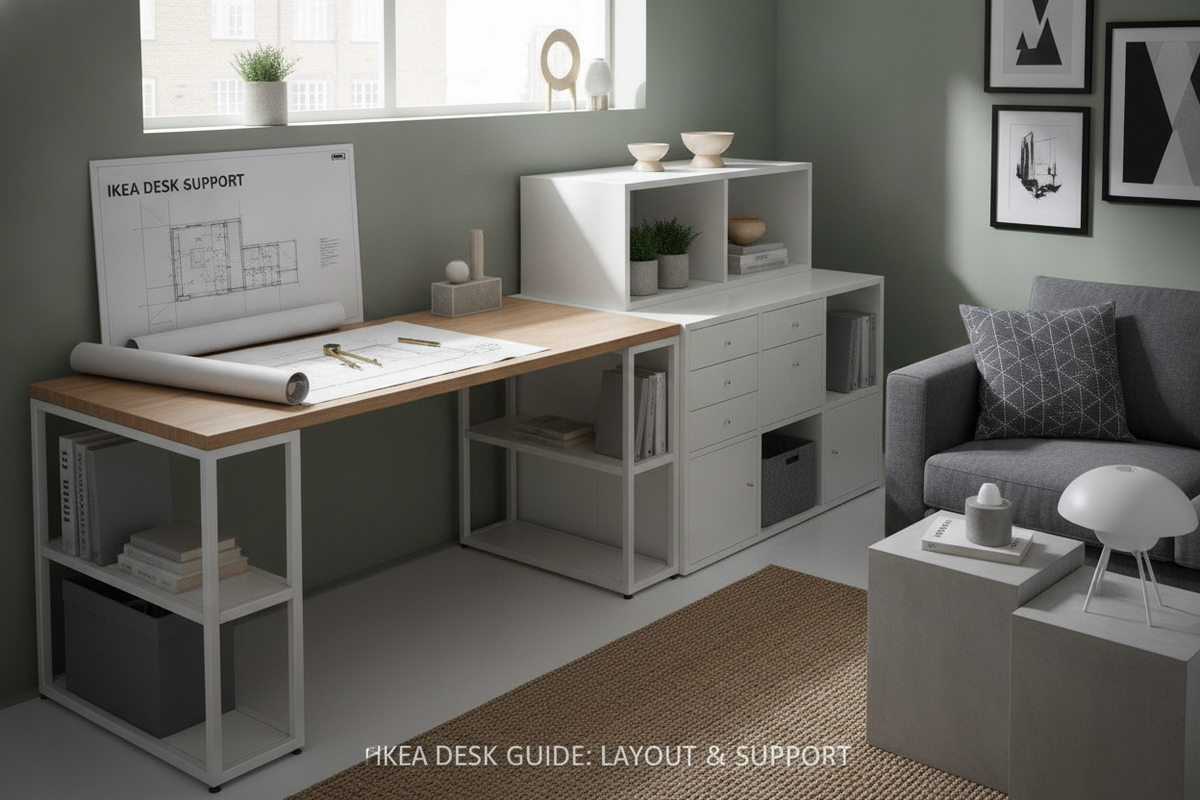
For specialized creative tasks requiring extensive exposed racks or audio interfaces, an open-format framework might prove more practical. In such scenarios, exploring a studio desk ikea guide offers insights into multi-tiered desk architecture designed for heavy equipment layouts.
Room Integration Strategies: Bedrooms, Living Areas, and Alcoves
Integrating a large armoire workstation into an existing room requires aligning finishes and architectural proportions with surrounding decor:
- Living Rooms: Select an exterior finish that matches your media unit, sideboard, or bookshelf. Panelled or minimalist door profiles help the cabinet read as general decorative storage rather than an office annex.
- Bedrooms: Position the armoire away from direct bed sightlines where possible. Neutral tones and smooth door fronts soften the visual presence of large cabinets in restful sleeping environments.
- Architectural Niches: Recessed alcoves provide natural containment for wardrobe-sized units, allowing the cabinet to sit flush with adjacent walls for an integrated, semi-custom appearance.
Alternative Freestanding Storage Solutions for Concealed Workstations
If you prefer a ready-to-assemble cabinet structure over building custom interior shelving from scratch, freestanding multi-door wardrobes provide an accessible baseline. A modern white wardrobe armoire features segmented vertical sections that can divide work equipment from utility storage, maintaining clean organization in medium-sized rooms.
For broader spaces requiring extensive office organization, a larger 4-door wardrobe armoire provides wide interior compartments that easily accommodate computer screens, accessory bins, and document storage while keeping the entire workstation concealed behind handsome panel doors.
Summary Checklist: Selecting and Setting Up Your Desk Armoire
Before selecting or assembling your cabinet workstation, review these practical checkpoints to ensure a durable and comfortable installation:
- Measure Available Floor Span: Confirm room dimensions, accounting for open door clearance, seating travel, and primary walkway navigation.
- Assess Legroom Depth: Verify that the interior work surface height and lower cavity depth allow comfortable seating posture.
- Plan Cable & Power Routing: Identify wall outlet proximity and map cord routing through back panels or internal channels.
- Ensure Passive Airflow: Maintain adequate clearance around electronic equipment inside enclosed compartments.
- Match Room Aesthetics: Select exterior finishes and hardware pulls that harmonize with the surrounding furniture palette.

Laisser un commentaire
Ce site est protégé par hCaptcha, et la Politique de confidentialité et les Conditions de service de hCaptcha s’appliquent.