


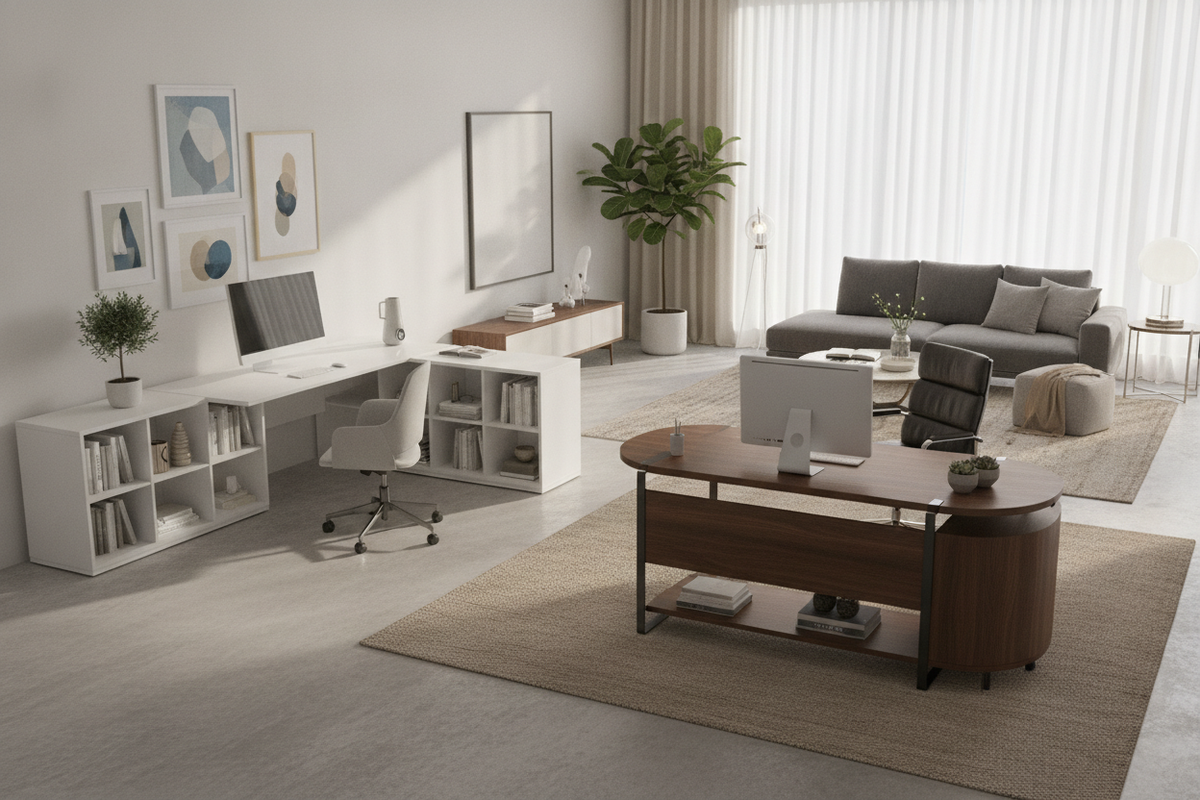
Setting up an effective workstation requires balancing surface area, storage access, and room flow. When evaluating corner and l shaped desks, many homeowners and remote professionals treat the two profiles interchangeably. However, distinct structural variations separate compact corner units from expansive L-shaped configurations. Choosing the right layout depends on your room dimensions, work equipment, and daily productivity routines.
Understanding Desk Geometries: Corner vs. L-Shaped Designs
While both desk styles maximize underutilized room perimeters, their structural geometry creates different ergonomic and aesthetic experiences. A dedicated l-shaped desk corner setup typically features two distinct rectangular surfaces joined at a right angle, forming a primary desk surface and an auxiliary side return. This architecture allows you to designate one wing for computer monitors and hardware, while the adjacent wing remains clear for paperwork, sketching, or peripheral gear.
In contrast, traditional corner desks often utilize a triangular, pentagonal, or curved wedge silhouette designed to nestle directly into a 90-degree room junction. True corner workstations orient the user facing straight into the corner apex, which condenses the total footprint while limiting the length of side wings. If you want to expand beyond a single workstation, pairing a compact corner table with matching pieces from a corner storage collection provides targeted utility without crowding narrow room paths.
Spatial Footprint Categories and Room Zoning Strategies
Evaluating your floor plan is essential before selecting a corner l shaped office desk. Workstations generally fall into three broad spatial categories:
- Compact Corner Nooks: Best suited for secondary bedrooms, guest spaces, or multi-purpose living areas where preserving central walking paths is the top priority.
- Mid-Scale L-Configurations: Provide balanced surface area along two adjoining walls, offering dedicated space for dual-screen computer setups alongside task lighting.
- Executive Peninsula Layouts: In larger rooms, an l-shaped corner office desk can project into the center of the room, using the return wing as a spatial room divider that creates a private working zone.
When planning your layout, verify adequate clearance behind your task chair to ensure smooth movement without knocking adjacent baseboards or doorways. Placing the primary monitor arm along the main wall helps prevent natural window glare while maintaining sightlines toward the room entryway.
Storage Configurations: Open Shelves, Drawers, and Credenza Returns
Storage integration significantly influences both desk functionality and open legroom. A well-designed l shaped corner desk with storage incorporates organization systems directly into one or both returns, reducing the need for standalone filing units.
Choosing an integrated model, such as a shaped corner desk product, helps keep daily essentials within arm's reach. Common storage configurations include:
- Open Book Shelves and Cubbies: Ideal for organizing reference books, storage baskets, and decorative items. Open storage maintains a lighter visual weight in smaller rooms.
- Enclosed Drawer Pedestals: Essential for concealing confidential documents, office stationery, and personal cables, keeping the tabletop uncluttered.
- Dedicated CPU or Peripheral Bays: Elevated bottom shelving protects desktop computer towers from carpet dust while freeing up valuable surface space above.
Vertical Storage and Desktop Organization
When floor area is constrained, building upward preserves your active desktop footprint. Selecting an l-shaped corner desk with shelves or an integrated hutch allows you to utilize vertical wall space for manuals, task lamps, and small electronics. For additional organizational strategies, consulting an actionable desk storage office guide offers helpful ideas for styling overhead shelving without compromising clean visual lines.
Material Selection, Reversibility, and Assembly Considerations
The durability and adaptability of corner l-shaped desks depend heavily on frame construction and assembly engineering. Heavy-duty steel leg frames paired with durable engineered wood tops offer sturdy support for heavy multi-monitor mounts, desktop printers, and audio interfaces.
One of the most practical features to look for is a reversible layout. Reversible L-shaped desks allow you to assemble the longer extension wing on either the left or right side during initial setup. This modularity ensures your desk can adapt to future room layouts or home relocations. A streamlined option like a modern office corner desk product provides clean aesthetics along with adaptable orientation to suit varying wall clearances.
Actionable Decision Checklist for Your Workspace
Before purchasing your workstation, run through this concise checklist to ensure your selected desk matches your room and workflow requirements:
- Measure Wall Dimensions: Confirm that baseboards, wall heaters, and electrical outlets will not be blocked by the desk wings or back panels.
- Evaluate Legroom Clearance: Ensure integrated drawers or shelving pedestals do not restrict your natural knee swing or seating comfort when rotating between wings.
- Audit Work Equipment: List your essential hardware—including monitors, laptops, docking stations, and printers—to determine how much surface depth you need on each wing.
- Plan Cable Pathways: Look for built-in grommets or rear clearance gaps that allow discreet cable routing down to power strips.
- Coordinate Secondary Storage: If built-in drawers are minimal, review a dedicated desk storage office guide to select complementary modular bins and desktop caddies.
By carefully assessing your available wall perimeter, storage preferences, and daily workflow habits, you can select the ideal corner or L-shaped workstation that enhances productivity while keeping your room balanced and organized.


Laisser un commentaire
Ce site est protégé par hCaptcha, et la Politique de confidentialité et les Conditions de service de hCaptcha s’appliquent.