


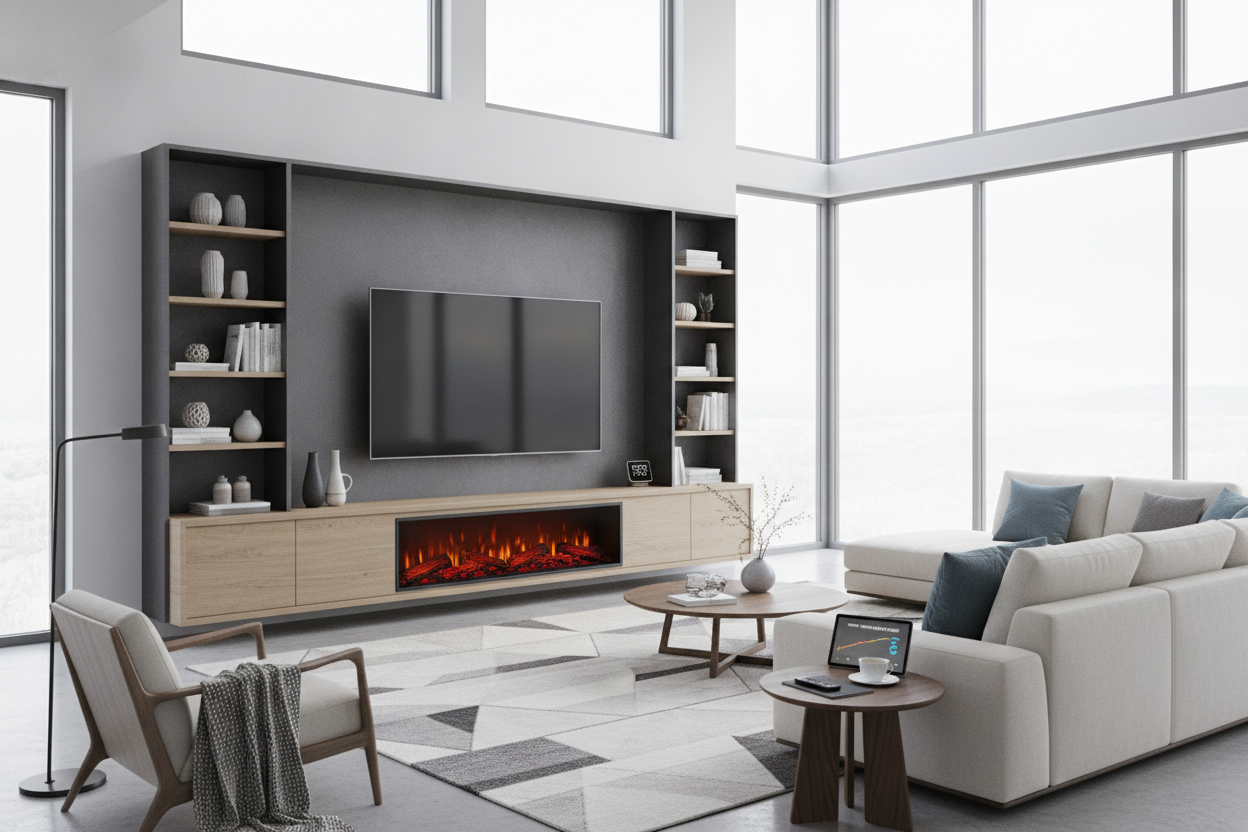
I spent most of last November wearing a puffer vest inside my own house. My living room is one of those cavernous, open-concept nightmares with 12-foot ceilings where the heat just disappears into the kitchen or floats up to the rafters. I was tired of paying the gas company $300 a month just to keep my toes from turning blue, so I started looking at a 1000 sq ft electric fireplace tv stand as a desperate solution to my drafty reality.
I've tried it all: heavy curtains, draft stoppers under the doors, and even those plastic window seal kits that make your house look like a crime scene. Nothing worked. I needed a heater that didn't just blow lukewarm air around, but actually changed the temperature of the zone I was sitting in. After staring at 47 browser tabs of media consoles, I decided to see if the '1000 square foot' promise was marketing fluff or a legitimate winter survival tool.
Quick Takeaways
- Infrared quartz technology is the secret sauce for reaching that 1,000 sq ft capacity.
- It warms people and furniture directly, making it perfect for rooms with high ceilings.
- Assembly is a two-person project—the fireplace insert alone usually weighs 30+ pounds.
- Zone heating (turning down the central furnace) can actually lower your monthly bill.
The Big Promise vs. My Freezing Living Room
Heating a large, open-concept space is a fool's errand if you're relying solely on central air. The thermostat is in the hallway, the vents are in the ceiling, and the cold air is pooling right where my feet are on the sofa. I looked into professional options first. I thought about a gas insert, but read about my initial sticker shock before I pivoted to furniture. A three-thousand-dollar quote just for the gas line and venting made me realize that a plug-and-play solution was the only sane choice.
The 1000 sq ft electric fireplace tv stand is pitched as a 'zone heater.' The idea is simple: stop trying to heat the guest bedroom and the laundry room at 7 PM. Just heat the room you’re actually using. But I was skeptical. Most space heaters I've owned couldn't even handle a bathroom, let alone a massive living area that flows into a kitchen. I needed to know if this piece of furniture was a glorified nightlight or a functional appliance.
I chose a unit that felt substantial. If you're going to put a 75-inch TV on top of a heater, you don't want something made of thin particle board that’s going to warp the second the coils get hot. I looked for something with a solid weight and a heater rated for 5,200 BTUs, which is the standard for these high-capacity units.
What Does 1000 Square Feet Actually Mean for a Heater?
When you're shopping, you'll notice two main types of heaters in these consoles. The cheap ones use fan-forced coils. They’re fine for a small office, but they tap out at about 400 square feet. If you want a fireplace tv stand 1000 sq ft rating, you have to look for infrared quartz technology. It’s a completely different way of moving energy.
Standard heaters work by convection—they heat the air. In a drafty room, that hot air just gets sucked out through the window cracks or rises to the ceiling. Infrared quartz works like the sun. It emits infrared light that is absorbed by your skin, your clothes, and your sofa. It doesn't dry out the air either, which is a massive plus if you're prone to winter nosebleeds or itchy skin. When the box says it heats 1,000 square feet, it means that within that radius, the radiant heat will be effective enough to supplement your home's temperature by about 10 to 15 degrees.
It’s also about the 'feel.' An infrared heater makes you feel warm immediately, even if the air temperature in the room hasn't climbed yet. For my open-concept layout, this was the only logical choice. I didn't need to heat the air in the 12-foot void above my head; I just needed to stop shivering while watching Netflix.
The Real-World Test: Did It Actually Keep the Chill Away?
The night I put it to the test, it was 30 degrees outside and windy. I turned my central heat down to 60 degrees—a temperature my husband describes as 'unacceptable for human habitation'—and turned the fireplace to its max setting. I was using a massive electric fireplace tv stand heats 1000 sq ft unit that I'd spent three hours assembling. Because I have a huge wall to fill, an extra-wide media console with electric fireplace heater was the only thing that didn't look like a toy in the space.
Within twenty minutes, the 'chill' was gone. Not just near the heater, but across the entire 20x20 sitting area. The infrared waves actually made the fabric of the sofa feel warm to the touch. It’s a much more comfortable heat than the dry, blasting air of a furnace. I could sit ten feet away and still feel the warmth on my face. It didn't quite reach the back of the kitchen, but it definitely covered the primary living zone as promised.
There is a catch, though. These units are heavy. You aren't moving this thing once it's set up. The fireplace insert is a dense box of glass and metal, and the console itself needs to be sturdy enough to support it. Also, the fan isn't silent. It’s a consistent whir—roughly the same volume as a modern dishwasher. If you’re a total silence purist, it might bug you. For me, it was a fair trade for not having to wear a scarf at the dinner table.
The Surprising Impact on My Winter Electric Bill
This is where everyone gets nervous. 'Won't running a 1500-watt heater all night kill your electric bill?' I did the math. My unit costs about 15 to 20 cents an hour to run at full blast. If I run it for six hours an evening, that's about $1.20 a day, or $36 a month. In exchange, my gas furnace—which costs a fortune to run because it's heating the entire house—runs 50% less often.
By using the fireplace for zone heating, I saved nearly $50 on my gas bill in December alone. The electric bill went up, sure, but the net savings were real. It’s about efficiency. Why heat the air in the guest bathroom at 9 PM? It’s a smarter way to manage a home, especially if you live in a place where electricity is relatively cheap compared to natural gas. Plus, you get the visual 'warmth' of the flames, which actually has a psychological effect on how cold you feel.
The Verdict: Is the High-Capacity Upgrade Worth It?
If you have a large room, don't even bother with the 400 sq ft models. You'll be disappointed, and you'll end up running it on 'high' constantly, which wears out the motor faster. The jump to a 1,000 sq ft capacity unit is worth every extra penny for the infrared technology alone. It’s the difference between a decorative piece of furniture and a functional home appliance.
However, if you're in a small apartment or a closed-off 10x12 den, this is total overkill. You'll be sweating within an hour. In those cases, you’re better off browsing standard TV stands and just buying a small, portable ceramic heater for your feet. But for those of us struggling with 'great rooms' that feel more like 'great refrigerators,' this was the best furniture investment I've made in years.
FAQ
Can I put my TV directly on the stand?
Yes, as long as the stand is rated for your TV's weight. The heat is forced out of the front of the unit through a vent, so the top surface stays cool. My 75-inch TV hasn't had a single issue.
Does the flame look like a real fire?
It's an LED projection. It won't fool a lumberjack, but it's remarkably cozy. Most units have adjustable brightness and color settings, so you can go from 'roaring fire' to 'dim embers' depending on your mood.
Is it safe for pets and kids?
The glass front usually stays cool to the touch because the heat blows from the vent above or below the glass. However, the vent itself gets very hot. I'd keep curious toddlers and wagging tails a few inches away from the heat discharge area.


Laisser un commentaire
Ce site est protégé par hCaptcha, et la Politique de confidentialité et les Conditions de service de hCaptcha s’appliquent.