


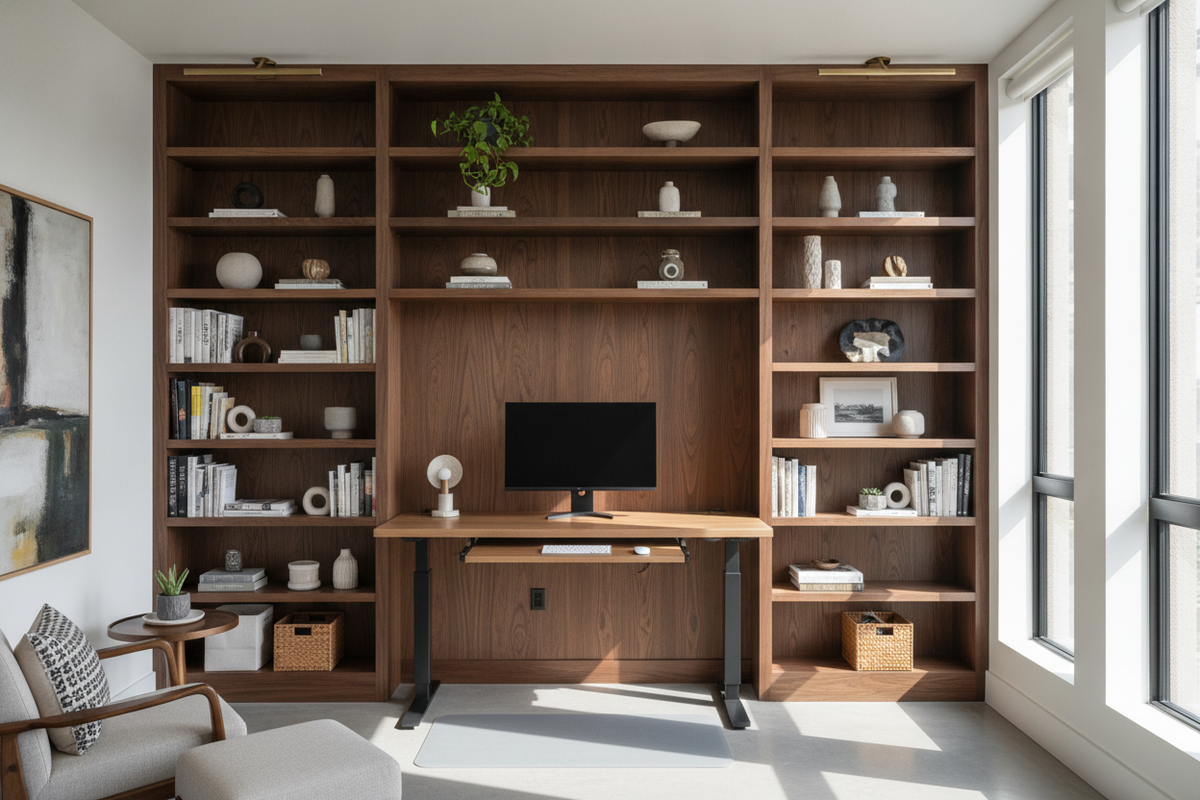
The Rise of the Bookcase Standing Desk: Merging Dynamic Posture with Vertical Utility
Modern home offices face a continuous tension between open surface space and ample document storage. Traditional executive desks provided deep file pedestals and drawers, but their fixed positions often locked workers into sedentary postures throughout the working day. Conversely, standard height-adjustable workstations encourage varied physical movement yet frequently lack adjacent surface capacity for reference volumes, notebooks, stationery, and office equipment. When monitors, keyboards, audio interfaces, and lighting consume primary tabletop depth, basic desk surfaces become overcrowded.
A bookcase standing desk arrangement bridges this divide by uniting dynamic postural flexibility with vertical storage capacity. Rather than scattering reference material across auxiliary tables or losing floor area to distant credenzas, integrating shelving adjacent to or alongside an adjustable work surface organizes work tools into tidy vertical zones. Exploring versatile standing desk collections highlights how modern workspaces merge functional utility with active movement, ensuring high-frequency tools remain easily within reach whether standing or sitting.
Structural Architectures: Integrated Attached Shelving vs. Modular Flanking Bookcases
When selecting a standing desk with bookshelf components, spatial planners generally choose between two primary configurations: direct mechanical integration or modular flanking arrangements.
Integrated designs physically anchor storage compartments, shelving tiers, or return cabinets directly to the adjustable lifting frame or its primary substructure. An all-in-one format, such as a standing desk with dedicated side storage, delivers an architecturally cohesive profile while anchoring drawers and shelving right at the desk perimeter. In these layouts, the base foundation remains grounded while the active work plane glides vertically, providing immediate access to personal essentials without taking up excess room.
Modular flanking configurations, on the other hand, decouple the adjustable motorized or manual desk from standalone shelving towers. Pairing a height-adjustable center table with an adjacent open multi-tier storage shelf affords versatile reconfigurability. This approach accommodates irregular room layouts, permits independent anchoring of tall book towers to structural wall studs, and allows you to reposition or expand shelving units whenever work equipment changes.
Motion Envelopes and Clearance Planning: Eliminating Collisions and Cable Tension
Introducing vertical movement alongside fixed vertical cabinetry introduces distinct spatial clearance considerations. Unlike stationary furniture, an adjustable desk traverses a continuous vertical path. Neglecting this motion envelope can lead to binding surfaces, scuffed veneer, or pinched wiring harness assemblies.
To maintain smooth movement, account for these structural and spatial factors during setup:
- Perimeter Spacing: Maintain a clean lateral gap between the moving desktop edges and the side uprights of any adjacent bookcase to prevent surface friction and rubbing.
- Wall and Baseboard Offsets: Account for floor baseboards and wall molding so that lower shelf bases do not push upper bookcase frames into the vertical travel zone of the desktop.
- Monitor Arm Arc: Calculate the rearward swing and tilt adjustment of clamp-mounted display arms, verifying they clear overhead shelves when raised to full standing heights.
- Cable Slack Management: Run electrical wiring, display feeds, and peripheral power through articulating cable management tracks that extend cleanly without catching on flanking shelf edges.
Reviewing common standing desk layout mistakes reinforces the importance of mapping the complete transition cycle before permanently mounting heavy accessories or setting desktop limits.
Shelf Organization Framework: Active Reach Zones and Balanced Weight Distribution
Effective vertical shelving relies on thoughtful weight distribution and intuitive reach zones. Stacking items haphazardly diminishes the functional convenience of a dual-purpose office hub and can compromise the visual balance of open-frame furniture.
Dividing a vertical bookcase into functional storage tiers helps balance daily access with stable weight placement:
- Base Tiers (Floor to Knee Height): Reserve lower shelves for heavy reference volumes, archival storage boxes, oversized portfolios, and computer battery backups. Placing denser objects near the floor lowers the structural center of gravity, providing reassuring stability.
- Mid Tiers (Desktop Level to Eye Level): Allocate this prime zone to high-utility materials such as daily journals, ongoing project binders, pen trays, and external hard drives. These items remain reachable from both seated and upright working postures.
- Upper Tiers (Above Seated Head Height): Dedicate high shelves to passive references, framed photographs, ambient lighting, or trailing indoor plants. Keeping higher elevations visually airy prevents the furniture piece from feeling overbearing.
Adhering to this ergonomic hierarchy keeps your primary desktop clear for typing, writing, and mouse movement without interrupting access to essential resources.
Room Layout Strategies: Optimizing Corners, Flat Walls, and Acoustic Separation
Placing tall storage furniture alongside an active workstation requires careful consideration of natural light paths, perimeter flow, and visual weight. Because vertical towers carry significant presence, their orientation influences how open a room feels.
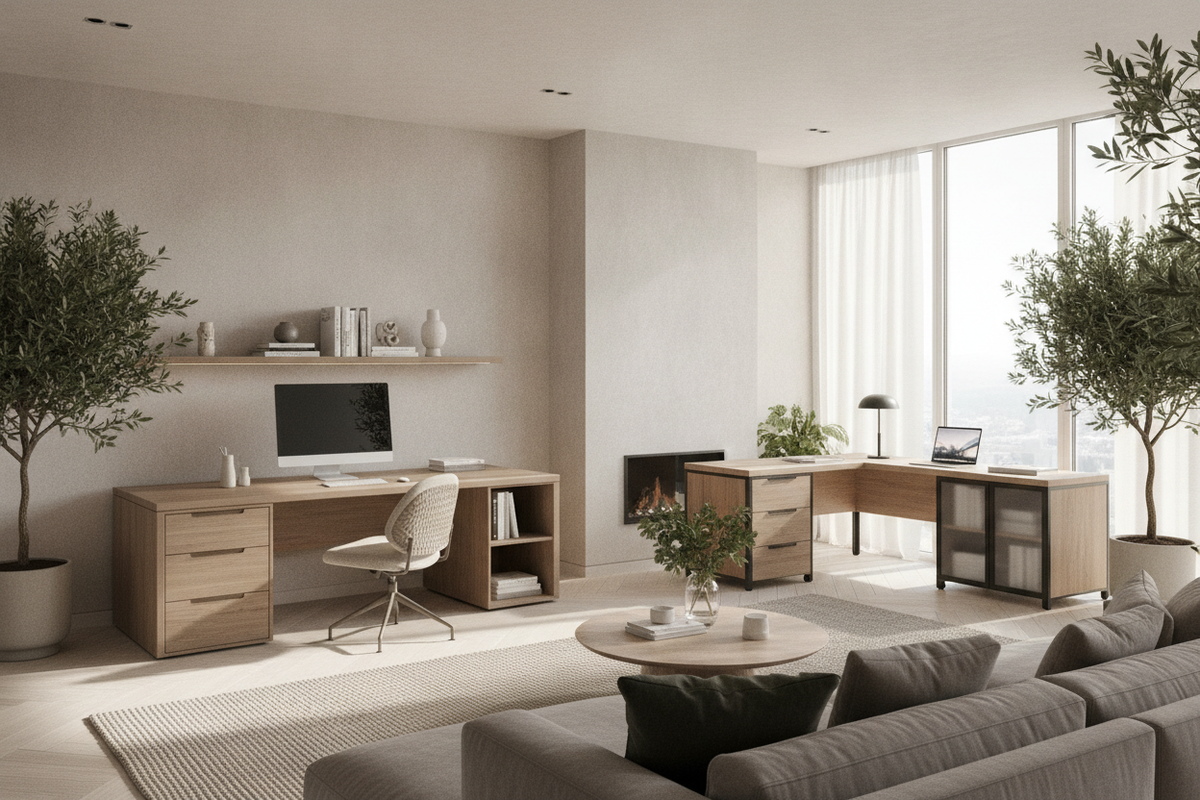
In modest room footprints, tucking an L-shaped standing desk with peripheral shelves into a corner makes practical use of architectural nooks that might otherwise go unused. Aligning tall shelving along secondary walls ensures direct window sightlines remain open, allowing daylight to illuminate the primary work surface without producing screen glare.
For larger floor plans or shared studio areas, a bookcase standing desk configuration can serve as an elegant room divider. Positioning open shelving perpendicular to a long wall creates dedicated functional zones, separating private work areas from surrounding living spaces. Open-backed bookcases preserve sightlines and airflow, creating a tailored study nook without enclosing the room behind solid partition panels.
Material Harmony and Visual Balance in Tall Office Furniture
A towering home office assembly should complement your interior decor rather than dominate it. When dynamic steel lifting columns stand beside tall shelving frames, harmonious materials and consistent design accents unify the installation.
Achieving cohesive standing desk visual styling involves pairing compatible frame finishes, shelf textures, and panel proportions across the workspace. Combining dark powder-coated steel uprights with warm oak, walnut, or espresso wood-grain surfaces creates an inviting industrial or modern transitional aesthetic. Incorporating open side frames helps tall vertical units feel light and unobtrusive, while integrated rear cross-bracing provides reassuring rigidity.
By harmonizing vertical reach with dependable sit-stand mechanics, a thoughtfully arranged bookcase standing desk creates a neat, productive, and adaptable workstation tailored to modern home office life.

Laisser un commentaire
Ce site est protégé par hCaptcha, et la Politique de confidentialité et les Conditions de service de hCaptcha s’appliquent.