


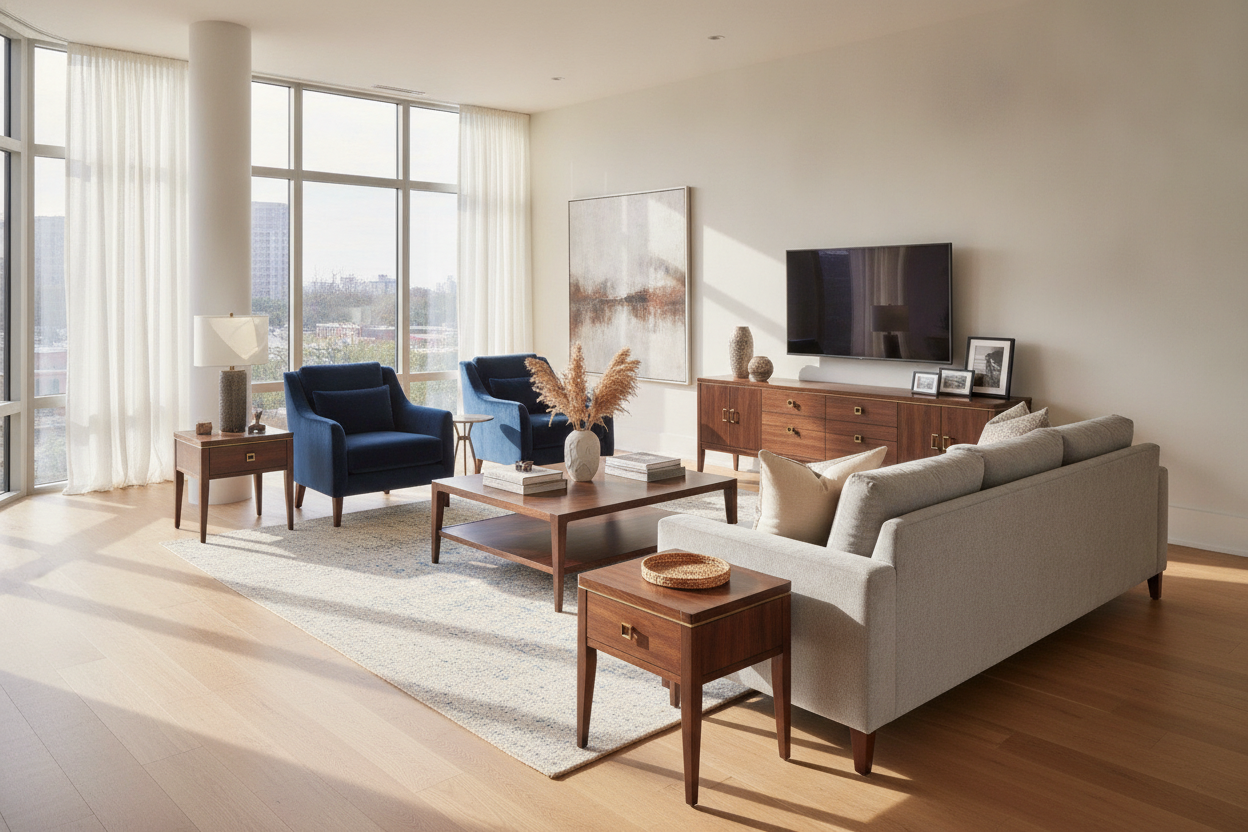
I spent three years trying to make my living room look 'curated.' I had a walnut media console, an oak coffee table, and a mango wood end table I found at a thrift store that I swore I would sand down and restain (I didn't). At night, under the warm glow of my lamps, the undertones fought like cats and dogs. One was too orange, one was too gray, and the whole room felt like a graveyard for mismatched clearance finds rather than a cohesive home.
Eventually, I realized that hunting for the perfect 'complementary but not matching' wood grain was a full-time job I didn't want. I caved and looked into matching tv stand coffee and end tables. I was terrified my house would look like a sterile hotel lobby, but I was wrong. Sometimes, the easiest way to make a room feel expensive is to let the furniture provide the baseline so your personality can do the heavy lifting.
Quick Takeaways
- Matching sets create a 'visual anchor' that prevents large rooms from feeling cluttered.
- The 'catalog look' only happens if you leave the surfaces empty; styling is the antidote.
- Mixing materials—like glass or metal—within a set prevents the room from feeling heavy.
- Sets save dozens of hours of browsing and eliminate the risk of clashing wood undertones.
The Exhaustion of Mixing Woods (And Why I Gave Up)
There is a specific kind of madness that comes from holding a swirled oak coaster up to a computer screen to see if it matches a 'natural ash' coffee table. Wood grains are finicky. You think you've found a match until the sun hits the grain and you realize one is cool-toned while the other is aggressively yellow. I reached my breaking point when my living room started looking like a lumber yard sample board.
I realized I was wrong about buying a tv stand and coffee table set because I was prioritizing 'uniqueness' over actual peace of mind. When your furniture matches, the background noise of the room disappears. You stop noticing the clashing legs and start noticing the art on the walls or the view out the window. It’s a design shortcut that high-end designers use more often than they’d like to admit.
Do Matching Sets Always Look Like a Furniture Catalog?
The biggest fear is the 'showroom effect.' We’ve all walked into a store where everything is the exact same shade of espresso brown, and it feels soul-crushing. But here is the secret: those rooms feel dead because they lack life, not because the tables match. If you put a pile of messy magazines and a half-dead pothos on a $5,000 custom table, it looks lived-in. If you put nothing on a matching set, it looks like a staged model home.
A coffee table tv console set provides a foundation. It’s the 'little black dress' of your living room. It’s not meant to be the entire outfit; it’s the base that allows your rug, your pillows, and your weird ceramic collection to actually stand out. Without that consistency, those decorative items just add to the visual noise.
The Secret is in the Styling
To break up the uniformity, you need to play with height and texture. If your tables are all dark wood, don't put dark wood trays on them. Use a white marble tray on the coffee table or a stack of oversized, colorful art books. I once saw a friend pull this off by choosing a fireplace tv stand and coffee table set that added a flickering light source to the room, which immediately distracted from the fact that the wood grain was identical across all three pieces.
Throw a high-pile rug under the coffee table to soften the edges. Use a tall, architectural lamp on the end table to draw the eye upward. These layers create a 'curated' vibe without the headache of sourcing four different tables from four different vendors.
Why Modern Bundles Actually Work in Open Layouts
In an open-concept house, your living room is often just a floating island in the middle of a kitchen and dining area. Without a cohesive end table tv stand set, the space can feel unanchored. Matching pieces create an invisible boundary that says, 'This is the lounge area.' It defines the zone much more effectively than a rug alone.
For smaller apartments or modern builds with lots of glass, I’m a fan of high-contrast sets. A high gloss LED TV stand paired with matching side tables can bounce light around a dark corner, making the whole 'zone' feel intentional and bright rather than cramped and cluttered.
How to Pick a Set That Doesn't Feel Heavy
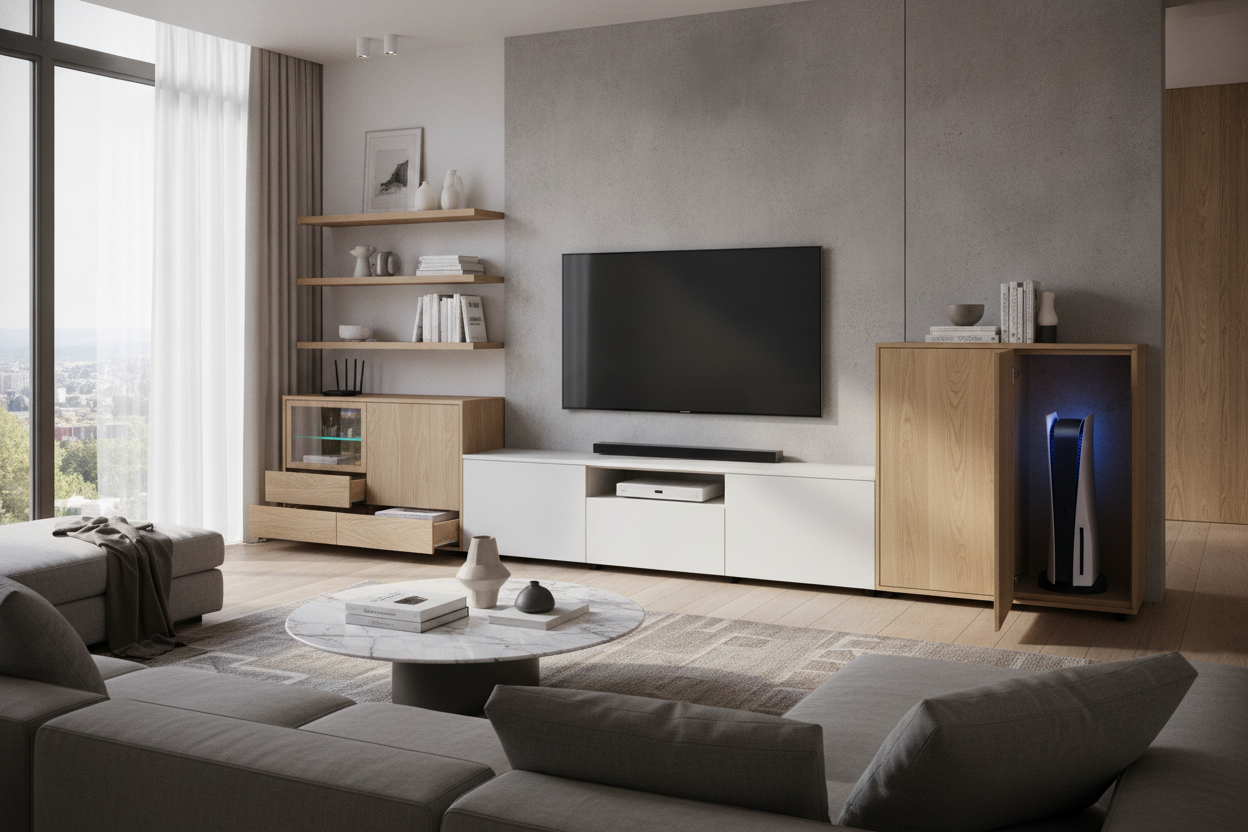
If you’re worried about a set feeling like a 'block' of wood, look for pieces with 'breathing room.' This means tables with legs rather than solid bases, or pieces that incorporate different materials. A set that features metal frames or glass inserts feels significantly lighter than solid cherry or oak. I always recommend a media console with glass doors to break up the solid front of a matching set. It allows you to display books or decor inside, adding a layer of depth that stops the furniture from feeling like a giant monolith in the corner of the room.
FAQ
Is it tacky to have a matching coffee table and TV stand?
Not at all. It’s only 'tacky' if you don't style them. Treat the matching surfaces as a blank canvas for different textures like wool, ceramic, and greenery.
Should the coffee table be the same height as the TV stand?
Usually, no. Your TV stand should be at eye level for viewing (often 24-30 inches), while your coffee table should be roughly the same height as your sofa cushions (16-18 inches). Matching sets are designed with these ergonomic differences in mind.
How do I make a matching set look more expensive?
Swap the hardware. If your set comes with basic silver knobs, replace them with heavy brass or matte black pulls. It’s a $20 fix that makes a big-box set look like a custom commission.

Laisser un commentaire
Ce site est protégé par hCaptcha, et la Politique de confidentialité et les Conditions de service de hCaptcha s’appliquent.