


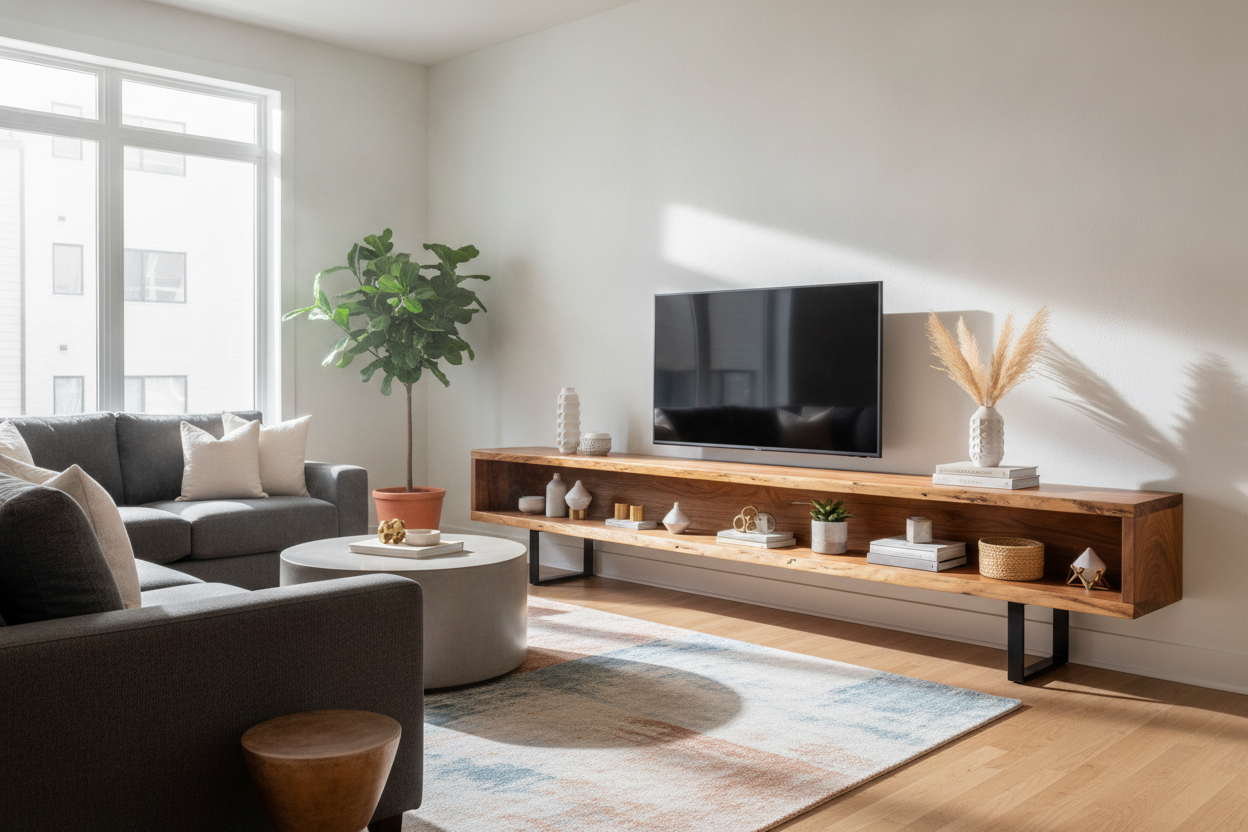
I spent three weeks staring at a 65-inch OLED sitting on its cardboard box because I couldn't commit to a media console. Everything looked like a generic hotel lobby or a flimsy piece of Swedish origami. Then I saw a 2-inch thick slab of walnut with a raw, wiggly edge, and I realized that live edge tv stands are the only things with enough visual weight to ground a massive black screen.
The fear, of course, is that your living room will suddenly smell like pine needles and look like a set piece from a Western. But after testing a few of these in my own 1950s ranch, I’ve found that the 'log cabin' vibe is actually pretty easy to avoid if you know what you’re doing.
- Contrast is key: Pair raw wood with high-tech gadgets to make both look better.
- Leg choice: Metal hairpin or U-shaped legs pull the piece into the modern era.
- Maintenance: Real wood needs a little oil, but it hides dust better than glass.
- Mounting: Floating slabs require serious studs; don't trust your drywall anchors.
The Great Tech vs. Nature Divide
There is a weird tension when you place a piece of 21st-century tech on a living edge tv stand. You have this hyper-flat, glossy rectangle of glass and plastic sitting on a piece of timber that spent eighty years growing in a forest. It shouldn't work, but it does. This exact contrast is what interior designers call 'visual interest,' but I just call it not being boring.
A live edge wood tv stand acts as a buffer. In most modern living rooms, we have too many hard, straight lines—the walls, the windows, the rug, the TV itself. Introducing a wood slab tv stand breaks that grid. It feels intentional. When you’re staring at a screen for four hours, having that organic texture underneath provides a much-needed rest for your eyes. I’ve noticed that in rooms with a live wood tv stand, the TV feels less like a black hole and more like a curated part of the decor.
The trick is to lean into the imperfection. Don't try to find a slab that is perfectly symmetrical. The knots, the cracks (often filled with sleek black epoxy), and the varying thickness are what give a live edge tv shelf its soul. If you wanted something perfect, you’d buy a plastic laminate unit from a big-box store and be done with it.
How to Avoid the 'Log Cabin' Aesthetic
The fastest way to make your house look like a ski resort is to pair a live edge wood tv console with a leather sofa and a bear-skin rug. Don't do that. To keep things contemporary, you need to balance the 'raw' with the 'refined.' When you are shopping for solid wood TV stands, look for pieces that utilize industrial materials for the base.
I’m a huge fan of matte black powder-coated steel legs. Whether they are slim hairpin legs or chunky square frames, the metal tells your brain that this is a piece of furniture, not just a fallen log. If you’re working with a smaller space, a live edge corner tv stand can actually feel quite modern if the wood is a lighter species like maple or ash. Avoid the heavy, dark orange stains that were popular in the 90s; they scream 'rustic' in all the wrong ways.
Instead, look for a clear matte finish. You want to see the grain, not a thick layer of shiny plastic. A live edge tv cabinet with clean-lined doors—maybe even painted a dark charcoal—contrasted against a raw wood top is the sweet spot. It bridges the gap between mid-century modern and organic industrial without needing a single antler decoration in the room.
Legs or No Legs? The Floating Slab Dilemma
If you really want to kill the rustic vibe and go full 'architectural digest,' a live edge floating tv stand is the move. By removing the legs entirely, you make the wood look like it’s defying gravity. It turns a heavy live edge entertainment center into something airy and light. However, let's talk physics for a second. A solid 2-inch slab of acacia or walnut is heavy. We’re talking 50 to 100 pounds before you even put a TV on it.
I attempted to install a live edge shelf under tv last year and nearly ripped my wall down because I missed a stud. You cannot mount these with simple toggle bolts. You need heavy-duty steel brackets that are screwed directly into the center of your 2x4 studs. If you’re renting or your walls are made of old plaster, stick to a floor-standing live edge tv table. It’s safer for your security deposit and your sanity.
The floor-standing live edge tv console also gives you more room for storage. While a floating shelf looks cool, you have nowhere to hide your router or your Nintendo Switch. A low-profile console with a thick slab top provides that same organic feel but actually gives you a place to put your stuff. Just make sure the legs are at least 6 inches high so your robot vacuum can get under there.
The Ugly Truth About Cords and Uneven Edges
Here is something the glossy photos won't tell you: a live edge media console is a nightmare for cable management. Unlike those MDF units with the convenient little circular cutouts in the back, a raw slab is just... a slab. If you have a live edge wood entertainment center, your cords are going to be visible unless you get creative. I ended up using black Velcro ties and industrial-strength command hooks to run my cables along the underside of the wood and down the back of the metal legs.
Then there’s the 'wobble' factor. Real wood moves. It expands and contracts with the seasons. Sometimes, the top of a live edge tv cabinet isn't perfectly level because the grain is naturally wavy. I once spent an hour trying to figure out why my soundbar was rattling, only to realize it was sitting on a slight hump in the wood grain. A few adhesive felt pads or a small shim fixed it, but it’s something you have to be prepared for.
Despite these quirks, I’d never go back. I recently swapped my old sagging MDF console for a TV stand in wood and the difference is staggering. The MDF was literally bowing under the weight of a 55-inch screen. A solid slab doesn’t bow. It doesn't peel at the edges when you spill a drink. It just sits there looking expensive and indestructible.
Is the Investment Actually Worth It?
You can find 'live edge' look-alikes at discount furniture stores, but they’re usually just a piece of particle board with a wavy plastic sticker on the front. Don't bother. An authentic live edge wood tv console is an investment piece. Because every slab is unique, you’re buying a one-of-one functional sculpture. If you move houses, that stand will work in a loft, a colonial, or a modern condo.
The durability is the real selling point. A barn wood TV stand is the only console surviving my house with two dogs and a toddler. If a real wood slab gets a scratch, you just rub a little oil on it or give it a light sand, and it disappears into the character of the piece. You can't do that with a veneer. In ten years, the tech inside your TV will be obsolete, but the wood slab underneath it will still be the best-looking thing in the room.
FAQ
Do live edge TV stands warp over time?
Only if the wood wasn't properly kiln-dried. As long as you buy from a reputable maker who treats the wood correctly, it won't warp. Just keep it away from direct heat sources like a radiator or a fireplace.
How do I clean a raw wood edge?
A soft vacuum brush attachment is your best friend for getting dust out of the crevices. For the top, a damp microfiber cloth is usually enough. Avoid harsh chemical sprays; they can strip the natural oils and make the wood look thirsty.
Is my TV too heavy for a floating live edge shelf?
It’s usually not the TV that’s the problem—it’s the shelf itself. Most modern TVs are surprisingly light. If your shelf is properly lagged into at least three studs, it can easily hold a 65-inch TV and all your peripherals.

Laisser un commentaire
Ce site est protégé par hCaptcha, et la Politique de confidentialité et les Conditions de service de hCaptcha s’appliquent.