


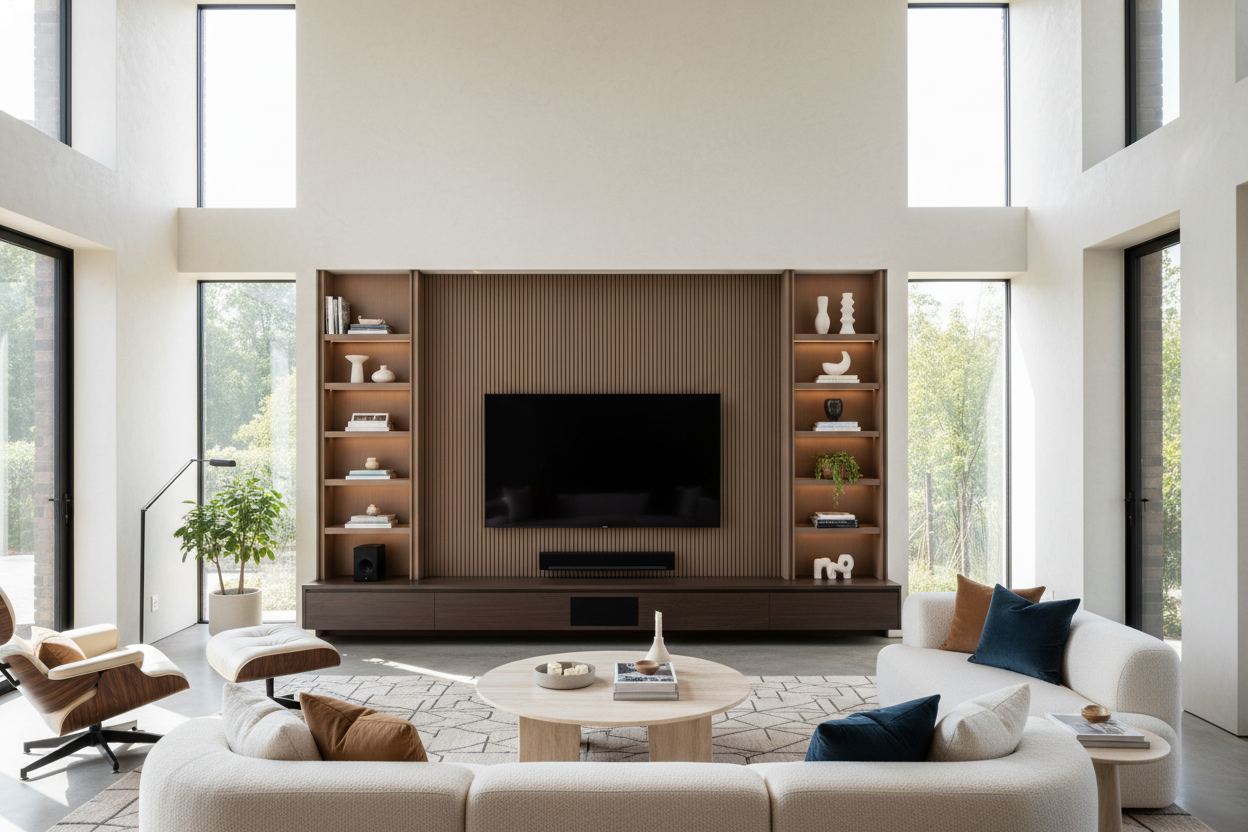
I spent three hours last night trying to hide a bird's nest of HDMI cables behind a spindly mid-century console that cost more than my first car. My 65-inch TV looks like a giant black monolith perched on a toothpick. It is a mess. I am starting to realize that the question shouldn't be are entertainment centers out of style, but rather: why did we ever think we could live without them?
Quick Takeaways
- The honey-oak 'monster' armoires of the 90s are dead, but modular wall units are back.
- Tiny consoles look disproportionate under the 75-inch and 85-inch screens common today.
- Modern units focus on 'framing' the TV rather than 'hiding' it.
- Cable management is the primary driver for the return of larger media furniture.
The Giant Oak Elephant in the Room (Why We Started Hating Them)
Remember the honey-oak beasts of the late 90s? I helped a friend move one into a third-floor walk-up in 2008, and I still have the lower back pain to prove it. They were built for 200-pound tube TVs and had those weird swivel stands that never quite stayed straight. They took up an entire wall and made every living room feel like a cramped electronics store.
When flatscreens finally became affordable, we collectively revolted. We wanted 'airy.' We wanted 'minimalist.' Suddenly, shopping for an entertainment center felt like buying a coffin for your living room. We pivoted hard to thin, low-profile stands that did absolutely nothing to hide the reality of our hardware. We traded storage for 'vibes,' and now we are all staring at tangled wires and dusty routers.
Wait, Are Entertainment Centers Outdated Now?
So, are entertainment centers outdated? The answer is a hard 'it depends.' If you are talking about the one-piece unit that encloses the TV in a dark, claustrophobic cave, then yes, those are buried. But modern wall units and entertainment centers are actually the hottest thing in high-end design right now. The difference is scale and breathability.
The modern version is often modular. It is about creating a dedicated 'zone' for the TV that feels intentional. I have seen designers using floor-to-ceiling shelving that frames the screen like a piece of art. It is not about a bulky box; it is about architectural interest. We are moving away from the 'TV on a stick' look because, frankly, it looks cheap in a grown-up house.
The Skinny TV Stand Era is Finally Ending
We went too far with the minimalist thing. I tried a 48-inch console under a 75-inch TV once in my old apartment. It looked like a bodybuilder standing on a skateboard. It was visually top-heavy and honestly felt dangerous. Plus, there was nowhere to put the PS5, the mesh router, and the three different remotes I can never find.
Today's screens are massive, and we finally have entertainment centers large enough for 85 screens that actually anchor the room. You need that horizontal weight to balance out the sheer acreage of black glass on the wall. A larger unit provides a visual foundation, making the TV look like part of the room's design rather than an appliance someone just leaned against the wall.
What a 'Modern' Media Unit Actually Looks Like
Forget the heavy doors and the 'media towers' of the past. Modern units use tricks like slatted wood that lets remote signals through while hiding the blinking lights of your modem. I am a huge fan of minimalist entertainment centers with adjustable width because they can grow with your space. If you move to a bigger house or buy a bigger screen, the furniture adapts.
The best ones I have tested lately use a mix of closed drawers (for the clutter) and open shelving (for the pretty stuff). You want a piece that looks like a custom built-in but doesn't require a contractor and a five-figure budget. Look for matte finishes, integrated LED lighting, and—most importantly—real cable management channels that are actually wide enough for a power strip plug.
3 Rules for Buying a Wall Unit That Won't Look Like 2004
First, follow the 2/3rds rule. Your furniture should be at least 20% to 30% wider than your TV screen. Anything less and the TV looks like it is about to tip over. Second, keep the height low. If the center of your TV is higher than your eye level when sitting, you are going to end up at the chiropractor. Low and wide is the modern silhouette.
Third, look for a piece where elevated style meets everyday entertainment needs. This means checking the depth. I once bought a gorgeous, slim unit only to realize my receiver stuck out two inches from the back. Measure your deepest component before you hit 'buy.' If you have a small room, go for a floating version or one with tall legs to keep the floor visible—it makes the room feel twice as large.
FAQ
Do entertainment centers make a room look smaller?
Only if they are too deep or too dark. A light-colored, wide unit can actually make a wall feel more expansive and organized by hiding the visual 'noise' of cables and gadgets.
How do I hide my TV wires without a wall unit?
You can run them through the wall, but that is a permanent DIY project. A modern media unit with a back panel is the easiest way to hide the mess without a drill and a permit.
Should the TV be centered in the entertainment center?
Usually, yes, for viewing angles. However, asymmetrical units are very trendy right now—you can offset the TV to one side and balance the other side with a tall vase or a stack of books to make the screen less dominant.


Laisser un commentaire
Ce site est protégé par hCaptcha, et la Politique de confidentialité et les Conditions de service de hCaptcha s’appliquent.