


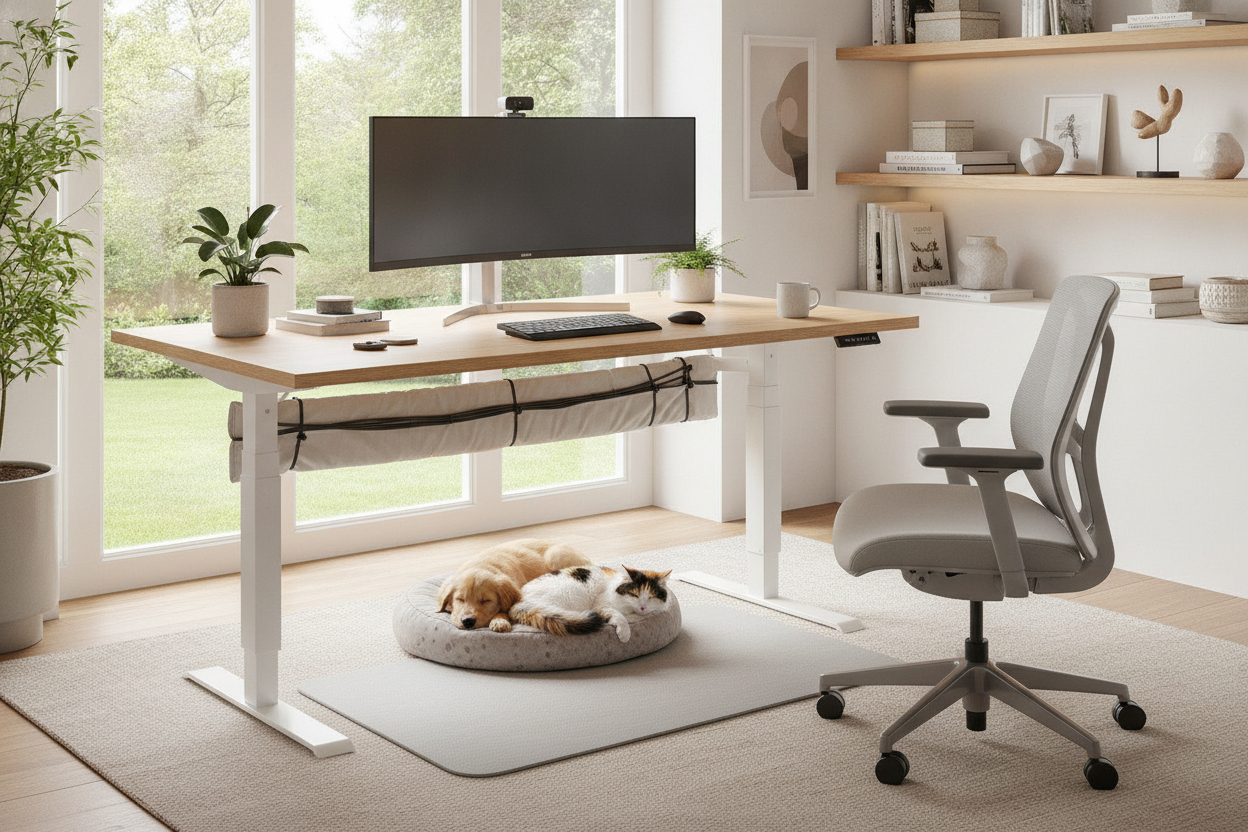
I spent three years working from home with a cat who thinks my keyboard is a bed and a dog who thinks my feet are a pillow. Adding electric standing desks to that mix felt like introducing a slow-motion guillotine to the living room. You don't realize how much stuff—and how many limbs—end up under your workspace until that workspace starts moving on its own.
If you are upgrading from a standard writing computer desk, the change is jarring. A static desk is a safe haven for a napping pet. A motorized one is a heavy piece of machinery with enough torque to crush a laptop or, worse, a tail. I’ve personally lived through the heart-stopping moment of hearing a 'yelp' because I wasn't looking before I hit a preset button.
- Anti-collision is non-negotiable: Do not buy a desk without high-sensitivity sensors.
- Cable management saves lives: Dangling power cords are irresistible chew toys.
- Presets are your friend: Use them to set a 'hard floor' that leaves room for a pet bed.
- Lock your controls: Touch-sensitive panels can be triggered by a stray paw or a wet nose.
The Terrifying First Time You Lower a Motorised Desk
The first time I lowered my desk while my Golden Retriever was snoring underneath, I realized I had made a tactical error. Unlike a standard writing computer desk, which just sits there being a piece of wood, a motorized frame is active. It doesn't know there is a living creature in its path unless it is specifically designed to 'feel' resistance.
The anxiety of pressing that 'down' button is real. You’re often looking at your monitor, not the floor. If your pet likes to tuck themselves into tight spaces, they are at risk of being pinched between the leg columns or crushed under the desktop itself. It’s a level of home office danger we didn't have to worry about five years ago.
What Anti-Collision Actually Means for an Adjustable Electric Desk
Most people think all desks stop the moment they hit something. They don't. The electric lift system in a high-quality desk uses a gyroscopic sensor or sophisticated software to detect a change in motor current. If the desk hits a chair—or a dog’s back—it senses the resistance and reverses direction.
However, the sensitivity varies wildly. An adjustable electric desk with poor sensors might require 30 or 40 pounds of force before it decides to stop. That is more than enough to break a plastic bin or hurt a small cat. You want a frame that reacts to the slightest nudge, not one that needs a full-on collision to wake up.
The Coffee Cup Test vs. The Dog Bed Test
I always test my desks with the 'Coffee Cup Test.' I place a sturdy mug on a chair and lower the desk onto it. A good desk stops instantly. But here is the problem: a plush dog bed is squishy. A budget standing motorized desk often fails the 'squish test' because the soft foam of a pet bed doesn't provide enough immediate resistance to trigger the sensor until the bed is already pancaked.
Why Dangling Cords on Power Standing Desks Are a Chew Hazard
The movement of power standing desks creates a unique problem: cable slack. To allow the desk to reach its full height, you have to leave several feet of loose power cords. To a kitten, those moving, dangling wires look like a jungle gym. I once found my cat batting at the main power lead as the desk was ascending, nearly unplugging the whole rig mid-update.
If you have a chewer, an electric stand sit desk is a nightmare. You cannot just tuck the wires away; they have to move. I highly recommend using braided cable sleeves or a 'cable spine' that keeps the wires contained in a rigid, pet-proof structure as the desk moves up and down.
Will the Whine of an Electric Rise Desk Scare Your Animals?
Most electric rise desk motors operate around 45 to 55 decibels. It’s a low-frequency hum that most pets eventually ignore. However, cheap single-motor frames often have a high-pitched whine or a jerky start-stop motion that can trigger 'zoomies' or fear in noise-sensitive dogs.
A high-end motorised sit stand desk usually features dual motors that are much smoother and quieter. In my experience, the smoother the motion, the less likely your pet is to notice the desk is even moving. If your dog hides during the vacuuming, they’ll probably hate a loud, budget-tier desk motor too.
How to Pet-Proof Your Electric Sit to Stand Desk
The best way to stay safe is to use your memory preset controller strategically. I have my 'sitting' height set slightly higher than usual—about 28 inches—which is just enough to clear my dog’s head if he’s sitting upright. It’s a safety buffer that prevents a total crush if I’m not paying attention.
Also, check if your desk has a 'lockout' feature. Many touch-sensitive controllers can be activated by a cat walking across the desk. I’ve come back from the kitchen to find my desk at its maximum height because the cat wanted to see out the window. Lock the panel every time you walk away.
FAQ
Can a cat trigger the desk buttons?
Yes, especially touch-capacitive panels. Always look for a controller with a child-lock or a physical 'off' switch to prevent accidental activation by paws.
What is the safest anti-collision tech?
Look for 'Six-Axis' or 'Gyroscopic' sensors. These are much more sensitive than basic software-based current sensing and will stop the desk if it tilts even slightly.
Are standing desks dangerous for small dogs?
They can be if the dog likes to hide under things. The best defense is a cable tray that blocks the 'pinch points' where the legs meet the desk frame.



Laisser un commentaire
Ce site est protégé par hCaptcha, et la Politique de confidentialité et les Conditions de service de hCaptcha s’appliquent.