


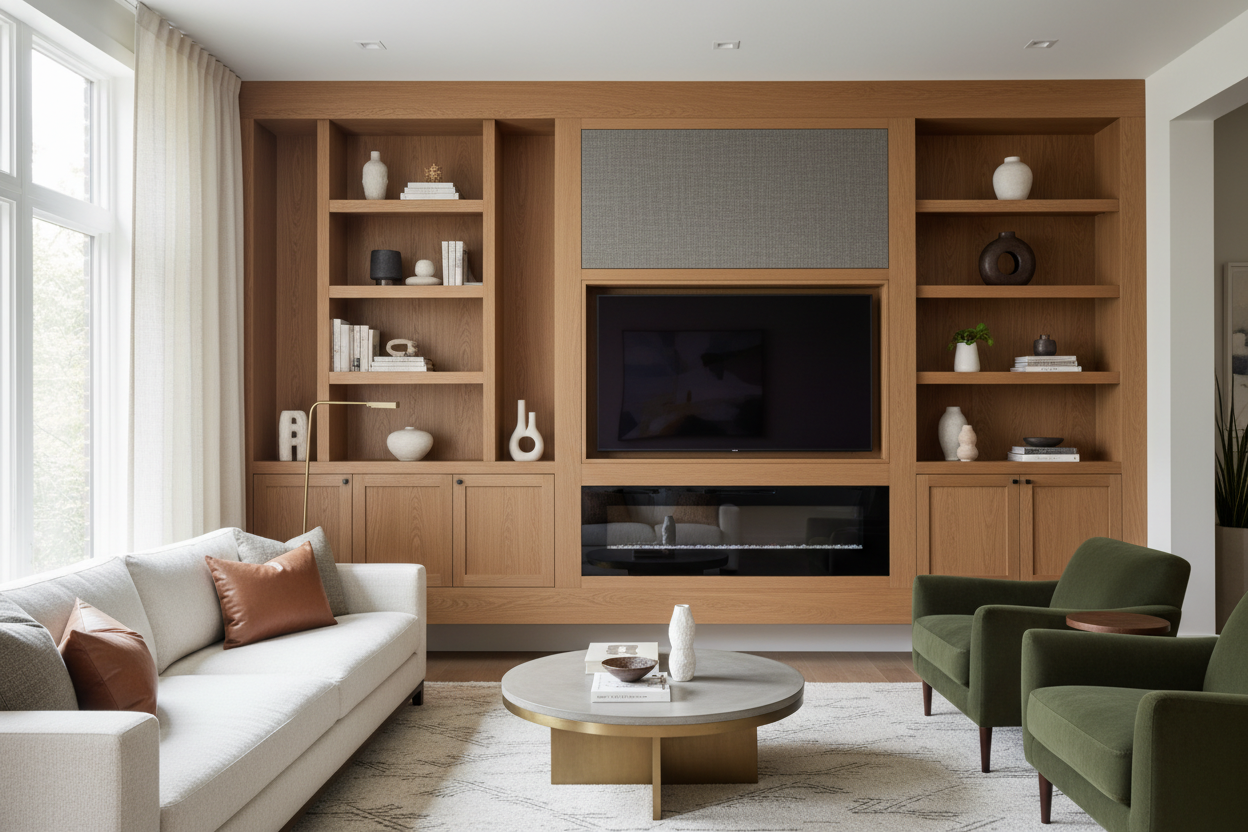
J'ai déjà passé tout un Super Bowl chez des amis à fixer le plafond parce que leur téléviseur était fixé à deux mètres de hauteur au-dessus d'une imposante cheminée en pierre. Au quatrième quart-temps, j'avais l'impression que mon cou avait subi un léger accrochage. Nous avons collectivement décidé que la cheminée est le cœur de la pièce et la télévision le cerveau, mais essayer de les empiler verticalement est un désastre ergonomique. Un meuble mural de salon avec cheminée est la solution qui respecte réellement vos vertèbres.
Points clés à retenir
- L'ergonomie avant tout : Gardez le téléviseur à hauteur des yeux, généralement à 107 cm du sol jusqu'au centre de l'écran.
- Sécurité : Recherchez des inserts électriques à ventilation frontale pour protéger vos appareils électroniques de la chaleur ascendante.
- Rangement : Ces unités remplacent trois meubles (le support, les étagères et l'âtre) par un seul ensemble cohérent.
- Échelle : Faites correspondre la largeur du foyer à au moins 50 % de la largeur du téléviseur pour éviter un aspect « déséquilibré ».
Le cauchemar des torticolis que nous avons tous accepté
La tendance du « téléviseur au-dessus de la cheminée » est le mulet du design d'intérieur – cela semblait une bonne idée à l'époque, mais nous allons tous regretter les photos plus tard. Lorsque vous montez un écran si haut, vous forcez votre cou dans un état constant d'extension. C'est physiquement épuisant. Au-delà du coût physique, cela a l'air encombré. Vous avez deux points focaux concurrents qui se disputent la domination dans une pile verticale.
Les options d'aménagement de salon traditionnelles vous piègent souvent. Soit vous orientez tous les meubles vers la cheminée et ignorez la télévision, soit vous l'orientez vers la télévision et laissez la cheminée se sentir comme un vestige architectural solitaire. Les intégrer dans une seule unité horizontale ou verticale basse met fin à la guerre visuelle.
Pourquoi une structure intégrée fonctionne réellement
Un meuble mural n'est pas seulement un meuble ; c'est un moyen de donner des « fondations » à une pièce sans équipe de construction. En combinant le meuble média, les étagères et un âtre électrique en une seule pièce, vous créez un point d'ancrage unifié pour la pièce. Le téléviseur peut enfin se trouver à une hauteur confortable – à peu près au niveau de la poitrine lorsque vous êtes assis – tandis que le foyer se trouve juste en dessous ou légèrement sur le côté.
J'ai vu des gens essayer de bricoler cela avec trois bibliothèques IKEA différentes et un chauffage autonome, et cela ressemble toujours à un fouillis de différentes essences de bois. Opter pour un centre de divertissement mural complet avec un foyer intégré offre cet aspect haut de gamme et sur mesure pour une fraction du prix d'un entrepreneur. Il comble le vide de la « boîte blanche » d'un salon de banlieue standard et donne à l'espace une impression d'enracinement.
Respecter les proportions
Ne placez pas un téléviseur de 75 pouces au-dessus d'un petit foyer de 18 pouces. Cela ressemble à une tête géante sur un petit cou. Idéalement, votre insert de cheminée devrait être suffisamment large pour avoir un certain poids visuel. Si vous avez un écran massif, recherchez un meuble avec une cheminée électrique linéaire qui s'étend sur au moins 50 ou 60 pouces. Cela crée un « bloc » équilibré de lumière et de mouvement qui ne donne pas l'impression d'être trop lourd en haut.
Styliser les étagères sans distraire de la flamme
Lorsque vous utilisez des meubles muraux pour le salon avec cheminée, la tentation est de remplir chaque centimètre carré d'étagères avec des photos de famille et des tasses souvenirs. Ne le faites pas. La lumière vacillante du feu et l'image en mouvement sur l'écran sont déjà des éléments visuels « chargés ». Vous voulez que le décor environnant soit discret.
Je suggère de regrouper les objets par couleur ou par matière — pensez à toutes les céramiques blanches ou à une collection de livres anciens à couverture rigide. Cela donne à l'œil un endroit où se reposer. Si vous trouvez toujours la technologie trop distrayante lorsque vous essayez simplement de savourer un verre de vin au coin du feu, il existe même des unités conçues pour cacher complètement l'écran derrière des portes coulissantes de grange ou des panneaux pliants. C'est l'ambiance « déconnectée » par excellence pour un vendredi soir.
Le débat Chaleur vs. Technologie : Est-ce sûr ?
La question numéro un que l'on me pose est : « Le feu ne va-t-il pas faire fondre ma télé coûteuse ? » Si vous utilisiez un poêle à bois, alors oui, absolument. Mais les inserts électriques modernes sont conçus différemment. La plupart des unités de haute qualité utilisent des souffleries frontales. La chaleur est projetée dans la pièce, pas vers l'écran. J'ai fait fonctionner mon unité pendant six heures d'affilée et le bas de ma télévision est resté parfaitement frais au toucher.
Mon expérience personnelle
J'ai appris à la dure que l'on en a pour son argent avec l'effet "feu". Ma première unité était une trouvaille bon marché où les "flammes" ressemblaient à une boule disco tournante de 1974. C'était distrayant et bas de gamme. Finalement, je l'ai remplacée par une unité avec un effet de flamme 3D et des couleurs de braises réglables. Cela ressemble vraiment à un vrai feu. Mon erreur a été de privilégier le nombre d'étagères plutôt que la qualité du foyer lui-même. Si vous allez le regarder tous les soirs, assurez-vous que la flamme ne ressemble pas à un écran de veille de Windows 95.
FAQ
Ces unités nécessitent-elles une prise spéciale ?
La plupart des foyers électriques standard se branchent sur une prise murale normale de 120 V. Cependant, ils consomment environ 1 400 à 1 500 watts, donc j'éviterais de partager ce circuit spécifique avec un radiateur d'appoint ou un aspirateur puissant.
Puis-je laisser la flamme allumée sans la chaleur ?
Oui ! C'est le meilleur. La plupart des modèles ont un réglage « flamme seule », vous pouvez donc avoir une ambiance chaleureuse au milieu d'une canicule de juillet sans transformer votre salon en sauna.
Sont-ils difficiles à assembler ?
Ils sont lourds. Prévoyez un travail à deux et environ trois heures d'assemblage. Ce n'est pas difficile, juste fastidieux. Utilisez un vrai tournevis, pas celui fourni dans la boîte, sinon vous aurez des ampoules à la dixième page du manuel.

Laisser un commentaire
Ce site est protégé par hCaptcha, et la Politique de confidentialité et les Conditions de service de hCaptcha s’appliquent.