


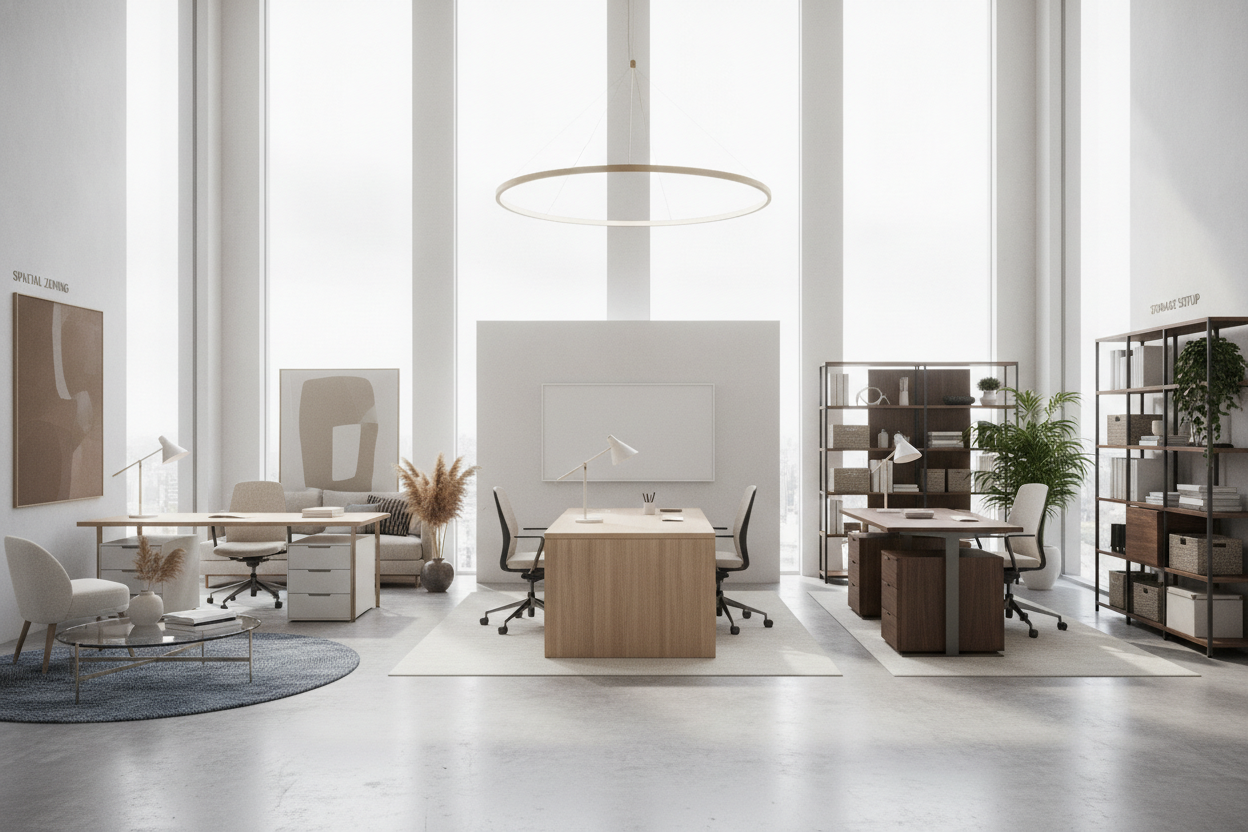
Designing a functional workspace for three people requires careful balancing of shared square footage, physical movement, and personal work zones. When setting up a 3 desk office layout, the arrangement must support daily focus while enabling smooth communication among teammates without creating visual or physical friction.
Core Spatial Considerations for a 3 Desk Office Layout
Before moving furniture into place, evaluating room architecture helps avoid cramped corridors and awkward seating angles. Referencing a comprehensive desk office layout guide provides a clear baseline for spatial planning, circulation routes, and natural lighting access across the room.
Circulation Clearance and Seating Envelopes
Every workstation requires an adequate envelope of clear floor space behind the desk to accommodate chair movement, standing transitions, and general foot traffic. When desks are placed too close together, rolling chairs can collide or block walkways. Ensuring clear perimeter aisles keeps movement fluid throughout the working day.
Balancing Screen Privacy and Collaborative Sightlines
Visual privacy and teamwork often compete in a three person office layout. Facing desks toward walls maximizes individual focus and conceals screens from direct sightlines, whereas facing desks toward a central point encourages ongoing dialogue. Desk dividers, acoustic felt panels, or low hutch shelving can establish distinct work zones without completely walling off team members.
Five Practical 3 Person Office Layout Configurations
Choosing the right structural arrangement depends primarily on room geometry and the team's typical daily workflow. Expanding beyond a standard person office layout guide, three-worker footprints present distinct structural options for linear, square, or irregular spaces.
The Linear Perimeter (In-Line Wall Setup)
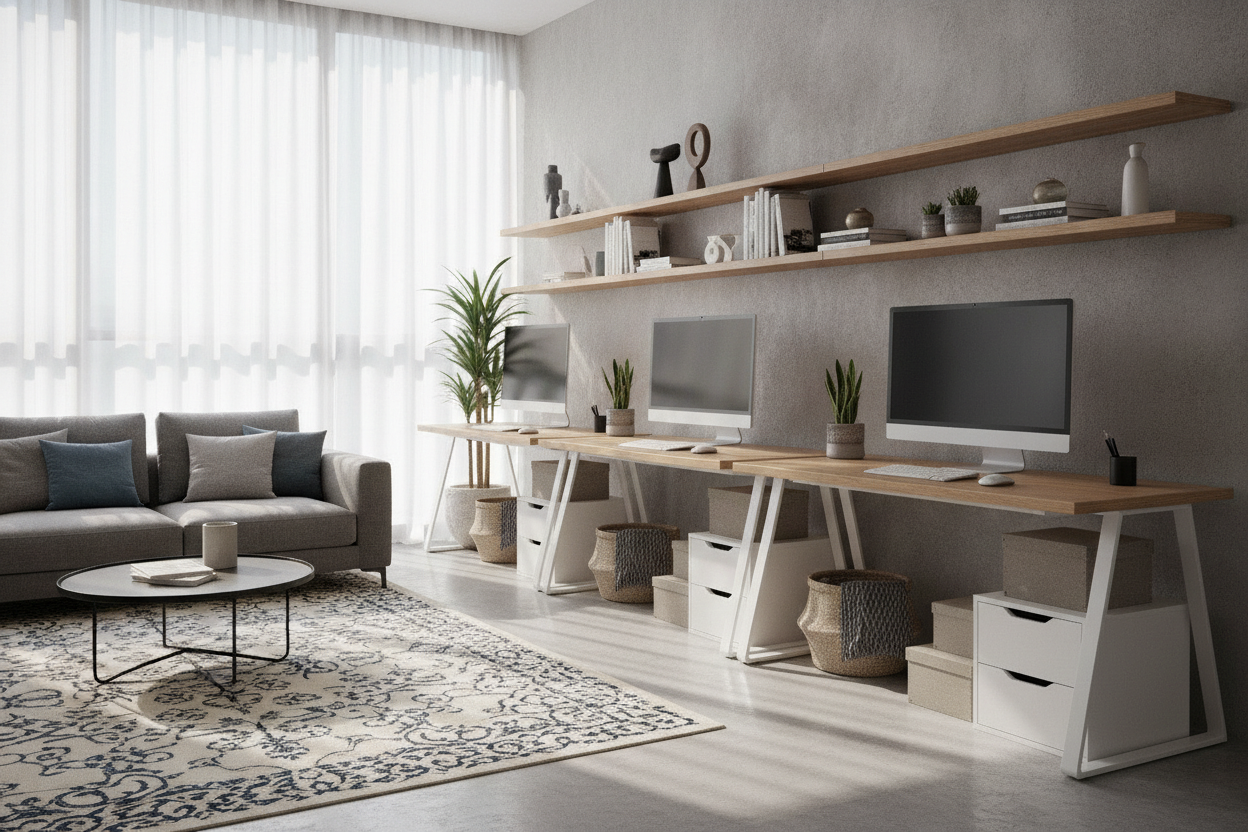
Positioning all three desks side-by-side along a single long wall creates an open, unobstructed central floor area. This setup excels in long, narrow rectangular rooms. It streamlines wall-outlet cable routing and keeps walkways wide, though it requires sufficient wall run length to give each person independent elbow room.
The T-Shaped Collaborative Hub
In a T-shaped layout, two desks are positioned facing one another or side-by-side, while a third desk joins perpendicularly at the end. This arrangement forms a dedicated collaborative core, making it well suited for lead-and-support team dynamics or project-based tasks requiring constant screen sharing.
The Corner L-Plus-One Setup
A corner-oriented setup pairs an L-shaped desk in the primary corner with two linear desks along adjacent walls. Incorporating a dedicated corner workstation, such as a multi-tier office desk product, makes productive use of corner dead space while preserving open floor area for the remaining two straight desks.
The Pinwheel / Triad Cluster
For square or open-plan rooms, arranging three desks radially—facing outward from a shared central junction—creates balanced personal territories. Each worker turns their back slightly to the core, minimizing direct eye contact during independent focus while keeping power drop points centrally grouped.
The U-Shaped Pod Layout
Using three separate perimeter walls or modular partitions, the U-shaped pod assigns one desk to each boundary. This provides the highest degree of personal separation and wall-mounted storage space, leaving the center of the room completely clear for circulation or a small communal work table.
Optimizing a Small Office 3 Desk Office Layout
When organizing a small 3 person office layout, spatial efficiency is paramount. Bulky executive desks quickly overwhelm modest footprints. Selecting streamlined frames with modest desktop depths preserves valuable floor space. For further guidance on mitigating spatial bottlenecks, consulting a small office layout guide helps prevent common spatial traps like blocking doorways or crowding main walkways.
Storage Architecture: Dedicated vs. Shared Units
A successful three desk office layout relies on balanced storage zoning so individual supplies do not spill across communal zones. Dividing storage into dedicated individual compartments and shared central storage maintains an orderly environment.
- Dedicated Pedestals: Mobile under-desk drawer units give each worker private storage for personal items and active files.
- Integrated Cabinet Desks: Selecting an all-in-one office desk product provides built-in drawers and enclosed cabinets directly within the workstation footprint.
- Shared Credenzas: Placing a low lateral filing cabinet or shelving console against a neutral wall serves as a central station for communal printers, reference materials, and office supplies.
Cable Management and Power Distribution in Shared Rooms
Multiple computers, monitors, and accessories can quickly create tangled cords and tripping hazards in a 3 person office layout. Effective cable management ensures clean aesthetics and orderly operation:
- Mount under-desk cable trays or J-channels to keep power strips and adapter bricks elevated off the floor.
- Route shared cords along baseboards using adhesive raceways rather than stretching wires across open walking paths.
- Consolidate power into heavy-duty surge protectors positioned directly beneath central desk clusters.
Summary Checklist: How to Arrange 3 Desks in an Office
When finalizing your layout, run through this practical checklist to confirm spatial harmony:
- Measure Usable Perimeter: Account for door swings, window sills, and heat registers before setting desk positions.
- Select the Matching Geometry: Use linear setups for narrow rooms, corner L-combinations for medium spaces, and triad clusters for square rooms.
- Verify Clearance: Ensure chairs can slide back freely without obstructing active pathways.
- Consolidate Storage: Pair integrated desk drawers with vertical wall storage to keep walking aisles completely clear.
- Secure Electrical Runs: Organize all power feeds along walls or beneath desk surfaces to maintain safe, uncluttered floors.

Laisser un commentaire
Ce site est protégé par hCaptcha, et la Politique de confidentialité et les Conditions de service de hCaptcha s’appliquent.