

















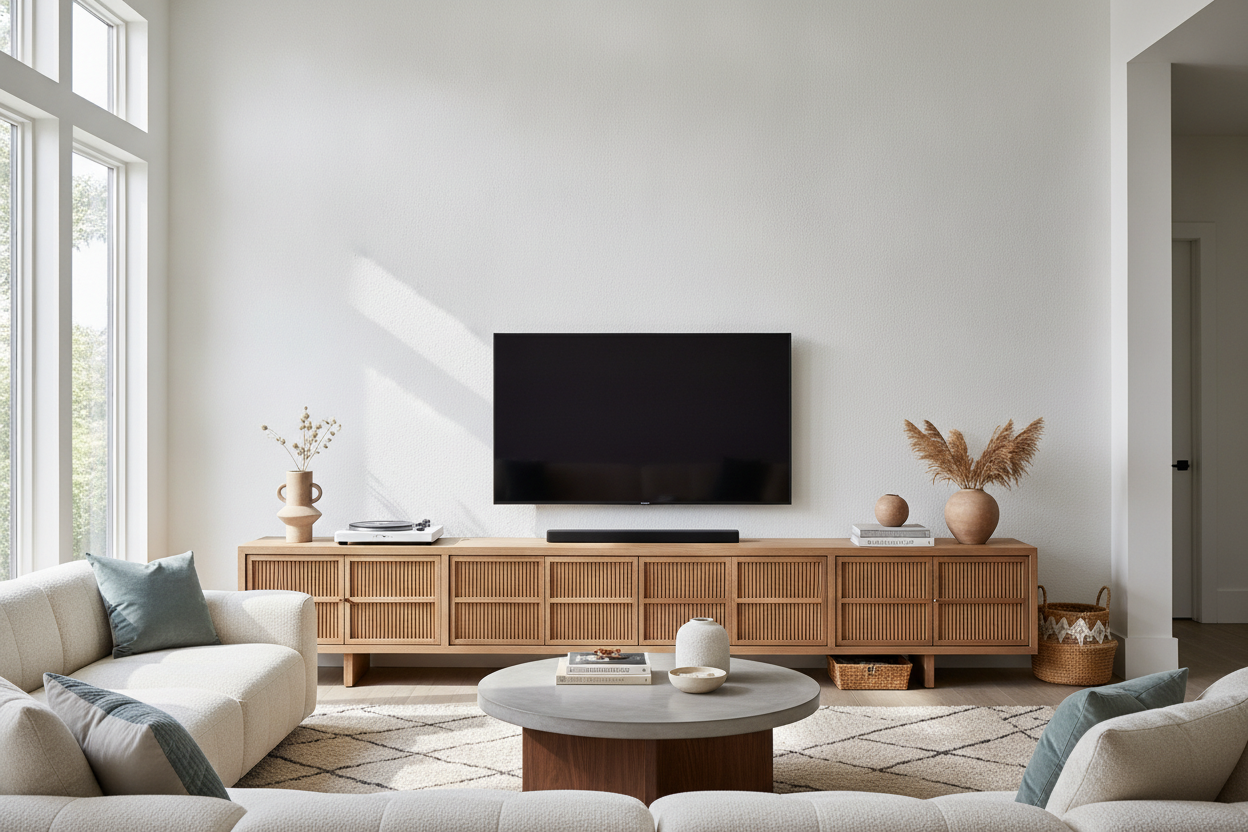
I spent three years living with a high-gloss TV unit that cost me way too much money. Every time the sun hit it, I got blinded by a glare that felt like a laser beam. The room had zero soul. When I finally dragged that heavy piece of plastic-coated particleboard to the curb and replaced it with a textured media console, the vibe shifted instantly. Suddenly, the giant black rectangle of a TV didn't feel like a void in the middle of my wall.
Quick Takeaways
- Texture breaks up the 'dead space' beneath large TV screens.
- Slatted and woven designs allow tech to breathe and remotes to work through closed doors.
- Real wood grooves create natural shadows that paint or flat finishes can't mimic.
- Balance is key: pair heavy textures with soft linens and plush rugs.
The Problem With Perfectly Smooth Furniture
Most people buy furniture that looks like a render. It's perfectly flat, perfectly smooth, and perfectly boring. When you pair a 65-inch glass screen with a smooth, white MDF box, you're essentially creating a black hole of zero dimension in your living room. There's nowhere for the eye to rest, nothing for the light to catch, and the result is a room that feels sterile—like a tech startup's breakroom rather than a home.
Standard flat-pack boxes are the worst offenders. They rely on uniform surfaces that offer no tactile interest. I've found that these pieces make everything else in the room look cheaper by association. Without texture, your furniture isn't grounding the space; it's just taking up floor area. You need something that fights back against the 'flatness' of modern electronics.
What Exactly Counts as a Textured Media Console?
We aren't just talking about a rough piece of wood. A textured tv stand can take many forms, and each one plays with light differently. Fluted wood—those vertical, rounded grooves—is my personal favorite. It creates a rhythmic series of shadows that change as the sun moves across the room. It makes the piece feel architectural rather than just 'bought.'
Then you have slatted doors, which offer a mid-century architectural feel, and woven cane, which leans more into that organic, coastal vibe. Even raw, reclaimed wood with visible knots and saw marks counts. The goal is to find a surface that isn't uniform. When natural light hits a textured tv console, it creates depth. It makes the furniture feel like it has a history and a weight that smooth laminate simply can't provide.
The Secret Bonus: Hiding Ugly Tech (While Keeping It Alive)
Beyond the looks, there's a massive functional win here. Most of us want to hide our PS5s, routers, and cable boxes, but putting them in a solid cabinet is a recipe for a melted motherboard. This is where a textured tv stand really shines. If you choose a slatted or cane-front design, you're getting built-in ventilation. The air flows through those gaps, keeping your gear cool while it stays out of sight.
I used to leave my cabinet doors open whenever I was gaming just so the fans wouldn't scream like a jet engine. It looked messy. Now, with a slatted front, the infrared signal from my remote passes right through the gaps, and the heat escapes naturally. It's the ultimate 'lazy person' hack for a clean setup.
How to Style Around Bold Grooves Without Clashing
A heavily textured piece can be a bit of a diva. If you put a fluted console on a busy patterned rug next to a velvet sofa, the room starts to feel like a visual headache. The trick is to let the console be the 'heavy' element and balance it with 'soft' textures. Think linen curtains, a chunky wool rug, or a simple ceramic vase with a single branch.
These rules apply whether you are using the piece as a traditional media console or a credenza for extra dining room storage. You want to avoid 'texture stacking' where every single surface has a pattern. If the console has deep vertical grooves, keep the decor on top minimal. A couple of coffee table books and one sculptural object are plenty. Let the shadows do the heavy lifting for you.
Is It Worth Splurging on Real Carved Wood?
I'll be honest: I've tried the budget route. I once bought a unit where the 'texture' was just a printed sticker on top of particleboard. From three feet away, it looked fine. From the sofa? It looked like a cheap imitation. If you can swing it, go for actual carved wood or genuine cane. The authentic depth and the way real wood grain interacts with the carving is what makes the upgrade worth it.
When you compare a high-quality piece to a basic IKEA shelf TV stand, the difference is in the weight and the shadow lines. A deeply grooved door has a presence that a flat door never will. It’s the difference between a room that feels 'furnished' and a room that feels 'designed.' Plus, real wood ages; that cheap vinyl wrap will just peel at the corners in two years.
FAQ
Do remotes work through slatted doors?
Usually, yes. Most infrared (IR) remotes work fine because the signal can bounce through the gaps. If you have a solid wood door with no gaps, you'll need a repeater, but slats and cane are generally remote-friendly.
How do you clean a fluted or grooved console?
Don't use a rag; it'll just snag on the edges. Use a vacuum with a soft brush attachment once a week. For deep cleans, a damp microfiber cloth tucked into the grooves works best.
Will a textured console make my small room look smaller?
Actually, no. Because texture adds depth, it can make a wall feel further away. The shadows create a sense of three-dimensional space that flat surfaces lack.

Leave a comment
This site is protected by hCaptcha and the hCaptcha Privacy Policy and Terms of Service apply.