

















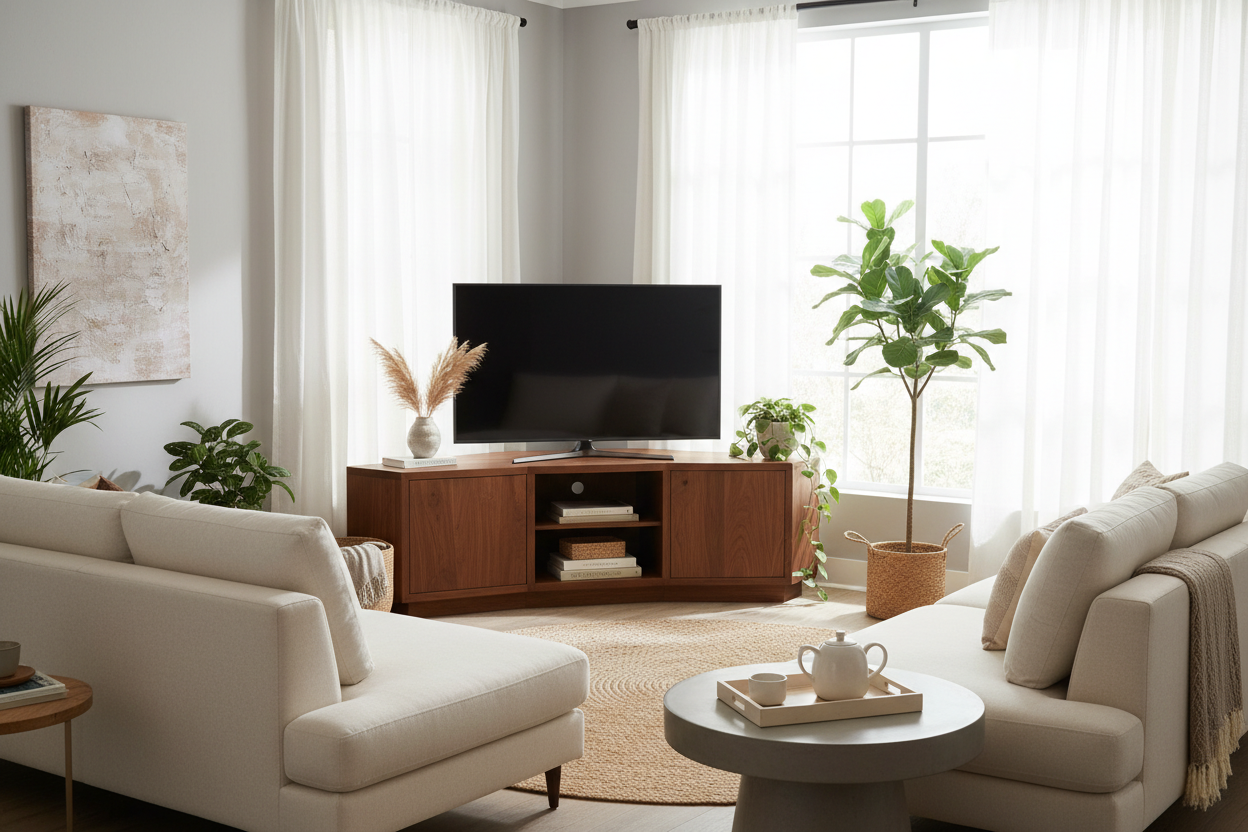
I spent three years in a 1920s bungalow where the only logical place for a TV was a corner flanked by a radiator and a swinging door. I initially bought a cheap, hollow-core 'wood-look' stand that started bowing in the middle after exactly two months of holding my 55-inch screen. It looked like a sinking ship. Finding solid wood corner tv stands flat screens actually fit on is a geometry puzzle most people lose because they forget that modern TVs are all width and no depth.
Quick Takeaways
- Measure the width of your TV's stand/feet, not just the screen size.
- Solid wood is mandatory for screens over 50 inches to prevent structural sagging.
- The 'Walkway Test' ensures your screen won't get clipped by people walking past.
- Avoid 'hollow' corners by choosing units with a clipped-back design rather than a sharp triangle.
The Geometry Problem With Giant Modern Screens
Here is the cold truth: a 65-inch TV is roughly 57 inches wide. If you try to shove that into a standard 90-degree corner on a tiny stand, the edges of the screen are going to hit the walls before the stand even touches the corner. You end up with a massive, dusty triangle of dead space behind the TV that serves no purpose other than collecting cat hair.
To fix that awkward dead corner, you need a unit designed with a wide front face and a tapered back. This allows the screen to sit flush with the front of the furniture while the base tucks deep into the corner. If the stand is too narrow, your TV ends up looking like a lollipop on a toothpick—top-heavy and visually stressful.
Why an All Wood Corner TV Stand is Non-Negotiable
Physics doesn't care about your budget. Modern flat screens might be thinner, but they are still heavy, and that weight is concentrated on two small feet or a single center pedestal. Particleboard or MDF (medium-density fiberboard) is just sawdust and glue. Over time, the humidity and constant downward pressure cause these materials to 'creep' or sag. I have seen $1,000 OLEDs hit the floor because a cheap cam-lock connector snapped on a fake wood unit.
An all wood corner tv stand uses joinery—think mortise and tenon or heavy-duty screws—that bites into actual wood fibers. If you are browsing a collection of sturdy TV stands, prioritize kiln-dried hardwoods like mango, acacia, or pine. They don't just look better; they have the structural integrity to keep your screen level for a decade, not just a season.
The Heavyweight Champ: Solid Oak Corner TV Stand
If you want to buy it once and never think about it again, get a solid oak corner tv stand. Oak is incredibly dense and heavy, which is exactly what you want for a unit that needs to anchor a room. One thing I love about oak is the grain density. When you inevitably have to slide the TV around to reach the HDMI ports, a solid oak surface won't immediately show deep gouges like softer woods or veneers will.
Wait, Is a Glass and Wood Corner TV Stand Too Dated?
The glass and wood corner tv stand used to scream 'bachelor pad 2004,' but the modern versions are actually quite clever. We are seeing a lot of fluted or smoked glass paired with natural timber frames. It is a smart move for a solid corner tv unit because glass allows your remote's IR signal to reach the cable box or Apple TV while hiding the mess of wires and blinking lights that usually clutter up an open shelf.
The 'Walkway Test' for Wood Corner TV Stands for Flat Screens
Before you hit 'buy,' do this: take blue painter's tape and mark the width of your TV on the floor in the corner where you want it. Now, measure 20 inches out from the corner. If the edges of your tape marks are sticking out into the path where you walk to the kitchen, you have a problem. This is the main issue with wood corner tv stands for flat screens; the screen is almost always wider than the furniture.
You want a wood corner tv console that is at least as wide as the TV itself. If the TV overhangs the stand by more than two inches on either side, it looks accidental and messy. Use the secret to fixing awkward rooms: choose a stand that is slightly wider than the screen to 'frame' the tech and make the corner look intentional rather than cramped.
Styling Your Solid Corner TV Unit Like an Adult
A big chunk of wood in the corner can look like a heavy wedge if you don't style it right. I usually tell people to skip the tiny knick-knacks—they just look like clutter next to a big screen. Instead, use the space behind the TV. A tall, floor-standing lamp or a large snake plant can fill that 'dead triangle' and add some vertical interest. If you realize the corner is just too restrictive for your setup, you might actually have the space for a modern 3 piece entertainment center on a flat wall instead.
FAQ
Can I put a 65-inch TV on a corner stand?
Yes, but you need a stand that is at least 58-60 inches wide across the front. Anything smaller will leave the corners of your TV floating in mid-air, which is a recipe for a disaster if someone bumps into it.
How do I manage cables in a corner?
Look for a unit with a 'cord management' hole in the back panel. Since the unit sits in a corner, you have extra space behind it to hide a power strip. Just make sure the stand isn't pushed so far back that it pinches the wires against the wall.
Is assembly hard for solid wood units?
Usually, solid wood units come 80% assembled because the main carcass is glued at the factory. You'll likely just be attaching the feet or the door handles. It’s much easier than the 400-piece puzzle of a flat-pack unit.

Leave a comment
This site is protected by hCaptcha and the hCaptcha Privacy Policy and Terms of Service apply.