

















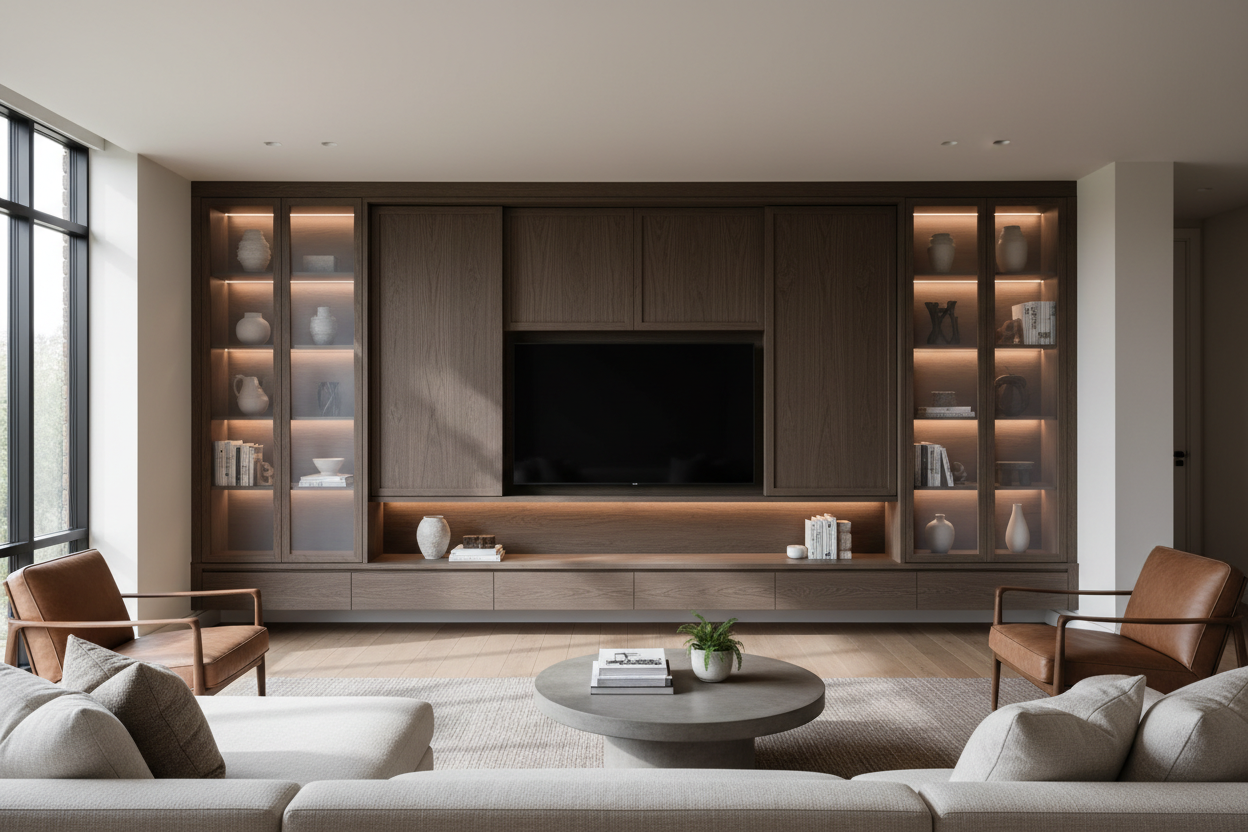
I remember sitting at my dining table last November, wine glass in hand, looking at my living room and realizing it looked exactly like a Buffalo Wild Wings. My 65-inch screen sat there like a massive, soulless void, sucking the life out of my velvet sofa and my carefully curated vintage rug. I wanted a cocktail lounge vibe, but I was living in a media room. That is when I realized I needed a tv wall cabinet with doors to reclaim my sanity.
Quick Takeaways
- Hide the tech to make your living room feel like a conversation space, not a theater.
- Solid doors offer the cleanest look but require an IR repeater for remotes.
- Ventilation is the most ignored factor—don't cook your Xbox.
- Wall-mounted units save floor space and make cleaning easier.
The 'Giant Black Rectangle' Problem
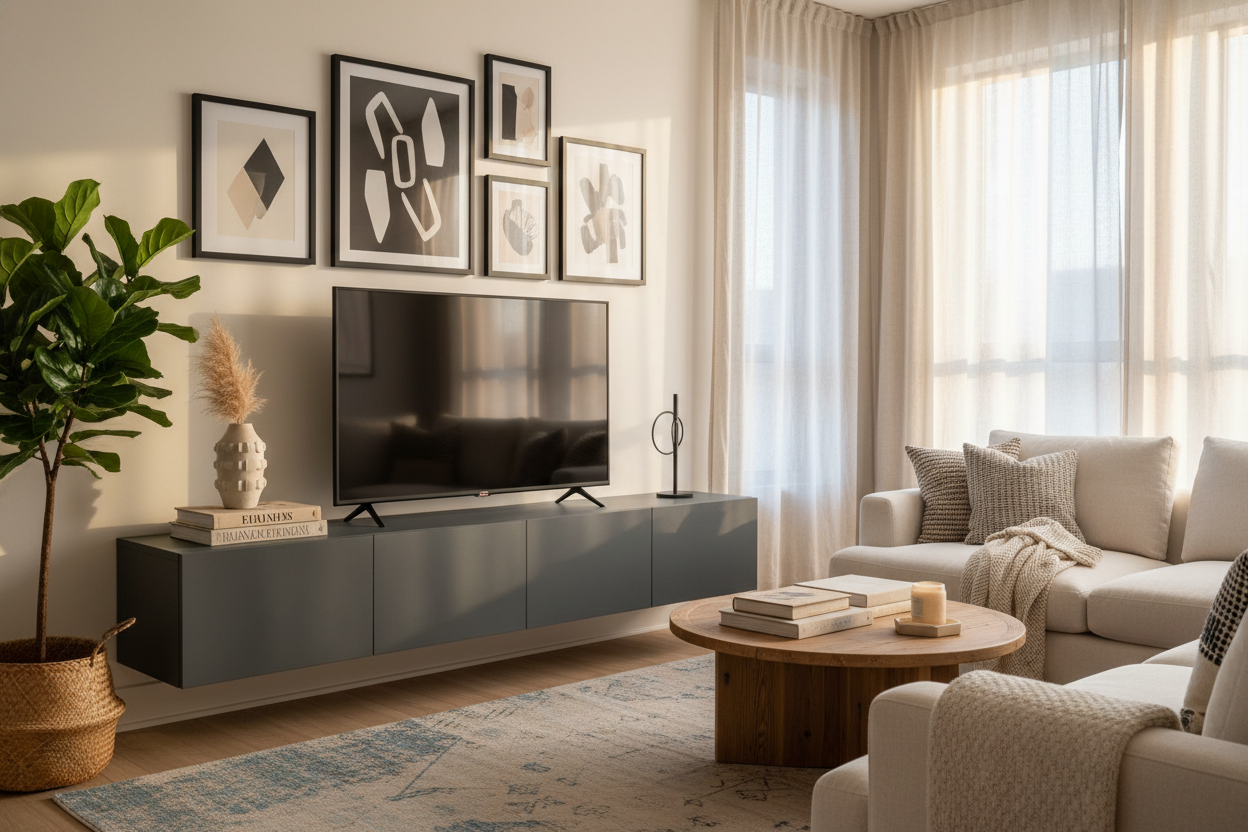
Modern TVs are gorgeous when they are on, but let's be honest: when they are off, they are just massive black holes. A 65-inch screen is roughly 1,800 square inches of dead space. In a room designed for relaxation or hosting, that much visual weight is hard to balance. I tried the 'gallery wall' trick, surrounding the TV with framed prints, but it just felt like I was trying to hide an elephant behind a houseplant. The TV always won.
The problem is the energy. A dead screen signals that the room is 'waiting' for something to happen. It kills the intimacy of a dinner party because your eyes are constantly drawn to that dark reflection. It is not just about aesthetics; it is about how the room makes you feel. I wanted a space that felt finished, where the focal point was the furniture and the people, not a piece of glass manufactured in a factory. Installing a cabinet meant I could finally choose when the TV was part of the room and when it was completely erased from the equation.
Why Open Shelving Makes Tech Clutter So Much Worse
I used to think open shelving was the 'airy' choice. I was wrong. Open shelving with a TV is just a front-row seat to a cable nightmare. Between the soundbar, the router, the gaming consoles, and the tangled nest of HDMI cords, my living room looked like the back of a server rack. Even with those plastic cable ties, you can still see the blinking blue and green lights of your modem at 2 AM. It is visual noise that your brain never quite tunes out.
When I finally replaced my clunky console with a TV cabinet on the wall, the relief was instant. Open units fail because they ask you to be a professional organizer. If your books are not perfectly stacked and your tech isn't color-coded, it looks messy. A closed-door cabinet is a 'cheat code' for a clean house. You can have a chaotic mess of controllers and charging cables behind those doors, and no one—not even your most judgmental friend—will ever know. It stops the 'tech creep' from taking over your home decor.
Giving the Room a Dual Identity
The real magic happened the first time I hosted a party after installing my wall cabinet for tv with doors. By simply sliding the panels shut, the room transformed. It went from 'media hub' to 'elegant lounge' in three seconds. This dual identity is essential if you live in a smaller home or an open-concept apartment where your 'TV room' is also your 'everything room.' You deserve a space that doesn't feel like a dormitory.
Finding a large TV cabinet with spacious storage was the turning point for me. You need that internal depth. I opted for a unit that was deep enough to house my bulky AV receiver and a PlayStation without pressing the cables against the backboard. When the doors are closed, the wood grain becomes the feature. It adds texture and warmth to the wall that a screen simply cannot provide. I actually found myself reading more books because the 'on' switch wasn't staring me in the face every time I sat on the couch. It creates a boundary between 'entertainment time' and 'living time' that most of us desperately need.
Glass vs. Solid Doors: What Actually Works?
This is the big debate. If you go with a black cabinet with glass doors, you get a very specific, high-end look. Tinted glass is great because it can hide the mess while still allowing infrared (IR) signals from your remote to pass through. It is the 'low maintenance' choice for people who hate opening doors just to change the volume. However, you can still see the silhouettes of your gear inside, which might defeat the purpose if you are going for total invisibility.
Solid doors, on the other hand, offer total visual silence. This is what I chose. The downside? Your remote won't work through solid wood. I had to spend $25 on an IR repeater kit—a tiny little 'eye' that sits on the edge of the cabinet and sends the signal inside. It was a five-minute setup and well worth it for the clean, monolithic look of solid oak doors. If you are a minimalist, go solid. If you are a tech-heavy household that wants to see your gear glow, go glass.
What to Measure Before You Buy
Do not just measure the width of your TV. You need to measure the depth including the mount. Most wall cabinets are surprisingly shallow. If your TV sticks out 4 inches from the wall, and the cabinet is only 6 inches deep, you are cutting it close. Also, check the 'swing' of the doors. If you have a narrow walkway, bifold doors or sliding panels are much better than traditional swinging doors that block the path when open.
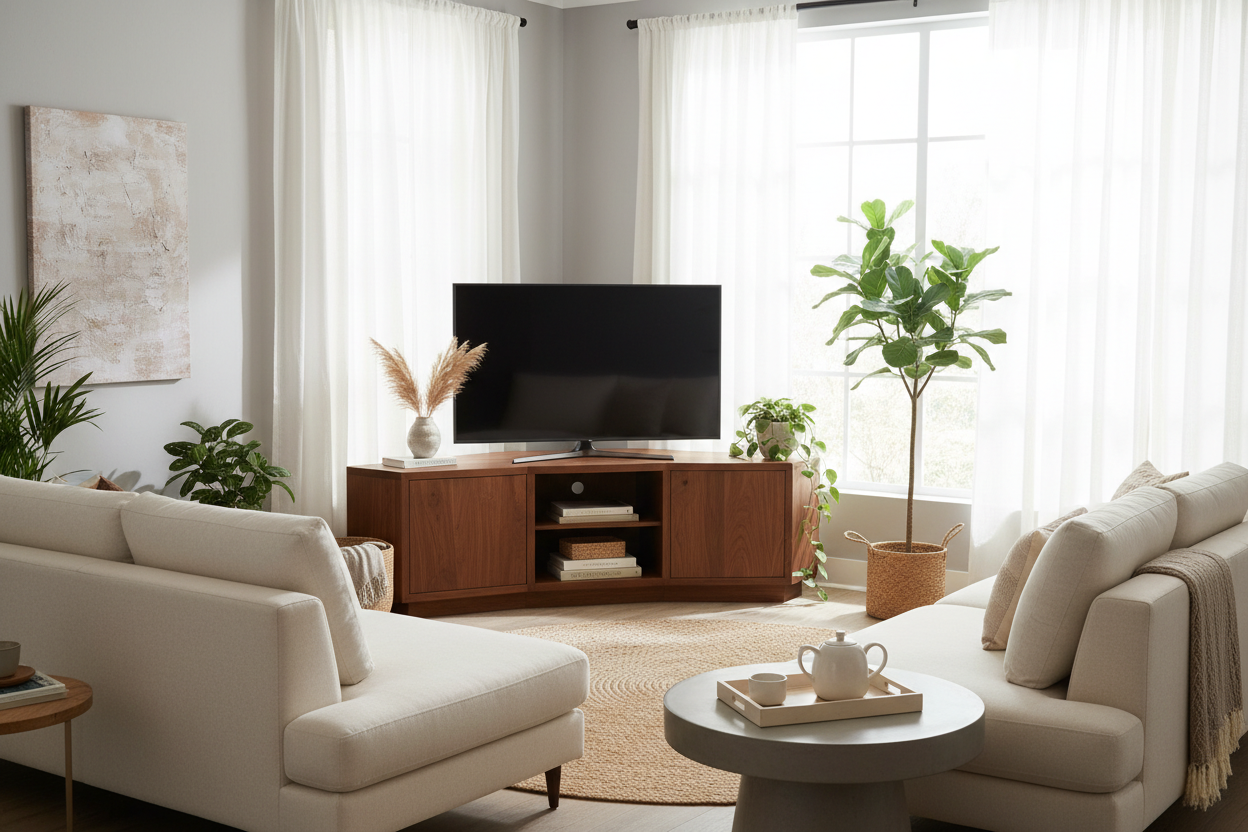
Ventilation is the silent killer. Electronics generate heat, and heat kills hardware. I learned this the hard way when my old receiver started smelling like burnt plastic. Look for cabinets with pre-drilled holes or slatted backs. If the cabinet you love is sealed, take a 2-inch hole saw to the back panel before you mount it. If you realize a wall-mounted unit is too much of a project, a modern TV cabinet table with storage can offer similar 'hidden' benefits while sitting safely on the floor. Just make sure whatever you buy has a dedicated path for airflow.
Personal Experience: The 'MDF' Mistake
I initially tried to save money by buying a cheap, flat-pack MDF cabinet. Big mistake. Within three months, the weight of the doors caused the hinges to sag, and the panels never lined up correctly again. It looked 'budget' in a way that ruined the whole vibe. I eventually sold it on Marketplace and invested in a kiln-dried hardwood unit. The doors click shut with a satisfying 'thud' and the alignment is perfect. In furniture, you often pay for the hardware, and cheap hinges are never worth the frustration.
Frequently Asked Questions
Will my remote work through the doors?
Not if they are solid wood or metal. You will need an IR repeater kit, which is a cheap and easy way to pass the signal through the cabinet wall. Glass doors usually allow signals to pass through unless they are heavily mirrored.
How do I prevent my consoles from overheating?
Ensure there is at least 2-3 inches of clearance around the vents of your console. If the cabinet back is solid, drill a few large holes for hot air to escape, or leave the doors cracked during long gaming sessions.
Is it hard to mount a TV cabinet on the wall?
It is a two-person job. You must secure it into the studs; drywall anchors will not hold the weight of the cabinet plus the TV. If you are not comfortable finding studs, hire a pro—it is cheaper than a shattered TV.

Leave a comment
This site is protected by hCaptcha and the hCaptcha Privacy Policy and Terms of Service apply.