

















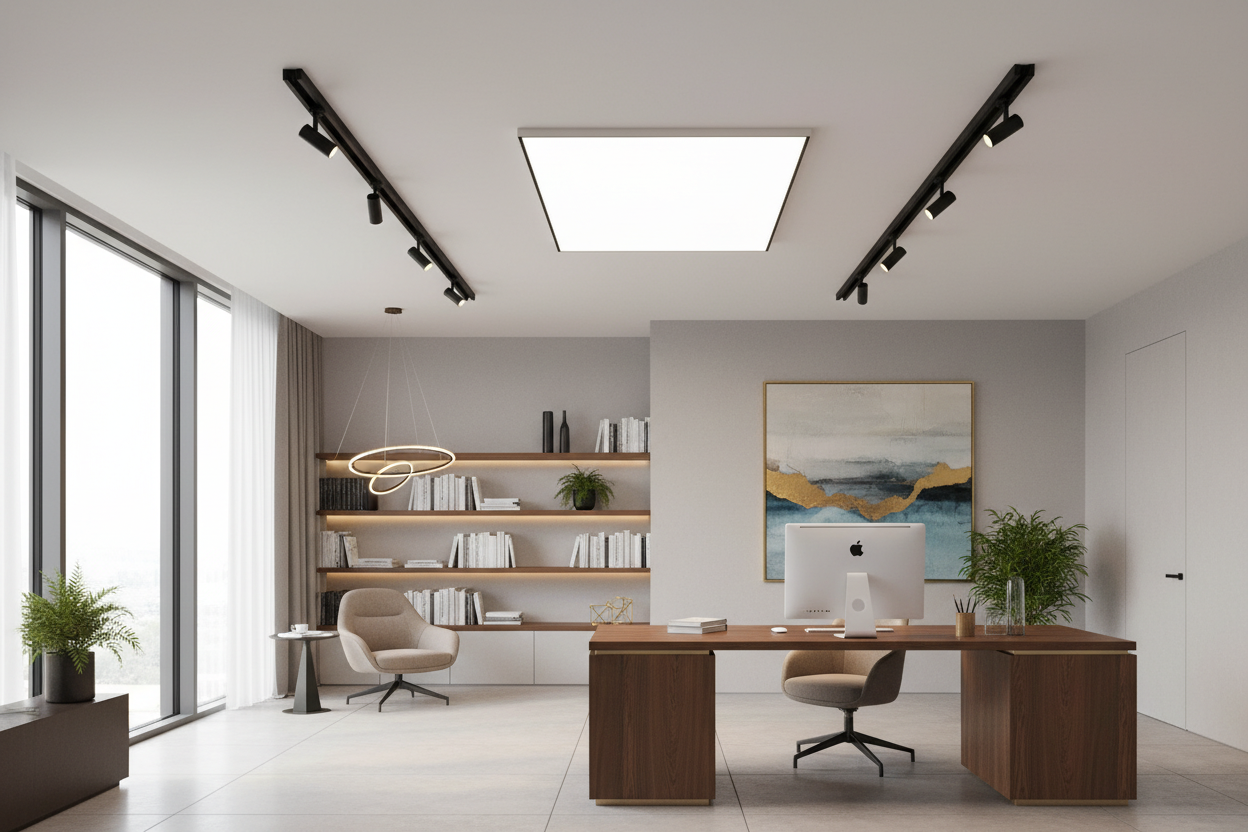
We have all walked into a workspace that feels sterile, cold, and reminiscent of a hospital waiting room. Conversely, we have struggled in home offices that are far too dim, leading to eye strain by mid-afternoon. The dilemma isn't usually the furniture; it is the illumination. As an interior designer, I find that lighting is the most undervalued element in workspace design. It dictates the mood, energy levels, and visual perception of the room. This article explores professional office ceiling lighting ideas that balance high-performance functionality with the sophisticated aesthetic your workspace deserves.
Key Features to Look For in Office Lighting
- Color Temperature (Kelvin): Aim for 3500K to 4000K for a neutral white light that promotes alertness without the harsh blue tint of daylight bulbs.
- Lumens per Square Foot: Ensure you have adequate brightness (ambient light) of roughly 30-50 lumens per square foot to prevent shadows.
- Glare Control: Look for fixtures with deep-set bulbs, frosted diffusers, or baffles to protect your eyes from direct light source exposure.
- Dimmability: Essential for transitioning from high-focus tasks in the morning to creative brainstorming in the late afternoon.
- CRI (Color Rendering Index): Choose a CRI of 90+ to ensure finishes and materials in your office look true to life.
Mastering the Layers: Beyond the Single Overhead Fixture
The biggest mistake I see in both corporate and residential projects is relying on a single central ceiling fixture. This creates a "light bomb" effect—bright in the center, dark in the corners. To achieve a luxury look, we must layer the light.
Ambient vs. Task Lighting
Your ceiling fixture provides the ambient foundation. For modern office lighting ideas, consider linear LED suspensions or recessed architectural tracking. These provide a wash of light that softens the contrast between your computer screen and the surrounding room. However, ceiling light alone is rarely enough. It should be supplemented with task lighting at the desk level to reduce the contrast ratios that cause eye fatigue.
Selecting the Right Fixture for Your Aesthetic
The physical form of the light fixture contributes significantly to the room's visual weight. In a space dominated by heavy mahogany desks and leather chairs, a delicate glass pendant will feel lost. Conversely, in a minimalist setup, a heavy industrial fixture might overwhelm the space.
Modern Home Office Lighting Ideas
In residential settings, we want to avoid the commercial grid look. I often recommend semi-flush mounts with fabric shades or brass-detailed chandeliers that bridge the gap between residential comfort and professional functionality. The goal is to maintain the warmth of a home while providing the lumens necessary for work.
Integrating Wall and Perimeter Lighting
Ceiling lighting does not have to do all the heavy lifting. To expand the perceived size of the room and eliminate "cave corners," incorporate office wall lighting ideas. Sconces placed on either side of a credenza or picture lights highlighting artwork can bounce light off the walls. This vertical illumination raises the overall brightness of the room without increasing the intensity of the ceiling fixtures, creating a softer, more diffused environment that is less taxing on the nervous system.
Lessons from My Own Projects: The "Glossy Desk" Mistake
I want to share a specific lesson I learned the hard way during a renovation for a boutique law firm. We selected stunning, high-output architectural pendants that looked incredible in the catalog. The client also insisted on a custom, high-gloss lacquered executive desk.
The moment we turned the lights on, the desk turned into a mirror. The reflection of the LED diodes hit the client directly in the eyes every time he sat down. It was unusable. I had to scramble to have custom acrylic diffusers fabricated to soften the output and eventually angled the fixtures slightly away from the primary seated position. It taught me a vital lesson: always cross-reference your ceiling lighting specs with your furniture finishes. If you have glass or glossy surfaces, you absolutely need diffused, indirect lighting sources, or you will be fighting glare constantly.
Conclusion
Transforming your workspace isn't just about buying a brighter bulb; it is about sculpting the environment to support your workflow. By carefully selecting ceiling fixtures that offer the right color temperature and integrating them with wall and task lighting, you create a space that feels intentional and luxurious. Treat your lighting as an investment in your productivity.
Frequently Asked Questions
What is the best color temperature for productivity?
For most office environments, 4000K (Cool White) is the sweet spot. It mimics morning daylight, which suppresses melatonin and keeps you alert. However, for a home office that doubles as a relaxation space, a tunable white fixture that can shift to 3000K (Warm White) in the evening is ideal.
How do I calculate the right size chandelier or pendant for my office?
A standard rule of thumb is to add the length and width of the room in feet; the sum equals the approximate diameter of the fixture in inches. For example, a 10x12 foot office would benefit from a fixture roughly 22 inches in diameter. Ensure the bottom of the fixture hangs at least 7 feet above the floor if it's in a walkway.
Can I use recessed lighting alone for an office?
While possible, it is not recommended for a high-end look or optimal comfort. Recessed cans cast shadows on your work surface because the light source is typically behind or directly above your head. Always pair recessed lighting with desk lamps or wall sconces to fill in the shadows.

Leave a comment
This site is protected by hCaptcha and the hCaptcha Privacy Policy and Terms of Service apply.