

















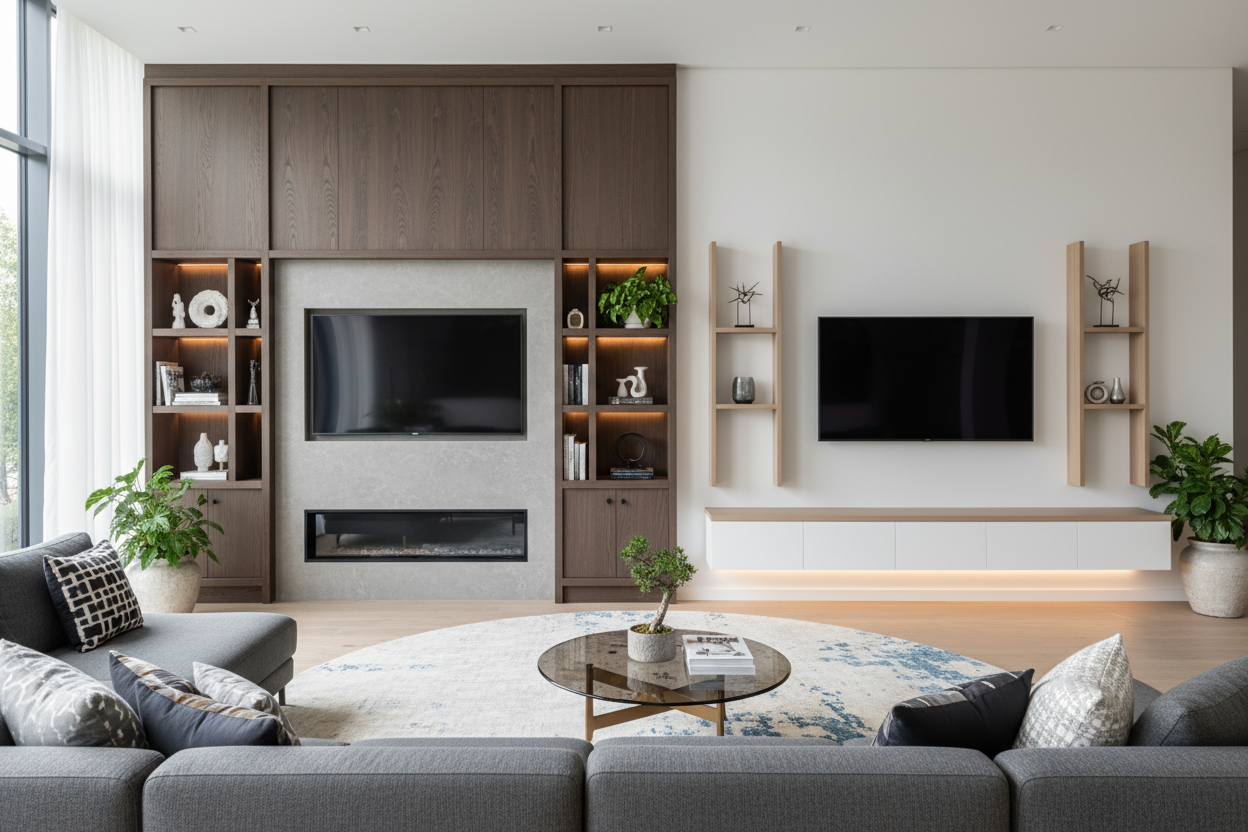
I spent three weeks staring at my TV hanging on the wall like a lonely black mirror before I realized I had made a huge mistake. I thought mounting it was the end of the job, but without a base, it just looked unfinished and weirdly high, like a departures board at an airport. I needed entertainment center ideas wall mounted tv setups that actually felt like a home, not a sports bar.
Quick Takeaways
- Floating units create the illusion of more floor space, making small rooms feel 20% larger.
- Cable management is the difference between a high-end look and a chaotic mess of black wires.
- Always aim for a console that is at least 10-12 inches wider than your TV on both sides.
- Standard eye level (about 42 inches from the floor) is the golden rule for mounting height.
The Great Debate: Permanent Built-Ins or Floating Modular Units?
When I finally bought my first place, I called a contractor to quote me for custom built-ins. He told me $6,500 and six weeks of dust. I laughed, then I cried, then I started looking at modular alternatives. Built-ins are beautiful, but they are a massive financial commitment that stays with the house forever.
Floating modular units give you that same 'off-the-floor' lightness without the permanent debt. I eventually swapped my TV stand for a modern wall cabinet and realized that having that empty floor space underneath makes the whole room breathe. It’s the difference between a heavy, dated mahogany block and a sharp, contemporary gallery look.
Wall Mount TV Stand Ideas That Won't Lose Your Security Deposit
If you are renting, the phrase 'wall mounted' usually triggers a panic attack about your security deposit. But here is the truth: drywall is easy to patch, and a few 1/2-inch holes are better than a cramped living room. You just need the right hardware to support the weight without causing a structural disaster.
For those who want the look without the permanent construction, choosing a floating TV stand wall mounted media console with a French cleat system is the move. It distributes the weight across multiple studs. I have used heavy-duty toggle bolts in apartments where the studs were spaced weirdly, and as long as you aren't sitting on the console, it’s rock solid.
Hiding the Mess: TV Stand Ideas for Wall Mounted TV Setups
Nothing kills the vibe of a sleek wall tv stand ideas board faster than a dangling HDMI cord or a dusty router sitting on top of a beautiful console. The 'floating' look only works if the guts of the system are invisible. You need a unit that prioritizes interior cable routing over just open shelving.
When you browse modern TV stands, look specifically for units with drop-down doors or integrated cord ports. I personally prefer a closed-cabinet approach for the bottom half. It lets you hide the ugly plastic of a Playstation 5 or a mesh router while keeping the top surface clean for things that actually look good, like a single ceramic vase or a stack of art books.
Creating a Mood with Integrated LEDs (Without Looking Like a Gamer)
There is a fine line between 'sophisticated lounge' and 'teenage gaming basement' when it comes to LED lighting. The trick is the color temperature. Avoid the neon blues and purples. You want a warm 2700K or 3000K glow that washes the wall behind the unit, creating depth and reducing eye strain during movie nights.
The 90 wall mounted and freely arranged TV stand with LED is a prime example of how to do this right. By tucking the light strip into a recessed channel, you get the ambient glow without seeing the individual 'dots' of the LED strip. It makes the whole unit look like it is hovering in a pool of light, which is exactly the kind of mounted tv stand ideas I recommend for high-ceiling rooms.
Mounted TV Stand Ideas That Actually Anchor the Room
The biggest mistake I see is the 'floating box' syndrome—where a small console is mounted too far below a huge TV, leaving a weird dead zone of wall in between. Your console should act as an anchor. If the gap is more than 8-10 inches, the visual connection breaks and the TV looks like it’s escaping.
To fix this, you have to style the top of the console to bridge the gap. I usually suggest a mix of heights: a low tray for remotes, a medium-sized plant, and maybe a taller lamp on one end. If you’re stuck, check out this guide on how to style for a high end look. It’s all about creating a cohesive vertical line from the floor to the top of the screen.
My Personal Lesson Learned
I once tried to mount a 72-inch console by myself on a Sunday afternoon. I didn't use a level, thinking I could 'eye it.' I ended up with a unit that slanted three-quarters of an inch to the left. Every time I watched a movie, I felt like the actors were sliding off the screen. I had to rip the whole thing down, patch the holes, and start over. Buy a $10 magnetic level. It will save your sanity.
Frequently Asked Questions
How high should I mount my floating TV stand?
Generally, you want the bottom of the console to be about 10-12 inches off the floor. This leaves enough room for a robot vacuum to pass under but keeps the TV at a comfortable viewing height.
Can I mount a TV stand on a plaster wall?
Yes, but skip the standard plastic anchors. Use metal toggle bolts or 'molly bolts' that expand behind the lath. If you can find a stud, always use that first.
How do I hide the wires between the TV and the console?
The cleanest way is an in-wall cable management kit. If you can't cut into the wall, use a paintable cable raceway that matches your wall color exactly. It’s not invisible, but it’s a 90% improvement over dangling wires.

Leave a comment
This site is protected by hCaptcha and the hCaptcha Privacy Policy and Terms of Service apply.