
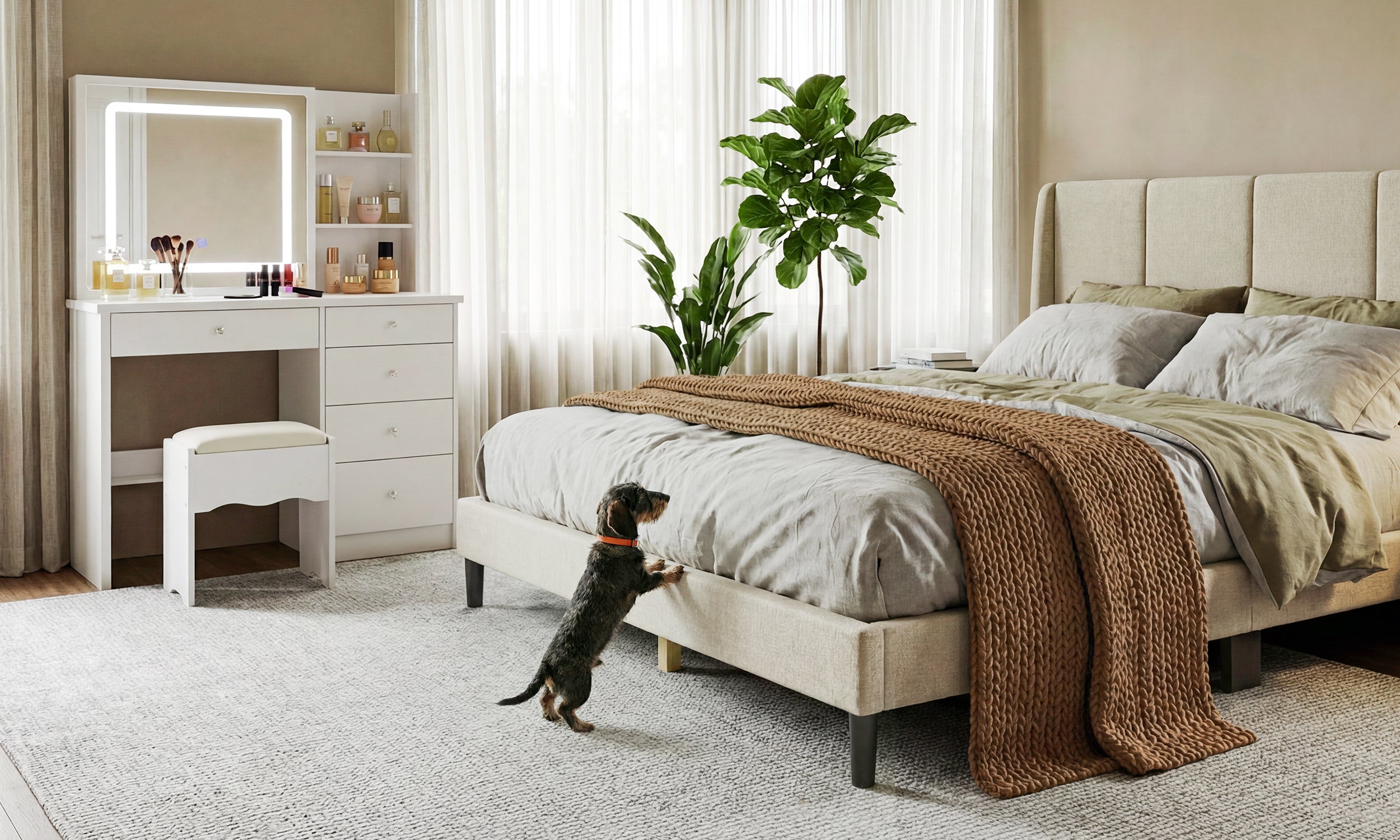
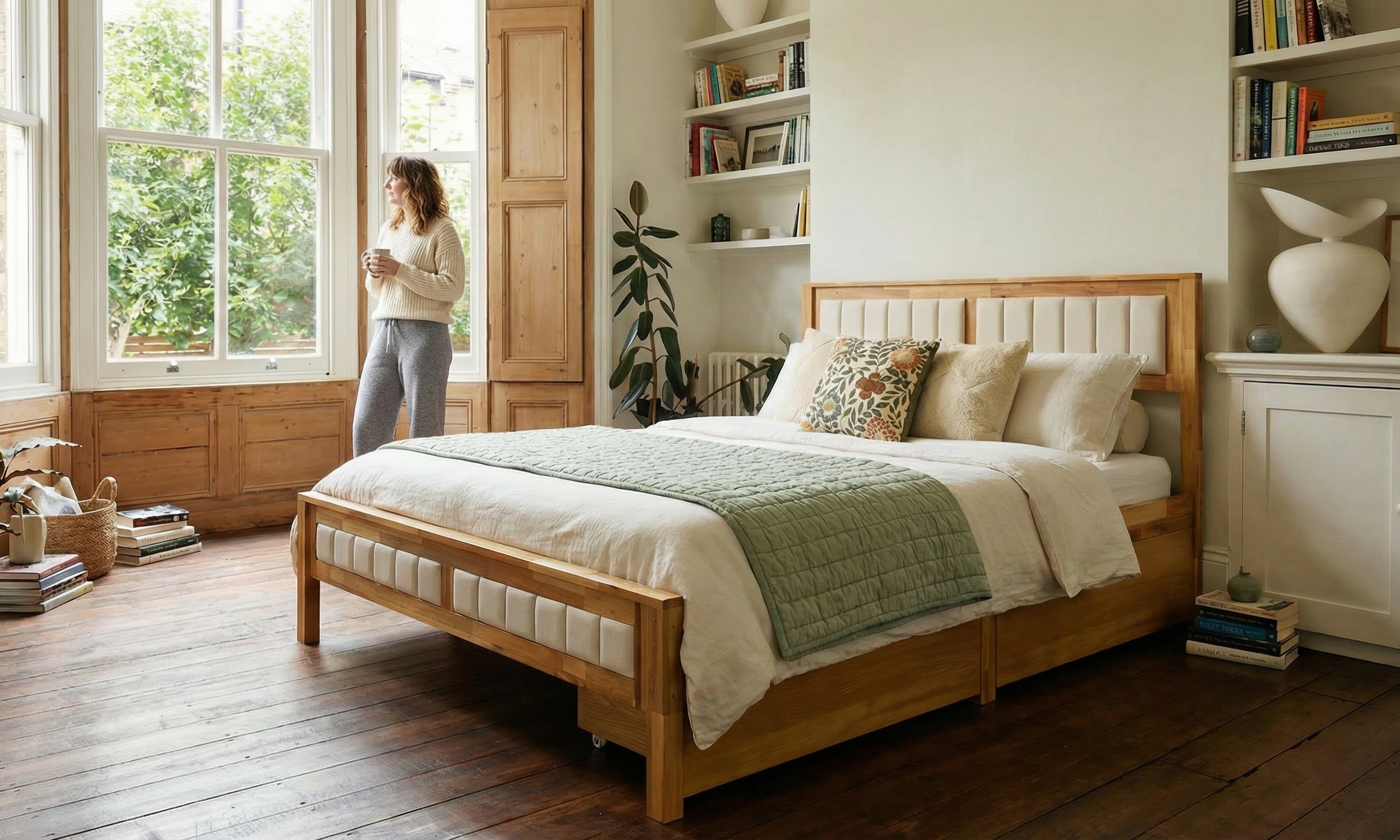
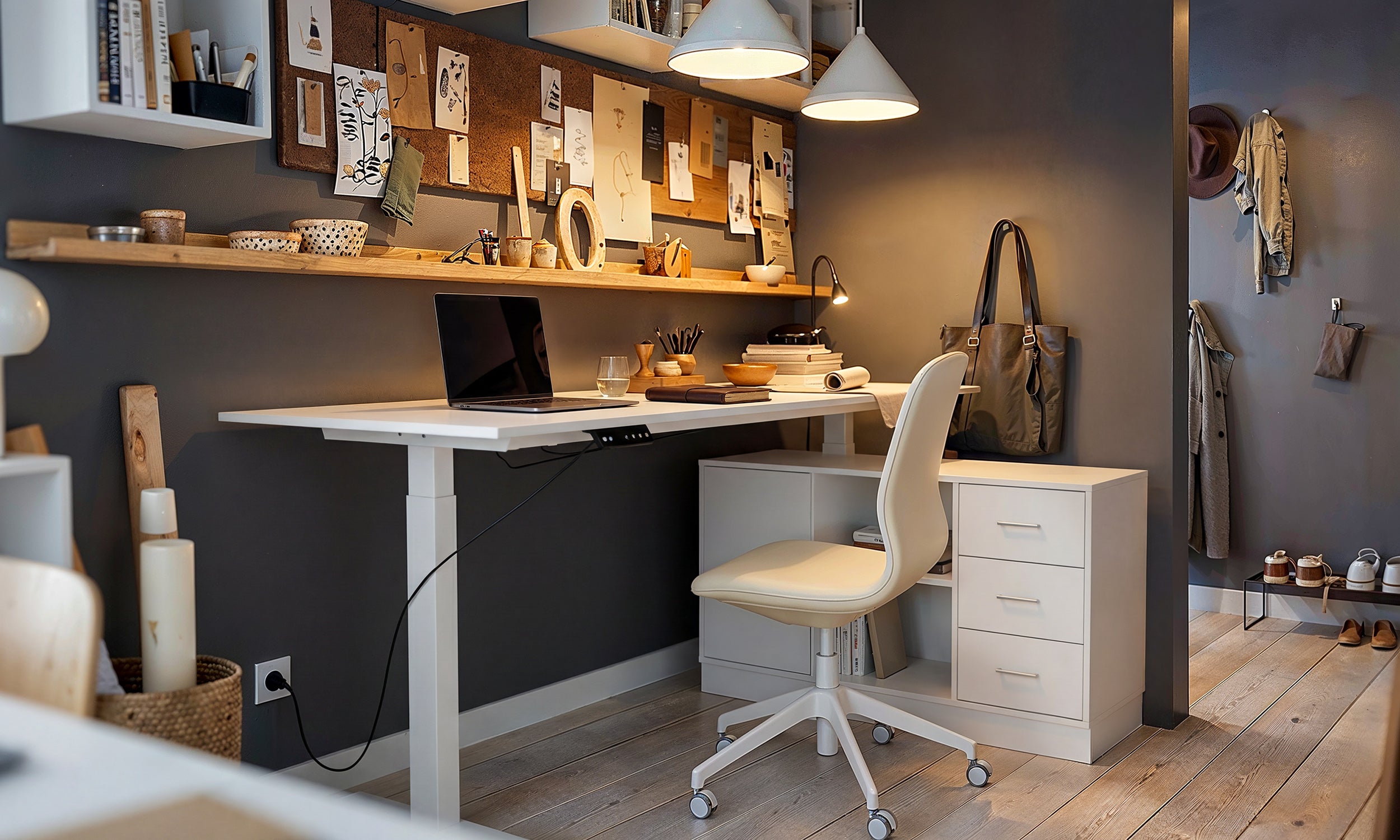
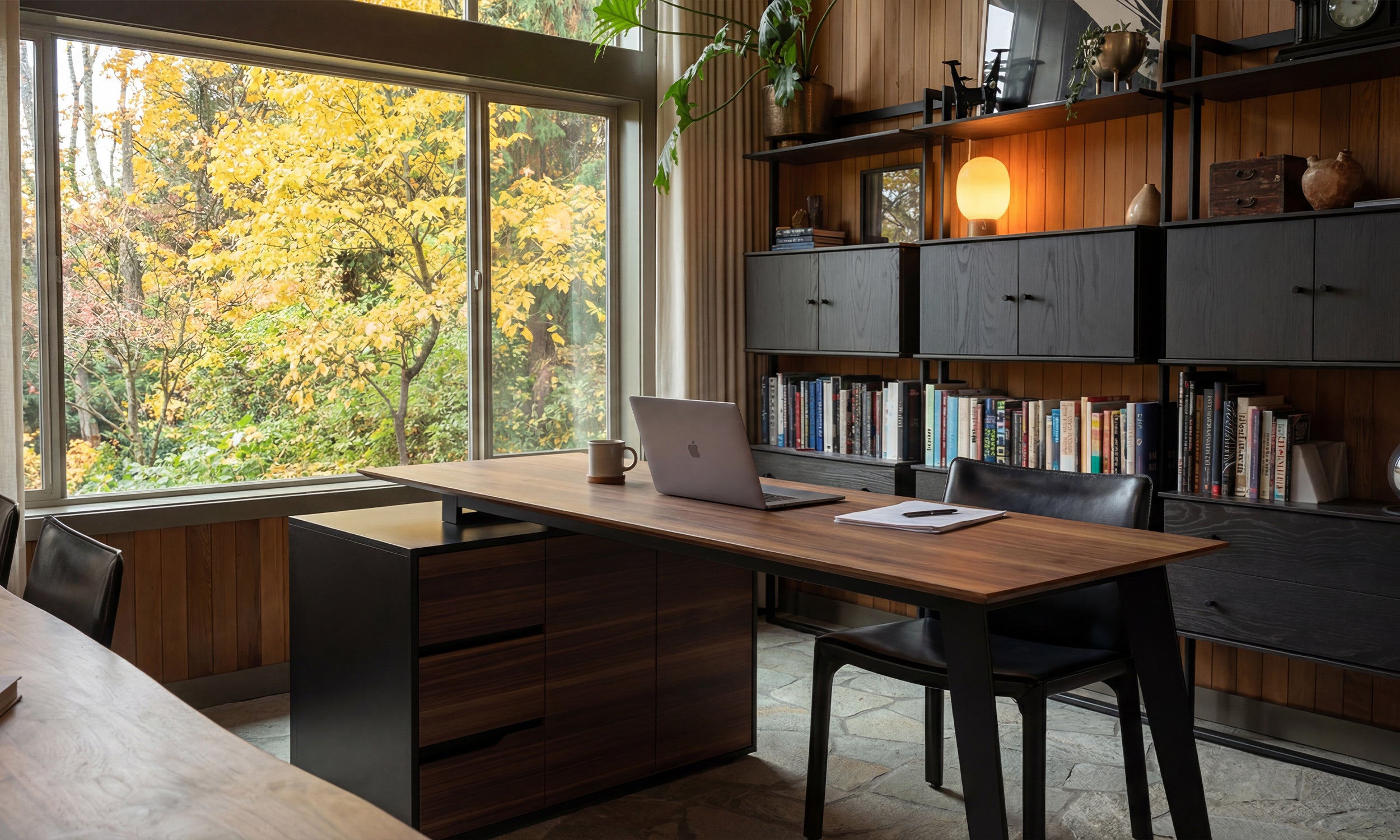


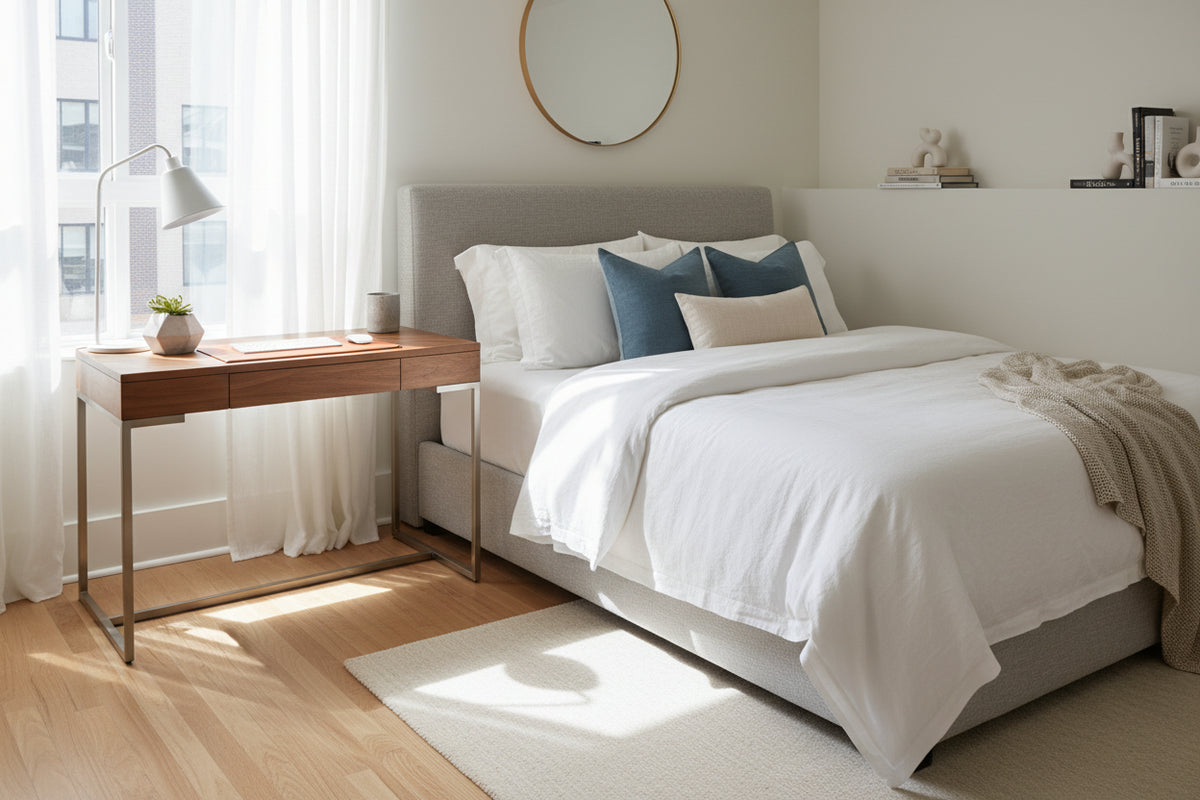
Yes, a desk next to the bed works well in a small bedroom, as long as you leave about 30 to 36 inches of clear floor where you walk and 36 to 42 inches behind the desk for the chair to roll back. The most space-saving setup is a desk beside the bed that doubles as a nightstand. In bigger rooms, a desk at the foot of the bed, on a window wall, or back to back with the headboard separates work from sleep more clearly.
Below: the four layouts with the arithmetic for each, clearances, light and sleep, cords, desk sizes, and five desks from our range with real widths and depths. To compare sizes as you read, open the FUFU&GAGA writing and computer desk collection.
Key takeaways
- Walkways: 30 inches minimum, 36 inches for comfort, around the open sides of a bed.
- Chair space: a rolling chair needs 36 to 42 inches from the desk edge.
- Desk depth: 20 to 24 inches suits a laptop or one monitor; 15 to 16 inch vanity desks are laptop-only.
- Height: desks are 28 to 30 inches tall, so a desk used as a nightstand sits a few inches above a typical mattress top.
- Sleep: keep the bed for sleep, dim the desk area in the evening and put screens away before bed.
Can you put a desk next to your bed?
You can. A desk in the bedroom is common in apartments and shared homes, and in a small bedroom with limited space, the side of the bed is often the only place a desk fits. A bedroom desk beside the bed takes the spot a nightstand would use, so it adds a work space without taking extra space in the middle of the room, and it keeps a lamp, a charger and a glass of water within reach at night.
The trade-off is that work stays in view from your pillow. The American Academy of Sleep Medicine advises using your bed only for sleep and sex and keeping the bedroom quiet and relaxing (AASM, Sleep Education). So work at the desk, not on the bed, and plan a way to clear the desk area at night. If you have enough room, a layout that puts more distance between bed and desk helps create a clearer line between work and rest, and keeping the bed out of sight can make it easier to focus and concentrate.
How much bedroom space do you need for a desk?
Three numbers decide whether a bedroom workspace fits in the available space. They come from Dimensions.com, an architectural reference for furniture and room sizes:
| Space | Minimum | Comfortable | Source |
|---|---|---|---|
| Open sides of a queen bed | 30 in | 36 in | Queen bedroom layouts |
| Chair that stays at the desk | 18 in | 30 in | Office workstation clearances |
| Chair that rolls back from the desk | 36 in | 42 in |
The same references put a queen bed at 60 by 80 inches, a typical desk at 28 to 30 inches tall, and a queen bedroom with a closet and a desk at roughly 128 to 131 square feet. An 11 by 12 foot room is 132 square feet; a 10 by 12 foot room is 120, which makes a queen bed plus a desk a tight fit. If there isn't enough space for a 30-inch path, push one side of the bed against the wall or pick a shallower desk. Mark the swing of the bedroom and closet doors before you pick a desk size.
Four desk next to bed layouts, with the arithmetic
The examples use a queen bed (60 x 80 inches) and a compact desk 39.4 inches wide and 21.7 inches deep, the smaller size of our wooden study desk. Swap in your own sizes.
| Layout | What you need | Arithmetic (queen bed) | Best for |
|---|---|---|---|
| Desk beside the bed, as a nightstand | Headboard wall for bed, desk and a path on the other side | 60 + 39.4 + 30 = 129.4 in, about 10 ft 9 in of wall | Small bedroom, one sleeper |
| Desk at the foot of the bed | Room length for bed, chair space and desk | 80 + 36 + 21.7 = 137.7 in, about 11 ft 6 in | Long, narrow rooms |
| Desk facing a window | Gap between window wall and bed | 21.7 + 36 = 57.7 in, about 4 ft 10 in | Daylight, bed behind you |
| Back to back with the headboard | Floating bed, desk behind the headboard | 36 + 21.7 + 80 + 30 = 167.7 in, about 14 ft | Spacious bedroom |
1. Desk beside the bed as a nightstand
Put the desk where one nightstand would go, its short end close to the mattress. It works as a bedside table at night and an office desk by day. The chair rolls back alongside the bed: 21.7 inches of desk plus 36 inches of chair space is 57.7 inches from the wall, which leaves the lower part of that side of an 80-inch bed free to get in and out.
Check the height. A nightstand top usually sits level with the mattress top, within about 2 inches, which is 24 to 28 inches for most beds, as our nightstand height guide explains. A desk is 28 to 30 inches tall, so on a typical bed it sits 0 to 6 inches above the mattress (28 - 28 = 0, 30 - 24 = 6), which is easy to reach from bed.
2. Desk at the foot of the bed
A slim desk at the end of the bed acts like a footboard with a job. Sit with your back to the bed facing the wall, or set the desk against the foot of the bed and face into the room. Either way the room length must hold bed, desk and chair: 80 + 36 + 21.7 = 137.7 inches, or 143.7 inches with 42 inches of chair space. Leave at least 30 inches beside the desk to walk past.
3. Desk facing a window
A window wall gives daylight and puts the bed behind you while you work. Glare is the catch: NIOSH, the U.S. workplace safety research institute, advises placing your display perpendicular to windows or adjusting blinds (CDC NIOSH, Working from Home). A desk on the wall next to the window, with daylight from the side, often works better than one directly under it. Facing a blank wall instead? Hang art or a mirror above the desk to give your eyes somewhere to rest.
4. Back to back with the headboard as a divider
In a spacious bedroom, float the bed away from the wall and set a desk against the back of the headboard, facing away from the bed. The headboard becomes a low wall between work and sleep, with the desk's background being the headboard rather than the bed. It needs the most floor: 36 + 21.7 + 80 + 30 = 167.7 inches, about 14 feet, plus the headboard's thickness. Pick a desk no taller than the headboard.

More ideas for a desk in the bedroom
- A corner: a corner desk position keeps the workspace out of the walking line and out of sight from the bed.
- Next to the dresser: a dresser looks heavy, so pair it with a desk on slim legs and keep the dresser on the wall opposite the bed. A desk style and finish that match the bed and nightstand keep the overall look calm.
- Facing the door: feng shui's "command position" means seeing the door from your seat without sitting directly in line with it.
- A vanity desk: a narrow vanity whose mirror folds away can be a makeup table in the morning and a laptop desk later, if its listing says it works as a desk.
Light, screens and sleep around the desk area
Lighting does two jobs: bright light to work, dim light to wind down. Harvard Health Publishing reports that blue light at night suppresses melatonin more than other colors, and suggests avoiding bright screens for two to three hours before bed, using dim red night lights, and getting plenty of bright light during the day (Harvard Health). The AASM also advises limiting bright light in the evening and turning off electronic devices at least 30 minutes before bedtime.
- Aim a desk lamp at the work surface, not toward the pillow.
- Turn the monitor off, not just to sleep mode, when work ends.
- Put work papers in a drawer or a closed box so the desk looks tidy from bed.
- Blackout curtains help if the desk sits by a window and streetlights shine in.
If you spend most of the day at a computer, comfort matters too. NIOSH suggests a monitor about an arm's length away with the top at or below eye level, and an office chair with armrests rather than a couch or soft chair. Working from the bed itself, even for short tasks, is the setup to avoid.
Cords and power next to a bed
A home office desk beside the bed means more plugs near it: lamp, laptop charger, computer monitor, phone. The U.S. Consumer Product Safety Commission says extension cords are for temporary use, should not be overloaded, and should not run under carpets, through doorways or under furniture (CPSC, Household Extension Cords Can Cause Fires). So position the desk near a wall outlet, use cords properly rated for what you plug in, run cords along the wall or the back of the desk, and keep them out from under the rug and the bed. On a standing desk that moves from 29.8 to 45.3 inches, every cable needs at least 15.5 inches of slack (45.3 - 29.8).
What size office desk fits next to a bed?
Depth matters more than width, because every inch of depth comes out of the walkway or the chair space. OSHA's workstation guidance says the desk should let you place the monitor directly in front of you, at least 20 inches away, and that the space under it should stay free of storage so your legs have room (OSHA, Computer Workstations: Desks). Your eyes sit a few inches back from the edge, so a desk about 20 inches deep or more can hold a monitor at that distance.
| Desk depth | What it handles | Where it fits |
|---|---|---|
| 15 to 16 in | Laptop, notebook, makeup | The nightstand spot, tight corners |
| 20 to 24 in | Laptop or one monitor and a keyboard | Most small and mid-size bedrooms |
| 27 to 32 in | Two monitors, spread-out paperwork | Foot of the bed or a window wall in a larger room |
For width, 39 to 48 inches holds a laptop and a lamp beside the bed; go wider only along a long wall. For a whole room plan, see our guide to small home office dimensions.
Our picks: desks that fit next to a bed
Five desks from the FUFU&GAGA range for the layouts above. All sizes come from the product listings.
Mid-Century Wooden Minimalist Study Desk (39.4 or 47.2 in)
The desk used in the arithmetic above. It comes 39.4 or 47.2 inches wide, both 21.7 inches deep and 29.5 inches tall, with solid wood legs, an MDF top, two drawers and a 220 lb desktop rating. Slim legs keep it visually light next to a bed.
Best for: beside the bed or at the foot of a queen bed in a small bedroom.
Skip it if: you need real storage; each drawer is rated for 3 lb, so pens and notebooks only.
Black Rubberwood Writing Desk with Drawer (47.2 in)
A classic writing desk with turned legs, 47.2 inches wide, 23.6 inches deep and 29.4 inches tall overall, in rubberwood with MDF and one drawer with a gold knob. The listing says it can also serve as a vanity with a mirror added, so it looks like bedroom furniture rather than office equipment.
Best for: the foot of the bed, where the desk is the first thing you see.
Skip it if: you run a heavy monitor setup; the desktop is rated for 50 lb and the drawer for 15 lb.

White Vanity Desk with Lights and Flip Mirror (18.7 in)
The narrowest option: 18.7 inches wide and 15.7 inches deep, with a 3-color LED mirror that folds into the top. The listing says that with the mirror folded down it works as a writing desk or a bedside table. Two drawers, hidden storage under the flip top and a storage stool; table height 31.5 inches.
Best for: the nightstand spot in a very small space, for makeup and a laptop.
Skip it if: you work at a monitor or type for hours; 15.7 inches of depth is laptop-only, and the stool has no back.
Solid Wood Writing Desk with Rounded Corners (51.2 in)
Solid rubberwood top and base, 51.2 inches wide, 27.6 inches deep and 28.7 inches tall, with rounded corners and a warm brown finish. The extra depth leaves room for a monitor plus papers.
Best for: a window wall or the foot of the bed in a mid-size bedroom.
Skip it if: you need drawers or a desk for beside the bed; it has none, and 27.6 inches of depth takes more floor.
Electric Standing Desk with Pegboard and Keyboard Tray (63 in)
A desktop 63 inches wide and 23.6 inches deep, shallower than our 31.5-inch-deep standing desks, moving from 29.8 to 45.3 inches with three memory presets and rated for 240 lb. Under the top: a drawer module with a filing drawer and a lockable drawer, open shelves with a pegboard, and a pull-out keyboard tray. For more on choosing one, see our standing desk guide.
Best for: a long window wall or behind a floating bed, if you prefer to stand for part of the day.
Skip it if: you lack a free wall of about 63 inches to accommodate it, or you want the desk to act as a nightstand; it is too long for the spot beside most beds.

Compare the picks
| Desk | Width x depth | Height | Storage | Best layout |
|---|---|---|---|---|
| Wooden minimalist study desk | 39.4 or 47.2 x 21.7 in | 29.5 in | 2 drawers | Beside or at the foot of the bed |
| Black rubberwood writing desk | 47.2 x 23.6 in | 29.4 in overall | 1 drawer | Foot of the bed |
| Vanity desk with flip mirror | 18.7 x 15.7 in | 31.5 in | 2 drawers, stool | Nightstand spot |
| Solid wood writing desk | 51.2 x 27.6 in | 28.7 in | None | Window wall |
| Electric standing desk | 63 x 23.6 in | 29.8 to 45.3 in | Drawers, shelves | Long wall, behind headboard |
Orders from fufugaga.com ship free to the 48 contiguous states and DC, with 35-day returns on unused, unassembled items. Every desk needs assembly; our flat-pack assembly guide covers the basics. More sizes are in the writing and computer desks collection.
Bedroom desk layout checklist
- Measure the room and bed; mark door and closet swings.
- Keep 30 to 36 inches on the open sides of the bed.
- Leave 36 to 42 inches behind the desk edge for a rolling chair.
- Choose depth: 15 to 16 inches for a laptop, 20 to 24 for a monitor.
- Beside the bed, compare desk height (28 to 30 inches) with your mattress top.
- Put the screen perpendicular to the window.
- Place the desk near an outlet; no cords under rugs or furniture.
- Give work a place to go at night: a drawer or a box.
FAQ
What is a desk next to a bed called?
There is no special name. People say bedside desk, nightstand desk or simply a desk used as a nightstand. Some narrow vanity desks are sold to work as a bedside table, writing desk and makeup table in one.
Is it bad to have a desk in the bedroom?
No. Sleep advice mainly focuses on the bed, not the room: experts advise keeping the bed for sleep, limiting bright light in the evening and turning off devices at least 30 minutes before bed. Work at the desk, not in bed, and clear it at the end of the day.
Which direction should a desk face in a bedroom?
Face a wall beside the window so daylight comes from the side of the screen, or face the door so you can see who comes in. Sitting with your back to the bed keeps it out of view while you work.
How much space should be between a desk and a bed?
If the chair sits between the desk and the bed, allow 36 to 42 inches from the desk edge to the bed. If the desk sits beside the bed as a nightstand, it can be a few inches from the mattress, but keep 30 to 36 inches clear on the bed's other open side.

Leave a comment
This site is protected by hCaptcha and the hCaptcha Privacy Policy and Terms of Service apply.