

















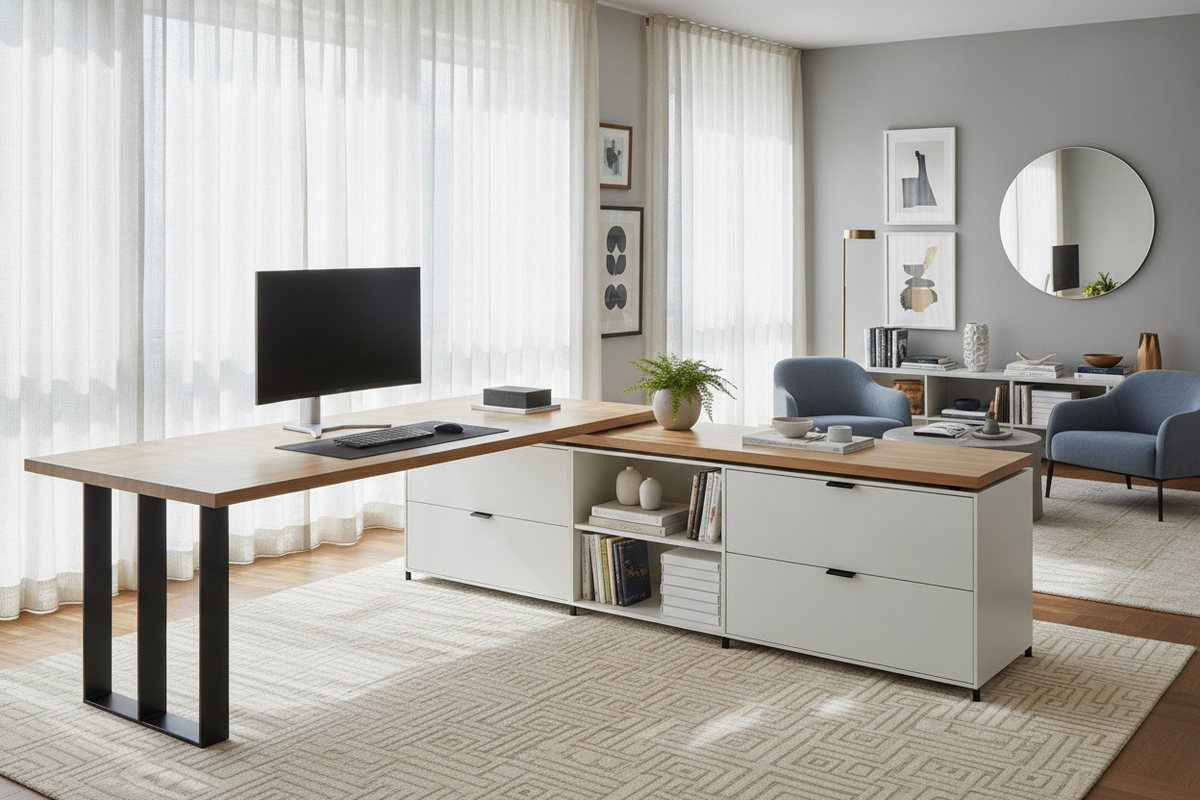
Understanding the Eight-Foot Footprint: Why Choose a 96 Inch Desk?
An eight-foot workstation commands attention in any home office or commercial suite. Choosing a 96 inch desk introduces an architectural presence that smaller furnishings cannot replicate. Rather than clustering separate side tables, writing desks, and printer credenzas across a room, an expansive 96 desk consolidates your entire technical workflow into a unified linear zone.
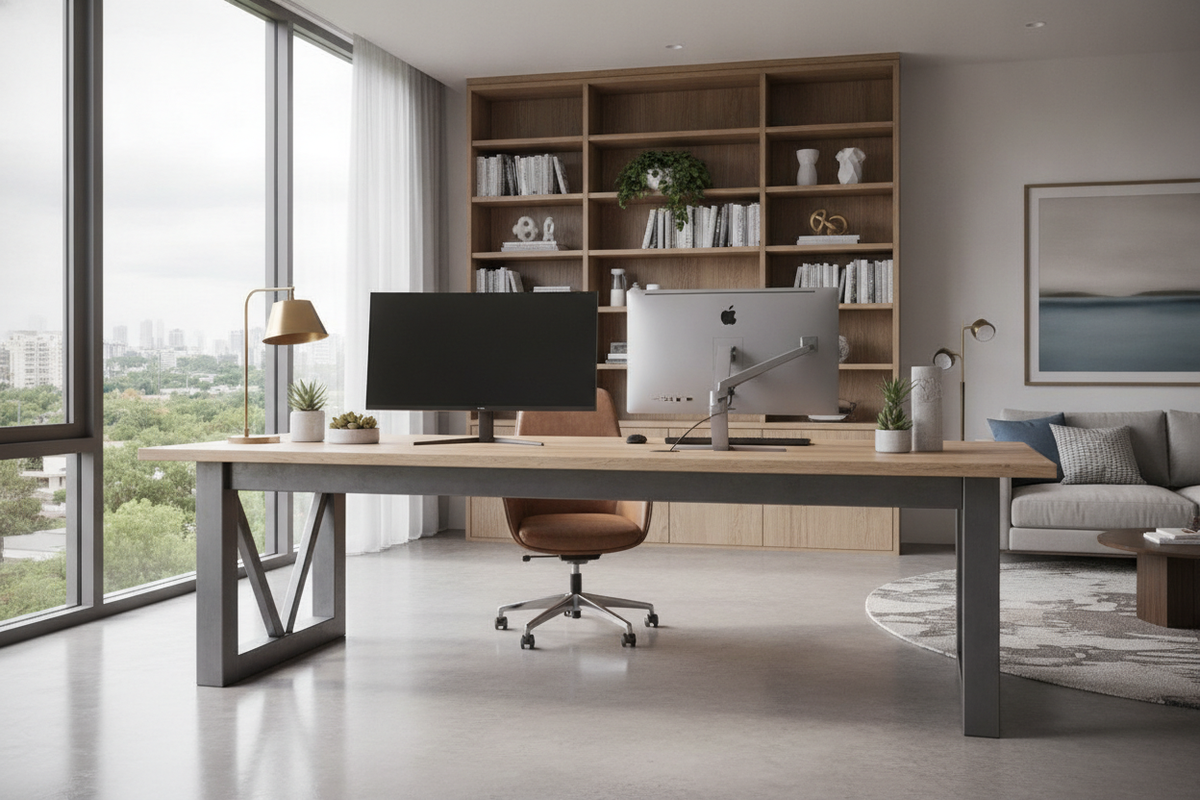
Large surfaces accommodate two distinct functional modes. For the solo executive or creative specialist, a 96in desk provides distinct horizontal zones: an active digital sector for multiple widescreen displays, a dedicated analog zone for drafting or paperwork, and a periphery for studio speakers, task lamps, and desktop organizers. Alternatively, this footprint excels as a shared tandem station. Two full-time professionals can work side by side while maintaining comfortable elbow room, separate peripherals, and clear boundaries for personal organization.
Room Fit and Clearance Planning for an Extra-Wide Workstation
Bringing an eight-foot piece of furniture into a floor plan requires careful consideration of perimeter pathways. Before selecting a 96" desk, verify that your target wall provides ample open span without encroaching on HVAC vents, light switches, low window sills, or baseboard heaters. When positioned along a wall run, the desk should leave sufficient negative space on either flank to avoid an overcrowded, wall-to-wall aesthetic.
Walkway clearance behind the working edge demands equal attention. In an active office, you need sufficient clearance for chair roll-out, seated recline, and unhindered movement around the desk edge. If guests or clients approach the far side of your setup, ensure walkways remain clear of door swings and closet access paths. You can review common layout pitfalls in our standing desk guide to ensure oversized furniture does not obstruct major circulation paths.
Desktop Span Architecture: Preventing Sag Across 96 Inches
The primary engineering challenge of an expansive 96 inch desktop is physical deflection over time. Any continuous surface spanning eight feet without adequate substructure risks gradual downward bowing under the concentrated load of heavy display arms, audio gear, and resting forearms. Material density plays an important role; dense hardwood boards and thick composite panels offer structural resilience, but panel stiffness alone is rarely enough across this width.
Long-term levelness typically relies on continuous longitudinal support. High-grade configurations incorporate running steel aprons, longitudinal channel stiffeners routed beneath the underside, or a supportive center leg. When selecting between a seamless single-piece top and modular alternatives, considering reinforced frame designs—such as those seen in a standing desk desktop product—helps visualize how structural framing and segmented supports distribute downforce evenly across substantial spans.
Fixed Executive vs. 96 Inch Standing Desk Mechanics
Deciding between a traditional credenza-style desk and an adjustable 96 inch standing desk comes down to dynamic stability versus classic joinery. Fixed-height desks offer solid grounding, often integrating full modesty panels, thick slab gables, and heavy perimeter framing that resist horizontal wobble naturally. They also provide deep modesty enclosures that hide long runs of wiring and multi-outlet extension bars.
By contrast, an active height-adjustable configuration must manage substantial leverage. Lifting an eight-foot surface smoothly requires synchronized multi-stage lift columns, typically utilizing heavy-duty dual- or triple-leg systems. Because monitor vibration amplifies as lifting columns extend upward, premium frames feature robust crossbars and deep footings. Exploring dedicated collections, such as our standing desk resource, highlights how structural lift geometry counters sway. Maintaining an uncluttered visual plane across this distance also requires generous cable raceways and flexible spine conduits, principles detailed in our standing desk guide to keep power lines tidy through height transitions.
Storage Integration: File Cabinets and Lateral Credenzas
Without integrated storage, an expansive tabletop can quickly become a catch-all for loose paper, hardware components, and peripheral clutter. The sheer width of a 96 inch desk offers an ideal baseline for balanced pedestal architecture. Placing matching drawer banks at each end creates a balanced, built-in appearance while leaving open knee space in the middle span for smooth seating transitions.
For document-heavy workflows, combining drawer pedestals with under-desk lateral file storage establishes organized compartments for letter and legal files. Balancing your storage layout ensures the visual weight is anchored at the perimeters rather than crowding the center. In tight room footprints where linear under-desk pedestals might restrict seating comfort, alternative layouts—such as pairing an eight-foot primary run with a standing desk product featuring dedicated returns—can keep essential filing immediately accessible without limiting chair movement.
Delivery, Hallway Turning Clearance, and Assembly Logistics
Bringing an eight-foot piece of furniture home requires logistical preparation well before assembly begins. A one-piece 96in desk arrives in an oversized crate that may not clear tight stairwell landings, residential elevator cars, or sharp entry hallway turns. Measuring your full pathway from curb to office door—including overhead ceiling clearances—prevents delivery-day bottlenecks.
Once inside the room, plan for a two-person assembly process. In my view, staging the build on a padded protective drop cloth ensures you protect both the finished surface edges and your flooring. Fasten under-mount stiffeners and structural framing before inverting the assembly, and use adjustable leveling glides to neutralize subtle imperfections in the subfloor. A level, plumb foundation preserves structural alignment across the entire eight-foot span for years of dependable use.

Leave a comment
This site is protected by hCaptcha and the hCaptcha Privacy Policy and Terms of Service apply.