

















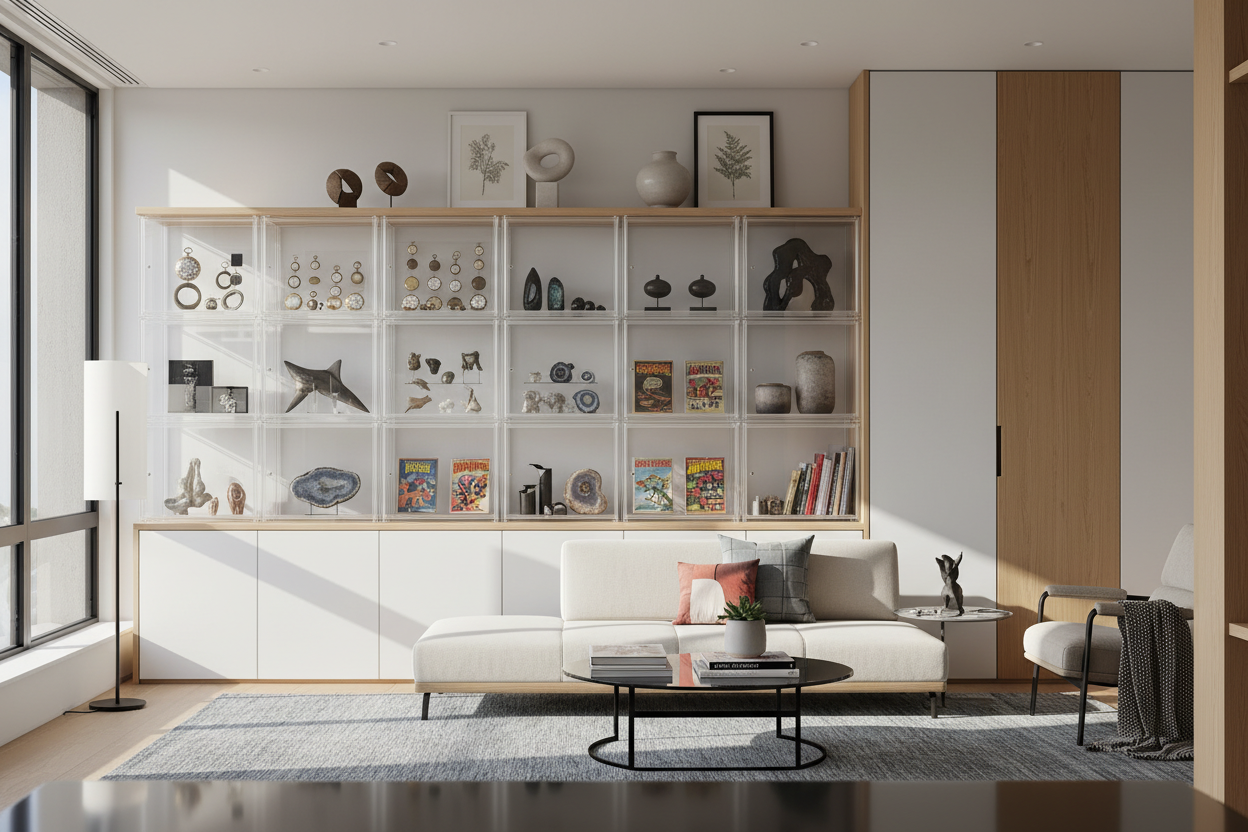
I remember staring at my vintage camera collection last November, realizing I had officially reached the 'overflow' stage. My bookshelves were double-deep with lenses, and a stray tripod was living behind the sofa like a piece of abandoned industrial equipment. I almost bought another massive, 72-inch-tall shelf, but my 12x14 living room simply couldn't handle another floor-hogging monolith. That is when I finally caved and bought my first set of stackable display cases.
Instead of committing to a permanent piece of furniture that would dominate the wall, I started with three small acrylic units. It felt like a small win for my floor space and a huge win for my sanity. If you are currently playing Tetris with your trinkets, you know exactly the stress I am talking about.
- Verticality is your best friend: When floor space is gone, look up.
- Pay as you grow: Don't buy a massive cabinet for a collection that might only need two boxes today.
- Dust protection: Enclosed cases mean you spend less time with a microfiber cloth and more time actually enjoying your stuff.
- Visual consistency: Using identical modular units makes a chaotic collection look like a curated gallery.
The 'One More Shelf' Trap Never Actually Works
We have all been there. You buy one of those standard bookcases and display cabinets thinking it will finally house everything. Six months later, you're stacking books horizontally on top of the vertical ones, and your favorite ceramic figurines are hidden in the shadows of the bottom shelf. Traditional shelving is static; your hobbies rarely are.
The trap is thinking that more surface area solves the problem. It doesn't. It just invites more clutter. When you use fixed-height shelves, you often end up with six inches of wasted 'dead air' above your items. It's an inefficient use of the vertical real estate you're paying rent for.
Why Stackable Display Cases Are a Collector's Best Friend
The beauty of modularity is the lack of commitment. I started with a small stack on my desk. When I found a few more rare SLR bodies at a garage sale, I didn't have to rearrange the whole room. I just bought two more matching boxes. This 'Lego-style' approach to furniture is the only way to build a custom display wall that actually fits your life.
These units allow you to grow vertically without the heavy lifting of moving a solid oak cabinet. Most quality sets use an interlocking groove system. I’ve found that as long as you aren't storing lead weights, a stack of four or five units is remarkably stable. It keeps the footprint small while the impact goes through the roof.
The Secret to Making a Stackable Display Look Expensive
Let's be honest: if you aren't careful, a stackable display can look like a pile of plastic shoe boxes. The secret is alignment and lighting. I always use a level to ensure the first row is perfectly flat. If the base is off by even a millimeter, a five-high stack will look like the Leaning Tower of Pisa by the time it hits eye level.
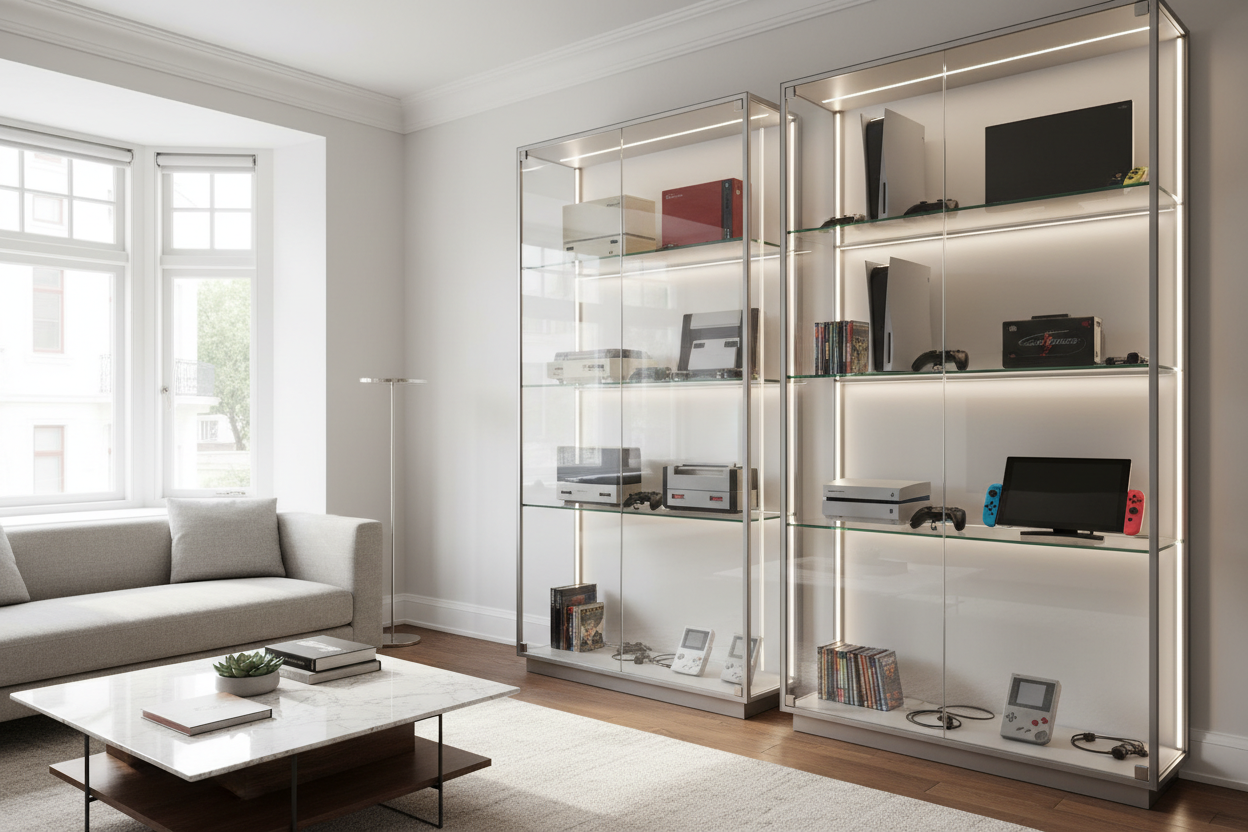
I also recommend adding thin, battery-operated LED puck lights to the top of each unit. It kills the 'plastic' vibe and gives the whole setup a museum-quality glow. Avoid mixing brands; even if the dimensions look similar, the clarity of the acrylic or the tint of the glass usually varies, which breaks the visual illusion of a single, cohesive unit.
When You Finally Need to Graduate to a Full-Size Cabinet
There does come a point where the modular look hits its limit. If you find yourself stacking boxes seven feet high or lining an entire 10-foot wall with individual cubes, it might be time to admit you’ve outgrown the 'starter' phase. At that point, the sheer number of seams between the boxes starts to look busy rather than clean.
That is when I suggest moving to a solid, architectural piece like a tall white curio cabinet. It provides a permanent anchor for the room and feels more like 'adult' furniture. If you are struggling to decide if you're a modular person or a permanent-cabinet person, check out this guide on how to choose between curio hutches and display cases.
My Golden Rules for Grouping Items Inside the Boxes
Don't pack your cases like a sardine can. The biggest mistake I made early on was trying to fit every single item I owned into the new boxes. It looked like a storage unit, not a display. You need 'negative space'—the empty areas around an object that allow your eyes to actually see it.
I follow the 'Rule of Three.' Group three items of varying heights together, then leave a gap. Group by color or theme, not just by what fits. If you have a bright red item, put it in the center box to act as a focal point. It turns a pile of stuff into a genuine design feature.
Frequently Asked Questions
Are stackable cases sturdy enough for heavy items?
Usually, no. Most are designed for lightweight collectibles like vinyl figures, cameras, or shoes. If you're displaying heavy stone sculptures or thick hardback books, you'll see the top panels start to bow. Stick to items under 5 pounds per 'cube' for the best results.
How do I stop them from sliding around?
If your cases don't have built-in interlocking tabs, use a tiny dot of 'museum wax' or clear mounting putty on the corners. It’s invisible and keeps the units perfectly aligned even if you bump into them while vacuuming.
Do they get yellow over time?
Cheap plastic will. If you want them to stay crystal clear for years, look for 'UV-resistant acrylic' or tempered glass. It costs about 20% more, but it’s the difference between a display that looks high-end and one that looks like a takeout container.

Leave a comment
This site is protected by hCaptcha and the hCaptcha Privacy Policy and Terms of Service apply.