

















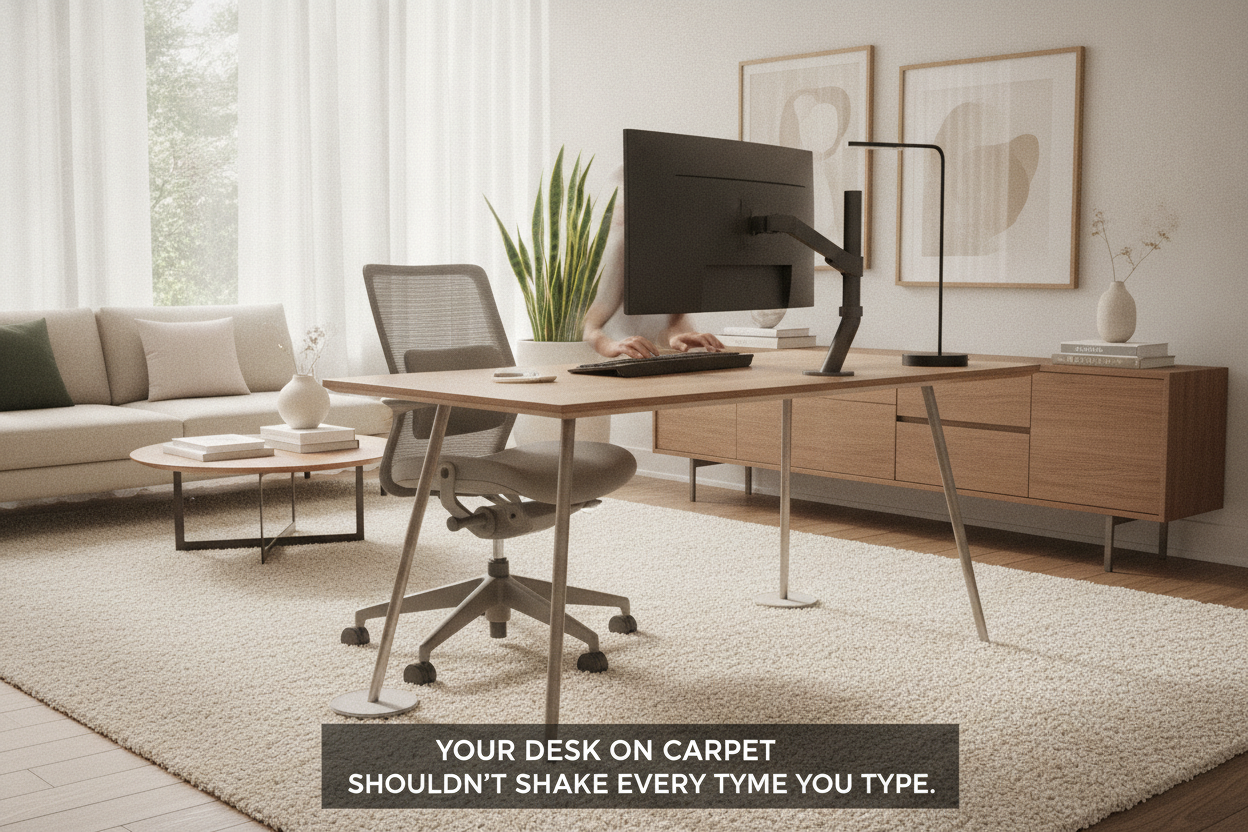
I once spent three weeks thinking I had a neurological tremor before I realized my desk on carpet was just reacting to my heavy-handed typing style. I’d be mid-email, and my 27-inch monitor would start doing a rhythmic dance that made me feel like I was working during a low-magnitude earthquake. It’s a common frustration for the WFH crowd: you buy a beautiful rug to 'zone' your office, only to find that your workstation now has the structural integrity of a Jenga tower.
- Carpet padding acts as a spring, amplifying every movement you make.
- Leveling glides are your first line of defense—most people forget they exist.
- Carpet spikes can bypass the fluff to reach the solid subfloor.
- Rigid glass or acrylic mats distribute weight better than soft plastic.
- If the frame is thin-gauge steel, no amount of floor-fixing will stop the sway.
The Plush Rug Problem: Why Your Setup Shakes
Physics is a cruel mistress. When you place a 100-pound piece of furniture on top of a 1/2-inch foam pad and a layer of polyester fibers, you aren't creating a foundation; you're creating a spring. The problem with a desk on carpet is that the weight isn't distributed evenly. Most of the mass is at the top—your monitors, your speakers, your morning coffee—while the contact points are four tiny feet buried in the fluff. This creates a high center of gravity that turns every keystroke into a vibration that travels down the legs and bounces back up from the subfloor.
I learned this the hard way after moving into a rental with wall-to-wall frieze carpet. Even a high-quality, sturdy writing computer desk can suffer from stability issues if the flooring foundation is too squishy. The carpet padding acts as a fulcrum, and because the legs are usually made of steel or wood that doesn't compress, the only thing that gives is the carpet itself. If one leg is even a millimeter deeper into the pile than the others, the whole thing starts the dreaded side-to-side sway.
3 Ways to Stop a Desk From Wobbling on Carpet
Fixing a wobbly desk doesn't always require a trip to the hardware store for a sheet of ugly OSB board. You have to address the disconnect between the rigid desk leg and the soft floor. The goal is to either bypass the carpet entirely or create a platform that forces the weight to distribute across a wider, more rigid surface. Here is how I finally stopped my standing desk wobble without making my office look like a construction zone.
1. Master the Leveling Glides
Look under your desk legs. See those little plastic or metal discs? Those are leveling glides, and 90% of people never touch them. They aren't just for uneven hardwood; they are your first line of defense against desk wobble on carpet. Carpet is rarely laid perfectly flat, especially near the edges of a room where the carpet tack strips create a slight incline.
To fix wobbly desk issues using glides, don't just guess. Have someone else gently push the desk while you watch the feet. You’ll see which leg is lifting off the subfloor. Unscrew that specific glide to extend it. The trick is to create tension. You want the desk to feel like it’s being pushed into the carpet. I usually over-extend the back two legs slightly because we tend to lean our weight on the front of the desk while typing, which causes the back to lift and sway. A quarter-turn can be the difference between a rock-solid surface and a wobbly desk.
2. The Carpet Spike Trick
If leveling glides aren't cutting it, you need to 'pierce the veil.' Standard flat-bottomed desk feet sit on top of the carpet fibers. This means the desk is essentially floating on a layer of hair. To stabilize a desk properly, you want the legs to make contact with the plywood or concrete subfloor underneath. This is where carpet spikes or specialized furniture casters come in.
You can find replacement screw-in feet that have small, blunt spikes on the bottom. They don't ruin your carpet—the fibers just move around them—but they allow the weight of the desk to bypass the 'squish' of the padding. When I swapped my standard glides for these, the standing desk stability improved by about 40% instantly. It stops the desk wobbles side to side because the legs are no longer sliding on the polyester fibers; they are anchored. It’s the same logic used for high-end audio speakers—spikes decouple the vibration from the floor.
3. The 'Hidden Platform' Hack
For those of us with ultra-plush 'shag' style rugs, spikes might not be long enough. You need a rigid layer. Most people suggest plywood, but that looks like a DIY project gone wrong. Instead, I use tempered glass or heavy-duty rigid acrylic chair mats—specifically the ones designed for high-pile carpet. If you are fitting a desk in a small bedroom where the carpet is wall-to-wall, a transparent rigid mat is the least visually intrusive way to add stability.
The key here is rigidity. A cheap, thin plastic mat will just dip where the legs are. You need a mat that is at least 1/4 inch thick. By placing the desk legs on the mat, the downward force is spread across 40 or 50 square inches instead of just the 1-inch diameter of the desk leg. This stops the sinking feeling and provides a level surface that doesn't yield when you lean on your elbows. It’s the most effective way to make a desk more stable without drilling holes into your walls.
Are You Fighting a Losing Battle with a Cheap Desk?
Sometimes, we blame the carpet when the real culprit is the desk itself. I’ve assembled dozens of these things, and I can tell you that a $150 standing desk on carpet is almost guaranteed to shake. Why? Because cheap frames use thin-gauge steel and lack a structural crossbar. If your desk is wobbly even when you move it to the kitchen tile, the carpet isn't the problem—the engineering is. A 'T-frame' desk where the legs are centered is naturally more prone to standing desk wobble than a 'C-frame' or a desk with a traditional four-leg post design.
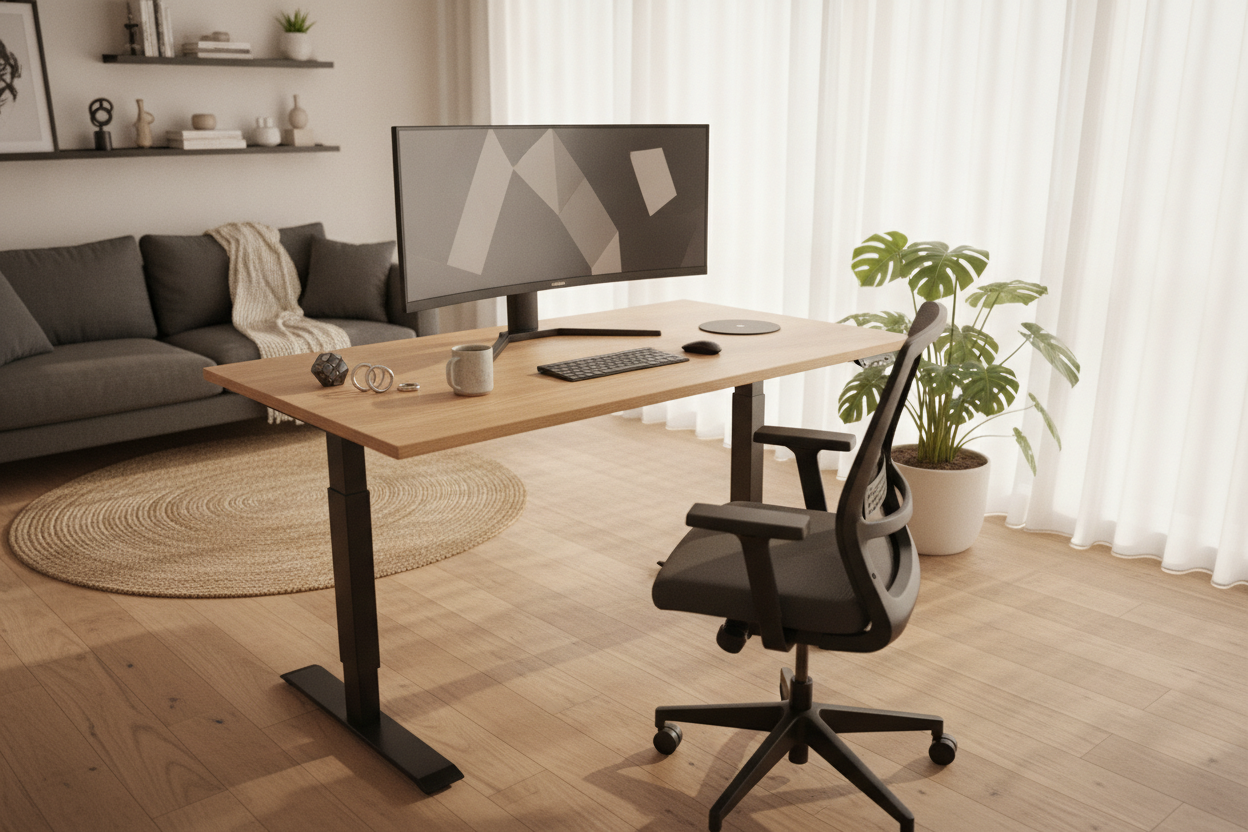
Before you lose your mind trying to fix wobbly desk on carpet, check your bolts. Over time, the vibrations from the motor or just daily use can loosen the hex bolts connecting the legs to the desktop. I make it a habit to tighten mine every six months. If the frame still sways like a willow tree, it might be time to admit defeat. You can’t make a desk sturdy if the joints are made of soft aluminum. If you're tired of the shake, check out my guide on finding a cheap standing desk that actually doesn't wobble. For those ready to invest in a permanent solution, I finally upgraded to a heavy-duty adjustable height standing desk with a reinforced steel base, and the difference is night and day. A heavier base lowers the center of gravity, which is the ultimate way to make desk less wobbly on soft surfaces.
FAQ
Will a rug pad help stabilize my desk?
Actually, no. Adding a rug pad usually adds more loft and squish, which increases the wobble. You want less cushion, not more. If you must use a rug, go for a low-pile or flat-weave option.
How do I stop my monitor from shaking on a wobbly desk?
If you can't fix the desk, try a wall-mounted monitor arm. By decoupling the screen from the desk surface, you eliminate the visual shake entirely, even if the desk still has a slight sway.
Does putting weight on the bottom of the desk help?
Yes. Lowering the center of gravity helps a lot. I’ve seen people strap sandbags or heavy UPS battery backups to the lower crossbar of their desk to make a desk more sturdy on carpet.

Leave a comment
This site is protected by hCaptcha and the hCaptcha Privacy Policy and Terms of Service apply.