

















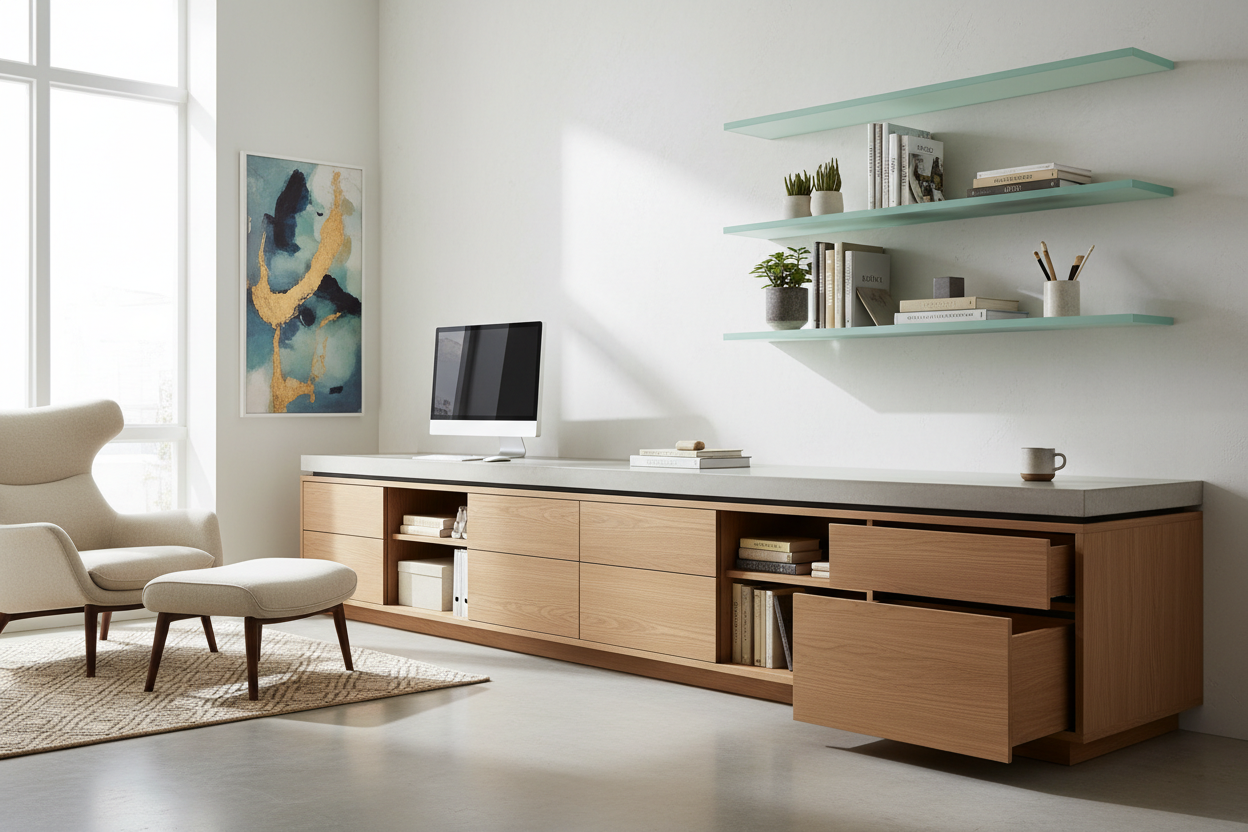
I spent the first three years of my remote work life convinced I could be a 'laptop and a succulent' person. I bought a slim mid-century desk with one tiny drawer and expected my life to suddenly look like a Pinterest board. Instead, within six months, my workspace looked like a Best Buy dumpster. There were tangled USB-C cables, stacks of 1099s I didn't know where to put, and a printer that took up 40% of my actual typing surface.
Adding a dedicated office storage cabinet was the only thing that actually fixed the chaos. It wasn't about being more organized; it was about having a place to hide the ugly realities of a working life. Once the physical clutter was behind a solid door, my brain finally stopped buzzing every time I sat down to write.
Quick Takeaways
- Stop buying acrylic trays; they just let you see your mess in high definition.
- Solid doors are superior to glass if you’re storing tech peripherals or tax folders.
- Place your storage at least three feet from your desk to create a 'work zone' and a 'storage zone.'
- Look for adjustable shelving; your needs will change from binders to hardware over time.
The 'Minimalist Desk' is a Lie (For Most of Us)
We’ve all been sold the same lie: that you only need a sleek piece of wood and a laptop to be productive. In reality, life happens. You have a scanner, a ring light for Zoom calls, and a mountain of reference books. When you try to force all of that into a cabinet organizer office setup on top of your desk, you lose the very space you need to actually think.
I realized my 'minimalist' desk was actually just a high-stress surface. Every time I looked at my printer, I thought about the ink I needed to buy. Every time I saw a stack of mail, I felt guilty. Moving those items into an office cabinet didn't just clean up the room; it cleaned up my mental bandwidth. You don't need a bigger desk; you need a place for your desk to breathe.
Why Bins and Trays Weren't Enough
I tried the tray route. I bought those stackable paper sorters and a cute little desk storage cabinet that sat right next to my monitor. It failed because visual clutter is just as exhausting as physical clutter. Seeing the edges of twenty different envelopes is still distracting, even if they are 'organized' in a gold-plated wire basket.
True cabinets for offices provide a 'visual reset.' When the doors are closed, the room looks like a room, not a cubicle. I eventually traded my open shelving for a unit with thick, 3/4-inch solid doors and soft-close hinges. The silence of closing that door at 5:00 PM became my new favorite ritual. If you can see your mess, you’re still working.
Finding the Right Setup for Your Specific Mess
Not all storage is created equal. Before you buy the first thing that matches your rug, look at what you’re actually hoarding. Are you a paper person? A tech person? Or a 'I have twelve different keyboards' person? Your specific brand of chaos dictates the furniture you need.
The 'Hide the Ugly' Approach (Solid Doors)
If your office is currently a graveyard of black plastic tech and messy binders, go for a fully enclosed office cabinet. Look for something with cord management ports in the back. I use a solid-door unit to house my backup drives and a charging station for my mouse and headphones. It keeps the dust off the gear and the 'tech-heaviness' out of my peripheral vision.
The Hybrid: Office Shelves and Cabinets
Sometimes you want to show off your collection of vintage cameras or design books while still hiding the boring stuff. This is where an office shelf cabinet shines. I personally use a multi-tier storage shelf that has open cubbies at eye level and deep, closed cabinets at the base. It allows the room to feel lived-in and personal without looking like a storage unit. It’s the best of both worlds: personality on top, tax returns on the bottom. Mixing office shelves and cabinets also prevents the room from feeling too heavy or 'boxed in.'
Rethinking Where the Cabinet Actually Goes
Most people think a cabinet has to be within arm's reach of their chair. I actually think that’s a mistake. When I moved my office cabinet systems to the opposite wall, my productivity shot up. Why? Because it forced me to stand up. If I need a file or a fresh notebook, I have to physically leave my 'work state' for a second, stretch my legs, and then return.
If you’re working in a bedroom or a shared living space, consider a mobile storage cabinet. On Friday evenings, I can literally wheel my entire work identity into a corner or a closet. It creates a physical boundary between 'Work Me' and 'Home Me' that a stationary desk simply can't provide.
The Final Verdict: My Desk is Finally Just a Desk
Separating the 'storage zone' from the 'work zone' was the single best decision I made for my home office. My desk is now a clean, empty surface where I can actually write without moving a stapler out of the way first. It feels like a luxury, but it was really just a matter of buying the right furniture. Stop trying to organize your desktop and start investing in a piece that hides the mess for you. Your brain will thank you.
FAQ
Do I need a locking cabinet?
Only if you have kids or nosy roommates. For most WFH setups, a lock is just an extra key you’re going to lose. If you’re storing sensitive legal documents, though, it’s worth the extra $20 for peace of mind.
Should I choose MDF or solid wood?
If you're storing heavy stacks of paper or a laser printer, cheap MDF will bow in the middle within a year. Look for high-density particle board with a thick veneer or solid wood if your budget allows. Check the weight capacity per shelf—you want at least 40 lbs.
How do I stop my cabinet from looking like a 'filing room'?
Style the top! Add a lamp with a warm bulb, a tray for your keys, or a large plant. Treating it like a piece of home furniture rather than 'office equipment' makes the whole room feel more cohesive and less like a corporate cubicle.

Leave a comment
This site is protected by hCaptcha and the hCaptcha Privacy Policy and Terms of Service apply.