

















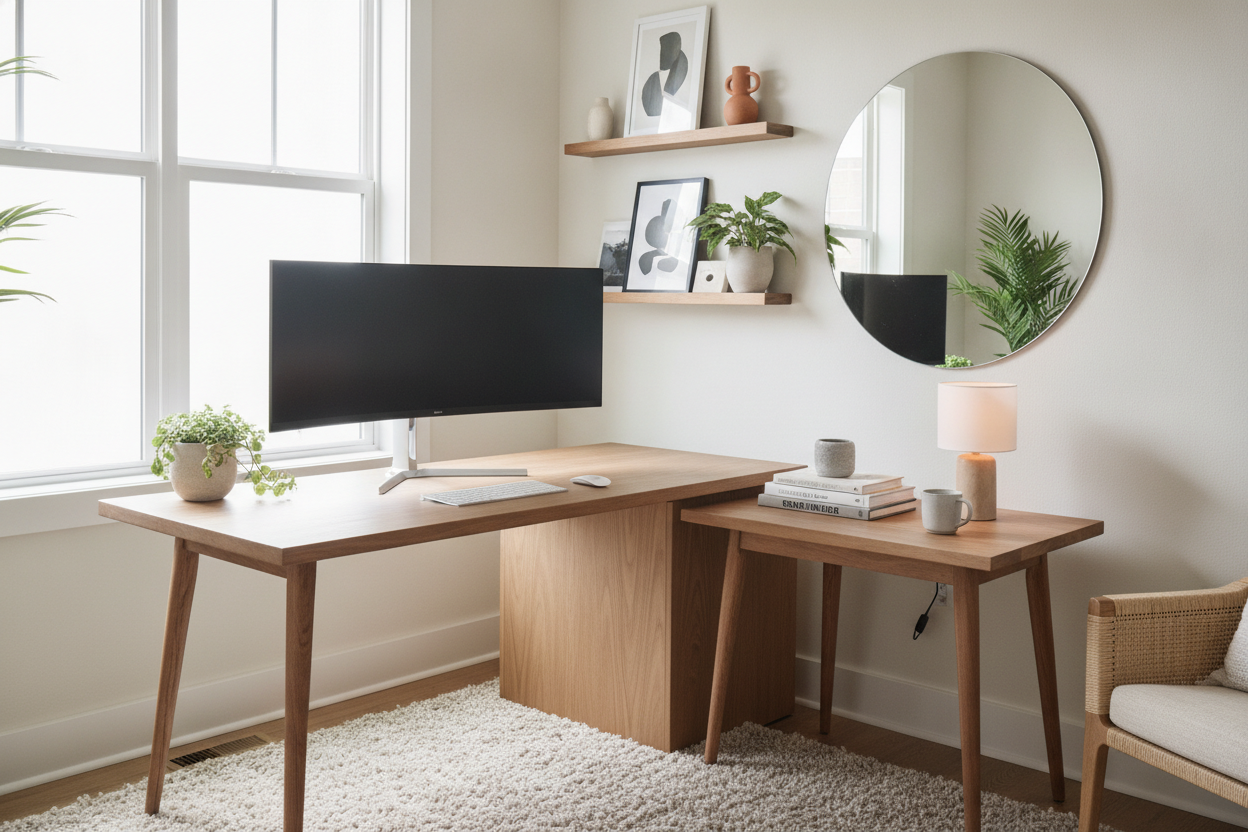
I spent three years trapped behind a massive L-shaped desk that made my home office feel like a 1990s corporate cubicle. It was a beast of a thing—particle board finished in a 'faux cherry' that looked more like a bruised plum. Every time I tried to reach my printer in the corner, I’d practically have to crawl across the floor. I thought I needed that massive footprint to be productive, but all I ended up with was a graveyard for cold coffee mugs and mail I didn't want to open.
Last month, I finally ripped it out and replaced it with a modular desk and side table setup. The difference is night and day. My room actually feels like a room again, not just a storage unit for a giant piece of furniture. If you are feeling suffocated by your current workstation, it is time to rethink the one-piece monster.
- Modular setups allow for better airflow and easier cable management.
- A separate side desk keeps the 'junk' away from your mouse hand.
- Using a side table for computer towers prevents dust buildup from the floor.
- Narrow side tables fit into tight corners where L-desks fail.
The L-Shaped Desk Trap
We are told that more surface area equals more productivity. That is a lie. In reality, a massive corner desk is just a magnet for clutter. When I traded my gaming table for an office desk adjustable setup, I realized that I only actually use about 30 inches of space for my keyboard and mouse. The rest of that L-shaped sprawl was just 'dead space' that I filled with things I didn't need.
These desks also kill the flow of a room. They force you into a corner, staring at a wall. By moving to a standard desk paired with a side desk table, I regained the ability to angle my main workspace toward the window. My office stopped feeling like a cage. Plus, cleaning under an L-shaped desk is a nightmare; you basically need a yoga certification to reach the dust bunnies in the back corner.
Why the Modular Swap Actually Works
The magic happens when you separate your 'active work zone' from your 'storage zone.' My main desk is now strictly for my monitor, keyboard, and mouse. Everything else—the hard drives, the notebooks, the stack of 'to-do' papers—lives on a dedicated side table for my office desk. This separation creates a mental boundary that actually helps me focus. When I turn to the side, I’m in 'admin mode.' When I’m facing forward, I’m in 'work mode.'
A side table workstation is also infinitely more flexible. If I decide I want to rearrange the room, I’m not wrestling a 150-pound piece of furniture that only fits in one specific corner. I can move the computer desk side table to the other side in three minutes. It is about modularity over permanence. You can even swap in a small side desk for a few days if you need extra room for a second monitor setup, then tuck it away when you're done.
Getting Your PC Tower Off the Floor
If you are running a desktop, putting your tower on the floor is a recipe for a dead fan. My old L-desk had a 'CPU cabinet' that was basically a wooden oven for my components. Now, I use a dedicated side table for a desktop pc. It keeps the tower six inches off the floor, away from the dust bunnies and my dog’s fur. Airflow is better, and my PC runs noticeably quieter.
This pc side table approach also frees up a massive amount of legroom. I can actually stretch my legs out under my main desk without kicking a metal box. Whether you call it a side table for pc or a computer end table, the goal is the same: better airflow for the machine and more comfort for you. I’ve found that a simple end table for computer use is one of the cheapest ways to extend the life of your hardware.
A Dedicated Zone for Office Clutter
Let’s talk about the printer. It’s the ugliest thing in any office, yet we usually put it right next to our monitors. By using a desk side table with storage, I’ve tucked the printer and the extra paper reams away from my immediate line of sight. I’ve even used a standing computer stand for desk on top of my side table to keep my laptop at eye level when I’m using it as a second screen.
Keeping the office desk side clear of peripherals makes the whole room feel lighter. When I look at my main computer desk side, I don't see a tangled mess of power bricks and USB cables. I just see my work. It’s a psychological win as much as an aesthetic one. A small desk side table can hold your coffee, your phone, and your snacks, leaving your primary computer desk with side space entirely for the task at hand.
How to Match Your Pieces (Without Looking Corporate)
The biggest fear with a modular setup is that it will look like you just threw random furniture together. To avoid the 'thrift store chic' look, try to match either the material or the leg style. If your main desk has black metal legs, find a small side table for desk that shares that same hardware. They don't have to be from the same collection to look like they belong together. In fact, a slight mismatch often looks more high-end and curated.
I generally avoid the modern vanity desk with mirror style for a primary office because those built-in drawers are usually too shallow for actual office supplies. Instead, a narrow side table for desk with open shelving gives you more utility. Mixing a wood-top desk with a metal side table for computer desk can actually look quite intentional if you pull in some other industrial accents in the room. Don't be afraid to use an end table computer desk setup—it's often sturdier than 'office' furniture.
My Personal Mistake: The 'Wobble' Factor
I’ll be honest—my first attempt at this was a disaster because I bought a side table that was two inches taller than my desk. It drove me crazy. Every time I reached for my coffee, my arm would hit the 'shelf' created by the height difference. Measure your desk height twice. You want your side table next to desk to either be flush or slightly lower. Anything else will feel like a permanent annoyance. I also once bought a pc end table that was too narrow, and my tower hung off the edge like a cliffhanger. Check your dimensions!
FAQ
Is a side table stable enough for a heavy PC?
Usually, yes, but check the weight capacity. Most end table for computer setups can handle 40-50 lbs easily. If you have a massive custom liquid-cooled rig, look for a side table for computer with a steel frame rather than thin MDF. Avoid anything with spindly legs if you're putting a $2,000 PC on top of it.
How do I hide the cables between the two tables?
Use a simple cable spine or some J-channels. Since there is a gap between the desk and the side table, I run my cables down the back leg of the main desk and across the floor inside a cord cover. It stays hidden and prevents a tripping hazard. Velcro ties are your best friend here.
Can I use a regular end table for a pc?
Absolutely. You don't need a 'specialty' office piece. A standard living room pc end table works perfectly as long as the dimensions fit your tower. Just ensure there is enough clearance on all sides for the fans to breathe. If the table has a back panel, you might need to drill a hole for better ventilation.

Leave a comment
This site is protected by hCaptcha and the hCaptcha Privacy Policy and Terms of Service apply.