

















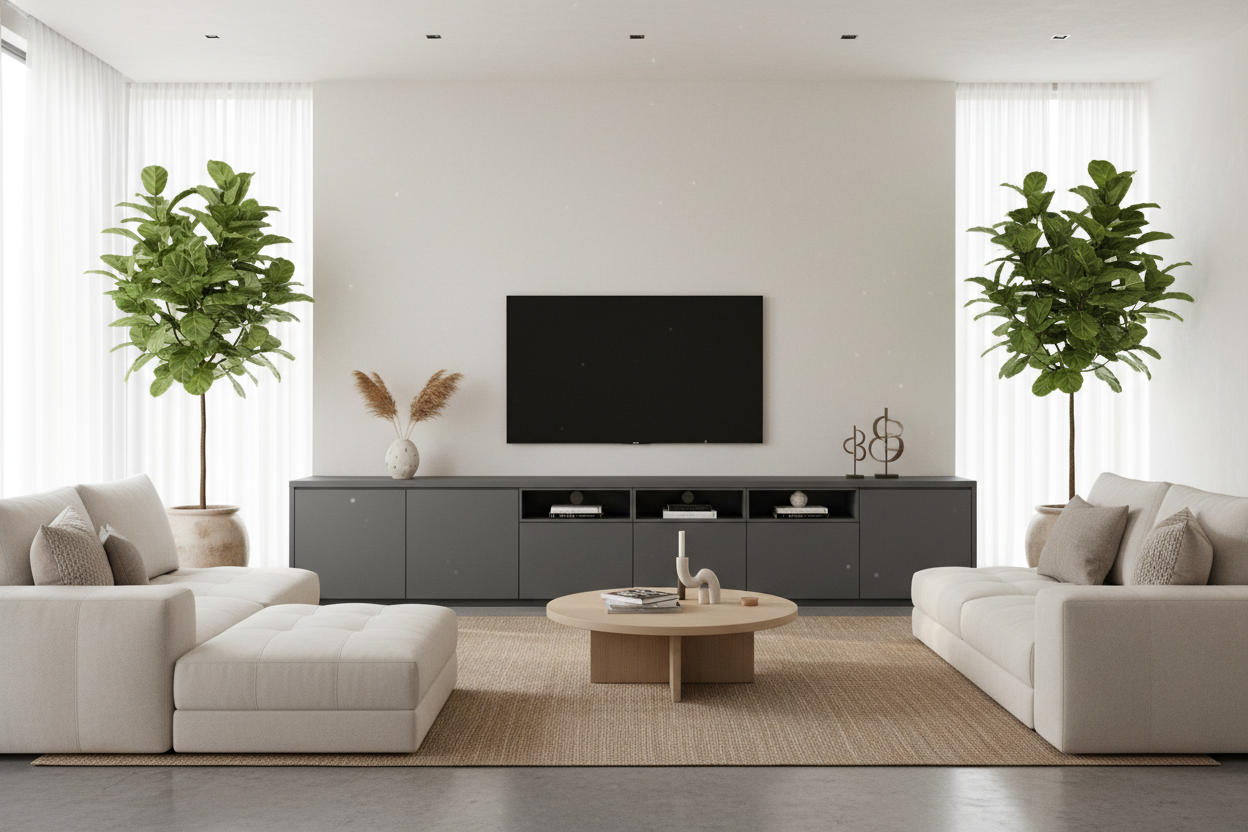
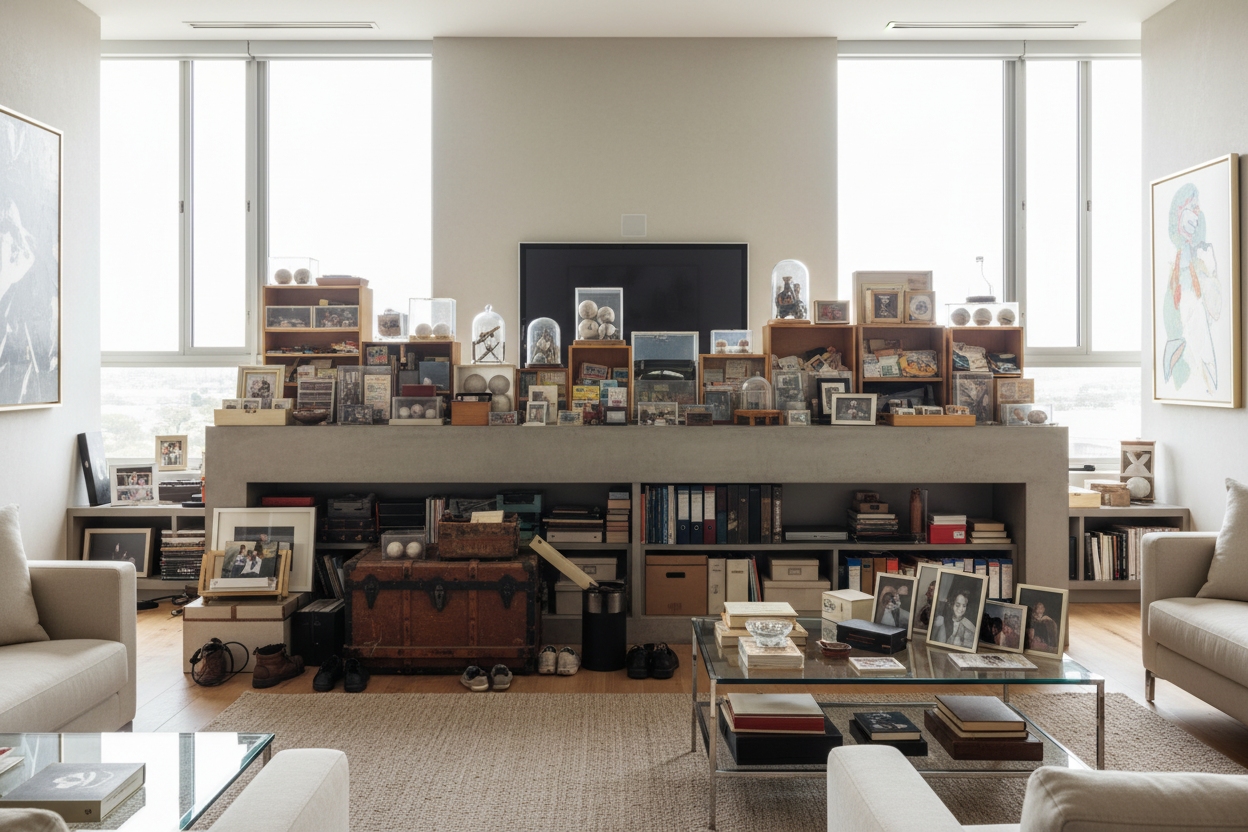
I spent three years staring at the honey-oak built-ins in my living room, trying to convince myself they were 'classic.' In reality, they were a dusty relic of 1998 that made my 20-foot wall feel like it was closing in on me. The day I finally took a sledgehammer to the drywall and pulled out those cabinets was the day I realized I didn't need more shelves; I needed better proportions. I swapped the clutter for a sleek 110 inch tv stand, and for the first time, my living room didn't feel like a library annex.
- Scale is everything: On a large wall, anything under 100 inches looks like a mistake.
- Horizontal lines create the illusion of width and height, making low ceilings feel taller.
- Freestanding units offer better cable access than rigid, permanent built-ins.
- A 110-inch span provides enough surface area to double as a high-end sideboard or credenza.
The Built-In Dilemma (Why We Grabbed the Sledgehammer)
There is a weird guilt associated with tearing out 'custom' cabinetry. You feel like you are destroying value. But those deep, dark cubbies were designed for CRT televisions and stacks of DVDs—things I haven't owned in a decade. They were heavy, claustrophobic, and dictated exactly where every piece of furniture had to go.
Once the oak was gone and the drywall was patched, the room tripled in size visually. The goal wasn't to fill that space back up with more cabinets. I wanted something low, long, and architectural. I wanted a piece of furniture that felt like a deliberate design choice rather than a structural necessity.
The Hunt for a 110 Inch Media Console
Finding a unit that spans over nine feet is harder than you’d think. Most big-box retailers tap out at 72 or 84 inches. I spent way too many nights shopping for TV stands only to realize that an 84-inch unit on my wall looked like a postage stamp. It was comically small.
When I finally tracked down a true 110 media console, the room clicked. A piece this size isn't just a place to park your remote; it becomes an anchor for the entire wall. If you have a wall longer than 15 feet, you need that extra length to prevent the furniture from 'floating' awkwardly in the middle of the room. It needs to feel grounded.
Floating vs. Grounded: Making the Call
I went back and forth on whether to go with a wall mounted media console or a floor-standing model. Floating units look incredibly modern, but they come with a massive caveat: weight. A 110-inch unit made of solid wood or high-density MDF is heavy before you even put a TV on it.
I eventually chose a floor-bound 110 inch tv console with hidden plinth feet. I wanted the structural peace of mind. Plus, a grounded unit allows for more substantial storage. I’m talking about a place for the receiver, the gaming consoles, and my husband’s slightly embarrassing collection of vintage tech—all tucked away behind soft-close doors without worrying about the whole thing ripping out of the studs.
Styling 9+ Feet of Wood (Without Looking Cluttered)
The biggest mistake people make with a 110 inch entertainment center is feeling the need to cover every square inch of the top surface. Don't do it. You have to embrace negative space, or it just becomes a giant landing pad for mail and half-empty water bottles.
I treat mine more like a gallery surface. I follow the 'rule of threes': a stack of oversized coffee table books on one end, a large ceramic vessel in the middle, and maybe a single leaning piece of art. Because these units are so long, they function more like a high-end buffet. I often think about the Media Console vs. Credenza: What Does TV Stand For Anymore? debate—modern stands like this are really just architectural credenzas that happen to hold a screen.
Will a 110 TV Stand Make My Screen Look Tiny?
This was my biggest fear. I have a 75-inch TV, which is big, but I worried it would look lost on a 110-inch surface. The opposite happened. Having about 18 inches of breathing room on either side of the screen creates a 'gallery effect.' It makes the TV look like a piece of art rather than a black hole sucking up all the attention in the room.
If you put a 75-inch TV on a 75-inch stand, the edges line up and it looks cramped and cheap. The extra width of a 110 inch tv stand gives the eye a place to rest. It’s the difference between a photo crammed into a frame and one with a proper mat. It’s all about the margins.
How do you ship a 110 inch tv stand?
Usually, they arrive in two or three modular sections that bolt together from the inside. This is actually a lifesaver for getting it through doorways and around tight corners. Just make sure the seams are well-aligned during assembly.
Is a 110 inch console too big for a small room?
Counterintuitively, no. One long, clean piece of furniture often makes a small room feel larger than three smaller pieces of furniture. It reduces visual 'noise' and creates a long, unbroken sightline.
Can I put a 110 inch stand on carpet?
You can, but I’d recommend using furniture coasters or a rigid rug pad. These units are heavy, and after a year on carpet, they will leave deep divots. If the unit has thin legs, they might even lean slightly as the carpet compresses unevenly.

Leave a comment
This site is protected by hCaptcha and the hCaptcha Privacy Policy and Terms of Service apply.